
TL;DR: Spatial computing blends AR and VR into a single medium where digital products exist alongside physical reality. Apple Vision Pro and Meta Quest 3 let customers place 3D products in their room, resize them with hand gestures, and interact with them naturally. Brands building spatial commerce experiences report 3x engagement vs flat product pages. Here’s what spatial computing means for e-commerce in 2026.
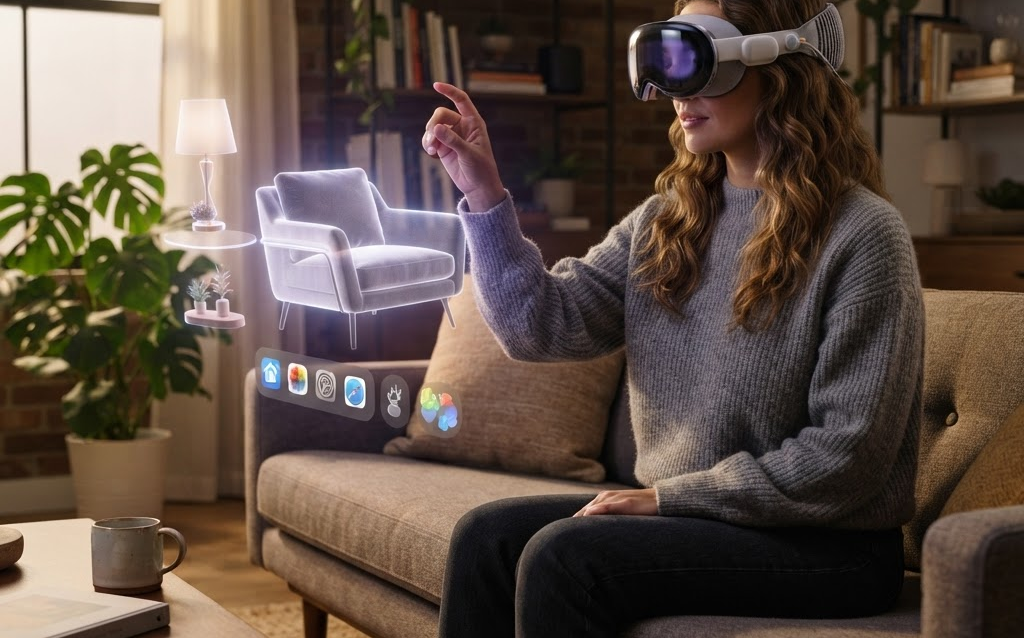
Spatial computing is the term Apple coined for the Apple Vision Pro—and it represents a fundamental shift in how humans interact with digital content. Instead of looking at a screen, you look at digital objects that appear to exist in your physical space. A 3D sofa sits on your floor. A watch appears on your wrist. A car renders at full scale in your driveway. And you interact with all of it using your eyes and hands—no controller needed.
What Makes Spatial Computing Different from AR?
Traditional AR overlays 2D images or simple 3D objects on a phone screen. Spatial computing creates persistent, interactive 3D objects that respond to your physical environment. The differences:
- Hand and eye tracking — you select and manipulate objects by looking at them and pinching your fingers. No controller, no touchscreen.
- Environmental understanding — the device maps your room in 3D, so virtual objects can sit on real tables and cast realistic shadows on real floors
- Passthrough rendering — you see the real world through the device’s cameras with digital objects composited in—unlike VR, which blocks reality
- Persistence — objects stay where you place them. Put a virtual lamp on your desk today, and it’s still there tomorrow when you put the headset on
Spatial Commerce: How Brands Use It in 2026
Product Placement at Full Scale
A customer opens a spatial commerce app on Vision Pro, browses a furniture catalog, and places a 3D sofa in their living room at real scale. They walk around it. They pinch to change the fabric color. They resize a side table to check if it fits next to the sofa. This is shopping in spatial computing—not browsing a catalog, but placing products in your life before buying.
Virtual Try-On with Real Depth
Spatial computing try-on is more accurate than phone-based AR because the device captures true depth information. A glasses try-on on Vision Pro knows the exact distance between your eyes, the width of your face, and how the frames sit on your nose. The result is try-on that’s nearly indistinguishable from a mirror.
Immersive Brand Experiences
Brands create spatial showrooms—virtual environments where customers browse products in curated settings. A luxury watch brand creates a virtual boutique; an automotive brand creates a virtual dealership. Customers walk through these spaces in mixed reality, examining products at scale and customizing in real time.
Collaborative Shopping
Spatial computing supports shared experiences. A couple in different cities can put on their headsets and view the same 3D sofa in a shared virtual room, discussing and customizing it together as if they were in the same furniture store.
The Devices: Who Has Spatial Computing in 2026?
| Device | Price | Key Features | Install Base |
|---|---|---|---|
| Apple Vision Pro | $3,499 | Eye/hand tracking, passthrough, highest quality | Growing (enterprise + prosumer) |
| Meta Quest 3/3S | $300–$500 | Mixed reality, hand tracking, largest install base | 20M+ headsets |
| Meta Quest Pro | $999 | Eye tracking, face tracking, enterprise | Enterprise/prosumer |
| HTC Vive XR Elite | $1,099 | Enterprise, mixed reality, compact | Enterprise |
How to Build for Spatial Computing
Development Platforms
- Unity with visionOS SDK — primary platform for Apple Vision Pro development
- Unity with Meta XR SDK — for Meta Quest mixed reality apps
- WebXR — browser-based spatial experiences that work across devices
- RealityKit / Swift — Apple’s native framework for visionOS apps
3D Asset Requirements
Spatial computing demands higher quality 3D models than phone AR because the device renders at higher resolution and users can examine objects up close. Target 50K–500K polygons per product with 4K PBR textures. Use USDZ format for Apple Vision Pro and glTF/GLB for Meta Quest and WebXR.
Cost of Spatial Commerce Development
| Scope | Cost | Timeline |
|---|---|---|
| WebXR spatial experience | $15,000–$50,000 | 4–10 weeks |
| Meta Quest mixed reality app | $40,000–$120,000 | 8–16 weeks |
| Apple Vision Pro (visionOS) app | $50,000–$200,000 | 10–20 weeks |
| Cross-platform spatial platform | $100,000–$400,000+ | 16–32 weeks |
FAQ: Spatial Computing for Brands
Do I need to build a separate app for Apple Vision Pro and Meta Quest?
Not necessarily. WebXR lets you build one spatial experience that works across both devices through the browser. However, native apps (visionOS for Apple, Meta XR SDK for Quest) provide better performance, hand tracking, and access to platform features. Many brands start with WebXR for reach, then add native apps for premium experiences.
Is spatial computing ready for mainstream e-commerce?
It’s early but growing fast. Meta Quest 3 has 20M+ headsets in the market—enough for meaningful reach. Apple Vision Pro is smaller but represents the premium segment. Most brands in 2026 use spatial computing as a premium layer alongside their web and mobile experiences, not a replacement.
Can I reuse my existing 3D models for spatial computing?
Yes, with upgrades. If you have glTF/GLB models, they can be used in Meta Quest and WebXR. For Apple Vision Pro, convert to USDZ. You may need higher-resolution textures and more polygon detail since spatial computing renders at higher quality than phone AR.
How much does a spatial commerce experience cost?
A WebXR spatial experience costs $15,000–$50,000. A Meta Quest mixed reality app costs $40,000–$120,000. An Apple Vision Pro native app costs $50,000–$200,000. Cross-platform solutions that deploy to multiple headsets from one codebase cost $100,000–$400,000+.
What’s the ROI of spatial commerce?
Early data shows 3x higher engagement than flat product pages, 25–40% higher conversion for customers who use spatial try-on, and significantly lower return rates (30%+) because customers place products in their actual space before buying. As headset adoption grows through 2026–2028, the ROI will compound for brands that build spatial experiences now.
The Future Is Spatial
Spatial computing is where AR and VR converge into a single medium. The brands building spatial commerce experiences in 2026 are positioning themselves for the next computing platform shift—just as the brands that built mobile-first experiences in 2010 won the smartphone era. Start with WebXR for reach, add native apps for premium experiences, and build a 3D asset library that works across all spatial platforms.
Ready to build a spatial commerce experience? Contact Ink & Algorithm to discuss your project—we’ll help you create spatial experiences that work across Vision Pro, Meta Quest, and the web.