
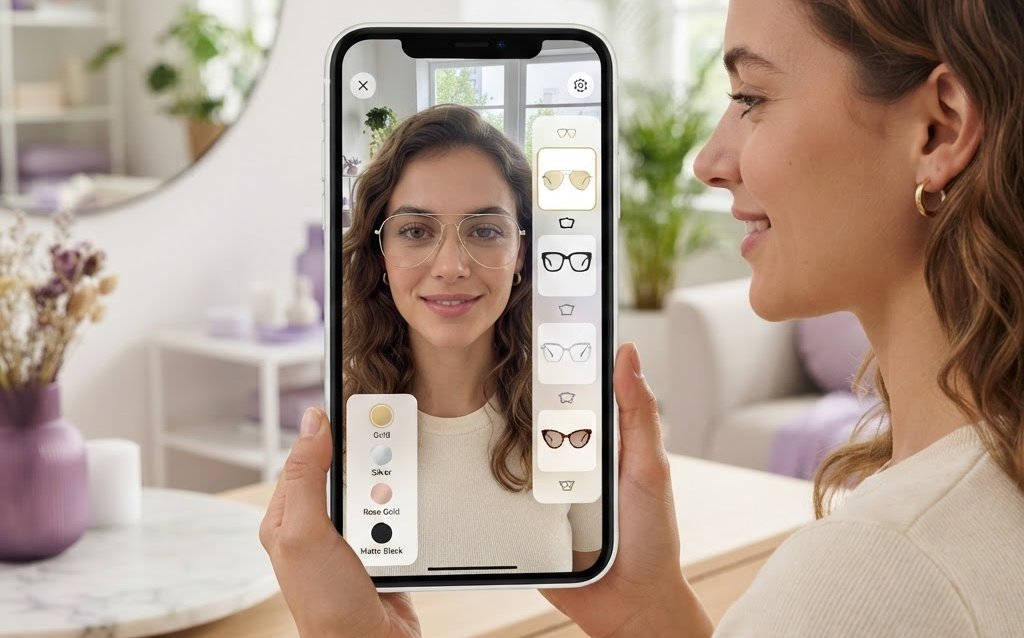
TL;DR: Eyewear 3D configurators let customers design custom frames, try them on using AR face tracking, and order prescription glasses online. US eyewear brands using AR try-on report 30% higher conversion, 40% fewer returns, and significant savings on physical frame inventory. With WebAR making try-on app-free, 2026 is the year every eyewear brand needs a 3D configurator.
The eyewear industry faces a unique challenge: glasses are one of the most personal purchases a person makes, yet buying online requires a leap of faith. Will these frames fit my face? Does this shape work with my features? Are these lenses right for my prescription? A 3D configurator with AR try-on eliminates every one of these concerns.
What an Eyewear 3D Configurator Does
An eyewear configurator lets customers customize and try on glasses in real time:
- Frame selection — browse frame shapes (round, square, aviator, cat-eye) in 3D with 360° rotation
- Color and material customization — acetate, metal, titanium, with real-time material rendering
- AR face try-on — see the glasses on your face using phone camera face tracking
- Prescription entry — input prescription details and see lens options (single vision, progressive, polarized)
- Lens tinting — preview sunglasses with different tint colors and gradients
- Temple customization — different temple styles, colors, and engraving options
- Live pricing — each option updates the price instantly
Why Eyewear Brands Need AR Try-On
The #1 barrier to online eyewear sales is fit confidence. Customers can’t try glasses on through a screen—or could they? AR face tracking changed the game:
- 30% higher conversion — customers who try on AR are confident enough to buy
- 40% fewer returns — seeing the glasses on your face prevents wrong-frame returns
- 25% higher AOV — customers add premium lens upgrades when they can see the frame
- Zero physical inventory needed — brands sell frames that don’t exist in stock, manufactured on demand
The Technology: AR Face Tracking for Eyewear
AR eyewear try-on uses facial landmark tracking to detect the position of eyes, nose, ears, and face shape. The 3D frame model is then overlaid on the face and tracked as the customer moves, smiles, and turns. Key technical requirements:
- Frame fit accuracy — the 3D model must scale to the customer’s actual pupillary distance (PD) for realistic fit assessment
- Material rendering — acetate frames have depth and translucency; metal frames have reflections. Both must render accurately
- Lens transparency — lenses should show the eyes behind them, with optional tint overlay for sunglasses
- Real-time performance — the frame must track at 60fps with no lag or jitter
Platforms like 8th Wall and Perfect Corp provide production-ready face tracking for browser-based eyewear try-on. No app download required—customers open a link and try on glasses instantly.
Cost of an Eyewear 3D Configurator
| Scope | Cost | Timeline |
|---|---|---|
| AR try-on (single frame, basic) | $8,000–$25,000 | 3–6 weeks |
| Full configurator (try-on + customization + prescription) | $30,000–$90,000 | 6–12 weeks |
| Multi-frame platform (50+ styles) | $60,000–$200,000 | 10–20 weeks |
| 3D model per frame | $500–$2,000 | 3–7 days |
FAQ: Eyewear 3D Configurators
Do customers need to download an app for AR glasses try-on?
No. Modern eyewear AR try-on uses WebAR, which runs in the browser. Customers open a link from the product page, allow camera access, and see the glasses on their face instantly—no app download required. This works on both iOS (Safari) and Android (Chrome).
Can the AR try-on show prescription lenses?
Yes. The configurator can simulate how prescription lenses look—showing lens thickness at the edges, tinting for sunglasses, and even anti-reflective coating effects. Customers input their prescription and see the lens options that work with their frame choice.
How accurate is the frame fit in AR?
Modern AR face tracking detects facial landmarks with pixel accuracy and can scale the 3D frame to the customer’s actual face measurements. Some systems ask the customer to input their pupillary distance (PD) for maximum accuracy. While not a replacement for professional fitting, it gives customers a highly realistic sense of how the frames will look and fit.
How much does an eyewear configurator cost?
A basic AR try-on for a single frame costs $8,000–$25,000. A full configurator with frame customization, AR try-on, and prescription lens integration costs $30,000–$90,000. A multi-frame platform covering 50+ styles runs $60,000–$200,000. 3D modeling per frame costs $500–$2,000.
Can the configurator connect to my lens manufacturing system?
Yes. The configurator exports the customer’s frame selection, prescription details, and lens preferences as a structured order that feeds into your lab’s manufacturing system. This eliminates manual order entry and reduces errors in prescription and lens specification.
Getting Started
Start with your top 5 frame shapes and build AR try-on for those. Most customers narrow their choice to 2–3 frames before purchasing—if they can try those on in AR, conversion skyrockets. Add customization and prescription integration as phase 2.
Ready to build an eyewear 3D configurator? Contact Ink & Algorithm to discuss your project—we’ll help you create an AR try-on experience that drives confident eyewear purchases.