
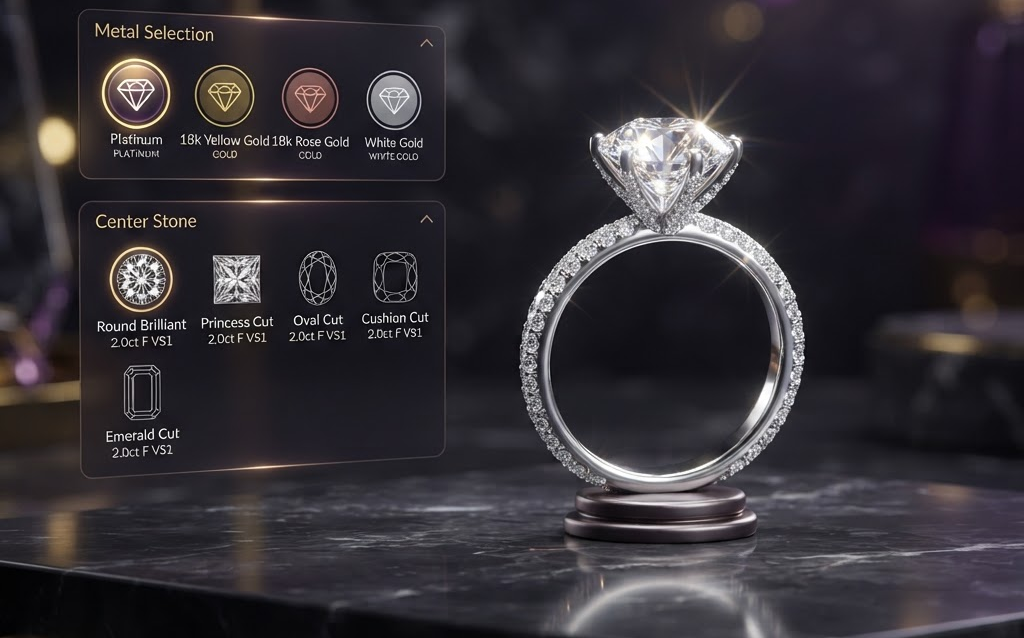
TL;DR: Jewelry 3D configurators let customers design custom rings, pendants, and earrings online—choosing metals, gemstones, settings, and engravings with photorealistic real-time previews. US jewelers using configurators report 45% higher conversion on custom pieces, 60% fewer in-person consultations, and higher average order values as customers upgrade stones and metals. Here’s how the technology works and what it costs in 2026.
Jewelry is one of the most personal purchases a person makes. Whether it’s an engagement ring, a milestone pendant, or a gift, customers want it to be exactly right. Traditionally, that meant visiting a jeweler, browsing display cases, and relying on imagination to visualize custom combinations. In 2026, jewelry 3D configurators let customers design their perfect piece online—with photorealistic previews of every metal, stone, and setting combination before they buy.
What a Jewelry 3D Configurator Does
A jewelry configurator is an interactive 3D experience where customers design custom pieces by selecting from available options and seeing the result rendered in real time. The key features:
- Metal selection — yellow gold, white gold, rose gold, platinum, silver, with accurate material rendering including karat color differences
- Gemstone selection — diamond, sapphire, ruby, emerald, moissanite, with accurate cut, clarity, and carat visualization
- Setting styles — prong, bezel, channel, pavé, halo—each rendered with correct geometry and light behavior
- Ring profiles — comfort fit, flat court, D-shape, with 360° rotation and cross-section views
- Engraving — custom text previewed on the ring band in real time
- Stone size visualization — see how different carat weights look on an actual hand using AR
- Live pricing — each selection updates the price instantly based on current metal and stone market prices
The visual quality is critical. Jewelry customers need to see sparkle—the way light bounces through a diamond’s facets, the warm glow of yellow gold, the precise color of a sapphire. This requires high-quality rendering with accurate material properties, not just flat texture mapping.
Why Jewelry Brands Need 3D Configurators in 2026
The Custom Jewelry Market Is Booming
Custom jewelry is one of the fastest-growing segments in the US jewelry market. Customers increasingly want unique, personalized pieces rather than mass-produced designs. But custom jewelry has a visualization problem—customers can’t see the finished piece until it’s made. 3D configurators solve this by showing photorealistic previews of every combination.
Reducing In-Person Consultations
Traditional custom jewelry requires multiple in-person consultations—choosing stones, approving designs, adjusting settings. A 3D configurator lets customers do 80% of the design work at home, arriving at the jeweler with a finalized design ready for production. This reduces consultations from 3–4 visits to 1, saving time for both customer and jeweler.
Higher Average Order Values
When customers can see exactly how a larger stone or platinum setting looks compared to a smaller stone in gold, they’re more likely to upgrade. Jewelry configurators report 25–35% higher AOV because customers make informed upgrades rather than guesses. Seeing the difference between a 1-carat and 1.5-carat diamond on their actual hand in AR is far more persuasive than a size chart.
Competing with Online-First Jewelers
Brands like Blue Nile, Brilliant Earth, and James Allen built their businesses on online customization. Traditional jewelers who don’t offer online configurators are losing customers to these digital-first competitors. A 3D configurator levels the playing field.
The Technology: Rendering Jewelry in 3D
Material Accuracy Is Everything
Jewelry rendering is arguably the most demanding use case for 3D product visualization. Key requirements:
- Metal rendering — gold, platinum, and silver have complex reflectance properties. Yellow gold has a warm tint; white gold has a cool cast. Platinum is denser and brighter than silver. These differences must be visible in the render.
- Gemstone refraction — diamonds and colored gemstones bend light. The render must show fire (spectral dispersion), brilliance (internal reflections), and scintillation (sparkle as the stone moves). This requires ray-traced rendering or advanced shader approximation.
- Environment reflections — jewelry looks different in different lighting. A diamond in a jewelry store looks different from the same diamond in candlelight. The configurator should offer multiple lighting environments.
- Engraving — custom text must be rendered in 3D geometry on the ring band, not as a 2D overlay. The engraving depth, font, and position must be accurate.
AR Hand Try-On
The most powerful feature for jewelry configurators is AR hand try-on. The customer points their phone at their hand and sees the configured ring on their finger in real time. This answers the most important questions: “How does this ring look on my hand?” and “Is this stone size too big or too small?”
AR try-on for jewelry uses hand tracking (tracking the finger position and ring placement) combined with the configured 3D model. The ring scales correctly to the user’s finger size and renders with accurate materials under the user’s actual lighting conditions.
Engine Choices for Jewelry Configurators
| Engine | Gemstone Quality | Delivery | Cost |
|---|---|---|---|
| Unreal Engine 5 | Film-grade (ray-traced refraction) | Pixel Streaming (browser) | $80K–$200K |
| Three.js + custom shaders | Very good (approximated) | Browser (client-side) | $30K–$80K |
| Unity | Excellent (with ray-tracing) | App or WebGL | $50K–$120K |
| KeyShot + web viewer | Excellent (pre-rendered variants) | Browser (image-based) | $15K–$50K |
For most jewelry brands, Three.js with custom gemstone shaders provides the best balance of quality and browser accessibility. Unreal Engine is worth the investment for luxury brands where the diamond sparkle must be photorealistic.
Cost of a Jewelry 3D Configurator
| Scope | Cost | Timeline |
|---|---|---|
| Single product (ring configurator) | $25,000–$80,000 | 6–12 weeks |
| Multi-product (rings + pendants + earrings) | $60,000–$180,000 | 10–20 weeks |
| Full custom jewelry platform | $120,000–$350,000+ | 16–32 weeks |
| 3D modeling per design | $1,500–$8,000 | 5–14 days |
Jewelry 3D modeling is more expensive than other categories because of the precision required—gemstone geometry must be cut-accurate, metal surfaces need micro-detail, and the model must support multiple material configurations.
FAQ: Jewelry 3D Configurators
Can a jewelry configurator show realistic diamond sparkle?
Yes. With ray-traced rendering (Unreal Engine 5) or advanced custom shaders (Three.js), diamonds show accurate fire, brilliance, and scintillation. The render simulates light entering the diamond, bouncing through internal facets, and exiting as spectral colors. Lower-cost solutions approximate this with environment maps and sparkle shaders that look very good but aren’t physically accurate.
How much does a jewelry configurator cost?
A single-product ring configurator with metal/stone selection, 360° rotation, and AR try-on costs $25,000–$80,000. A multi-product platform covering rings, pendants, and earrings runs $60,000–$180,000. Full custom jewelry platforms with CMS, pricing engine, and manufacturing integration cost $120,000–$350,000+. 3D modeling per jewelry design costs $1,500–$8,000.
Can customers see the ring on their hand in AR?
Yes. AR hand try-on lets customers point their phone at their hand and see the configured ring on their finger in real time. The ring scales to the correct finger size, renders with accurate materials, and stays positioned as the hand moves. This feature requires hand tracking technology (8th Wall or MediaPipe) integrated with the 3D configurator.
Can a jewelry configurator connect to manufacturing?
Yes. The configurator can export the customer’s design as a 3D file (STL or CAD) for direct 3D printing or CNC milling. This bridges the gap between customer design and manufacturing—the configured ring goes straight from the web configurator to the production floor without manual re-creation.
Does a jewelry configurator work for engagement rings specifically?
Yes—engagement rings are the most popular use case. Customers select the setting style, metal, center stone (type, cut, carat), and side stones, then preview the result in photorealistic 3D and AR. Live pricing updates help customers understand how each choice affects the budget, and the AR try-on helps them see the ring on a real hand before ordering.
Getting Started
- Start with your best-selling category — if engagement rings are your top seller, build that configurator first
- Invest in gemstone rendering quality — sparkle is what sells jewelry. Don’t cut corners on material quality.
- Add AR hand try-on — this is the feature that makes jewelry configurators transformative
- Connect to manufacturing — export designs directly to your production pipeline
Ready to build a jewelry 3D configurator? Contact Ink & Algorithm to discuss your project—we’ll help you create a photorealistic jewelry configurator that turns browsers into buyers.