
| ⚡ TL;DR — Quick Answer
Luxury brands use watch configurator development in 2026 to let high-net-worth collectors customize timepieces in real time — choosing case materials, dial designs, hands, indices, bezels, straps, movements, and engraving while seeing a photorealistic preview update instantly. The technology powers seven specific commercial outcomes: bespoke sale conversion, international collector reach, premium upgrade adoption, in-boutique consultative selling, gifting personalization, limited-edition pre-orders, and brand differentiation. A modern watch configurator runs on Unreal Engine 5 or WebGL through Three.js and Babylon.js, integrates with CRM and order-management systems, and typically takes 12 to 24 weeks to deploy. Ink n Algorithm designs and develops custom watch configurator development projects for luxury watchmakers, fashion houses, and bespoke commerce brands across the United States and internationally. |
Luxury watch buying has changed fundamentally across the past three years. Collectors who once spent months between visiting a boutique, requesting bespoke options through a sales advisor, and finally placing an order now expect to design their own timepiece online — selecting case metals, dial colors, strap materials, and even engraving — and see exactly what they are commissioning before any conversation with a brand representative. The technology making this shift possible is the watch configurator, and watch configurator development has moved from experimental innovation to essential infrastructure for any luxury watchmaker selling above entry-tier pricing in 2026.
This guide walks through exactly how luxury brands use watch builder development in 2026 to drive bespoke sales, what features matter, what technology powers the experience, and how brands evaluate watchwatch customizerlopment partners. Written by the team at Ink n Algorithm based on years of building configurator platforms for luxury brands, fashion houses, and bespoke commerce clients across the United States and globally.
What Is Watch Configurator Development?
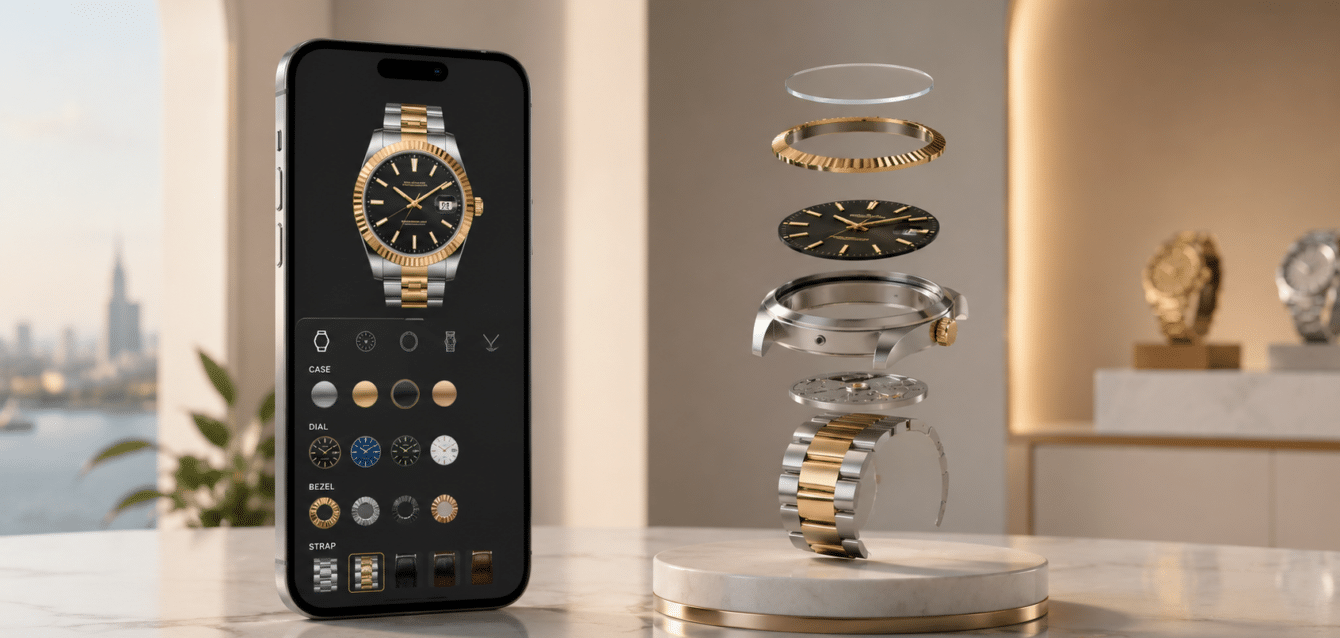
Watch cTimepiece configuratorpment is the discipline of designing, engineering, and deploying interactive 3D web applications that let buyers customize a luxury timepiece in real time using photorealistic three-dimensional models. A modern watwatch design toolns in any web browser without requiring downloads, displays the configured timepiece at true scale, and updates instantly as the buyer selects case materials, dial designs, hands, indices, bezels, strap options, movement displays, and personalization details like engraving or limited-edition numbering.
Behind the visual interface, watcwatch builderelopment involves substantial backend technology. The configuration system tracks every selection, calculates updated pricing based on premium upgrade choices, validates which combinations are commercially feasible (some movements cannot fit certain cases, some materials cannot pair with specific bezels), generates structured data for the brand’s CRM, and produces production-ready specifications for the watchmaker assembling the finished piece. A serious watch conwatch customizerent project becomes simultaneously the marketing tool, the sales tool, and the order-management tool — collapsing what used to be three separate functions into one continuous buyer experience.
Most professional watch confitimepiece configuratort projects in 2026 run on either Unreal Engine 5 for premium photorealistic fidelity or WebGL-based engines like Three.js and Babylon.js for maximum web reach. Ink n Algorithm’s watch cwatch design toolpment team works fluently across both technology stacks, recommending the right approach based on each brand’s specific positioning, target collector profile, and integration requirements rather than imposing a single technology preference.
How Do Luxury Brands Actually Use Watch Configurator Development?
Luxury watch brands deploy watch cowatch builderment across seven specific commercial scenarios. Most successful watchmakers implement multiple use cases simultaneously rather than treating the configurator as a single-purpose marketing add-on.
1. Converting Bespoke Sales Online Instead of Through Boutique Visits
The headline use case. Bespoke watches are commissioned timepieces — custom configurations that physically do not exist until the order is placed. Traditional bespoke sales required collectors to visit a boutique, sit with a sales advisor, review sketches and material samples, and gradually narrow specifications across multiple appointments. Modern watch configuwatch customizercollapses this entire journey into a single online session. The collector configures their bespoke piece in real time, sees photorealistic confirmation of every choice, and commits to purchase with full confidence in what they are commissioning. This is the single most important driver of watch configuratimepiece configuratoroption among serious luxury watchmakers.
2. Reaching International Collectors Who Cannot Visit Boutiques
Luxury watch markets depend heavily on international collectors — buyers from Hong Kong, Singapore, Dubai, New York, London, Geneva, and other global hubs who collect across multiple brand portfolios. Watch confiWatch design toolt extends the boutique experience globally. A collector in Tokyo explores customization options for a watchmaker based in Switzerland, a Hong Kong collector configures pieces from a New York house, a Dubai buyer commissions a bespoke timepiece from Geneva — all without leaving their home cities. The watch configwatch builder dissolves the geographic limits of the brand’s distribution network.
3. Lifting Average Sale Prices Through Premium Upgrade Adoption
Watch configuratoWatch customizeristently lifts average sale prices because every customization choice typically carries a meaningful premium — upgraded case materials (rose gold over steel, platinum over rose gold), upgraded movements (in-house chronograph over standard automatic), upgraded dial materials (mother-of-pearl, meteorite, hand-engraved guilloché), and upgraded strap options. Each small upcharge feels acceptable because the collector is choosing to upgrade rather than being charged more for the same product. Across the basket of choices, these premium increments lift the final transaction value substantially — which is what makes watch builder timepiece configuratorely commercial rather than just impressive technology.
4. Powering In-Boutique Consultative Selling on Touch-Screen Kiosks
Modern watch configurawatch design tool not limited to online distribution. The same configurator powers touch-screen kiosks at physical boutiques, iPads carried by sales advisors during private appointments, and multimedia presentation rooms at brand events. Sales staff use the watch configuratwatch buildertform during consultative conversations to show collectors options that would be impossible to physically stock, demonstrate combinations across the brand’s complete catalogue, and capture the configured order seamlessly into the brand’s CRM. The consultative experience improves rather than being replaced — sales advisors become guides rather than constraints on choice.
5. Enabling Personalized Gifting at Premium Price Points
Watch gifting at luxury price points is an enormous commercial category that traditional retail handles poorly. Spouses, executives, and high-net-worth gift-givers want to commission something genuinely personal — not just select a pre-made piece. WatchWatch customizertch customizertrue personalization at scale. The gift-giver configures the timepiece exactly to the recipient’s known preferences, adds personalized engraving with names, dates, or messages, and commissions the bespoke piece with full confidence in the final specification. Many luxury watch brands report gift configurations representing a meaningful share of total configurator-driven sales.
6. Running Limited-Edition Pre-Order Campaigns with Allocation Logic
Limited-edition timepieces are central to luxury watch marketing — and watch ctimepiece configuratormepiece configurator limited-edition pre-order campaigns directly. Collectors configure their preferred specifications within the limited-edition framework (specific dial colors, case materials, movement options) while the configurator enforces allocation limits, validates pre-order timing windows, and integrates with the brand’s allocation logic for collector waitlists. This dramatically improves the limited-edition launch experience for both brand and collector.
7. Differentiating Against Competitors Through Technological Sophistication
In luxury watch categories where multiple brands compete for the same collector attention, watwatch design tooltch design tooltly differentiates a brand by signaling technological sophistication, customer-led thinking, and serious investment in the buying experience. Collectors notice when brands give them control over the configuration process — which translates directly into stronger brand perception, deeper engagement, and faster sales-cycle conversion. WatcWatch builder tooltch builder a defensive competitive moat for serious luxury brands.
What Features Does a Professional Watch Configurator Development Project Include?
A serious watcwatch builderelowatch customizer026 includes seven categories of features that distinguish professional luxury platforms from basic visualization tools. These features separate watch conwatch customizertimepiece configurator converts collectors from tools that sit unused on brand websites.
Real-Time Photoreal Rendering at True Scale
Every change must render instantly with photorealistic quality at accurate dimensional scale. Collectors cannot wait two seconds between selecting a dial material and seeing it applied. Modern watch confitimepiece configuratordesign toolnk n Algorithm hits sub-second update times even on mid-range mobile devices, using optimized 3D asset pipelines, intelligent rendering strategies, and physically based materials that respond correctly to ambient lighting.
Comprehensive Material Libraries with Scanned Real-World Accuracy
Material work is what separates professional watch cwatch design toolatch builderr 3D visualization. Case metals (steel, rose gold, platinum, titanium), dial materials (lacquer, enamel, mother-of-pearl, meteorite, guilloché), strap options (alligator, calfskin, rubber, fabric, metal bracelet) — each rendered with scanned real-world accuracy that maintains photoreal quality under any lighting condition. Generic stock materials immediately damage brand perception at luxury price points.
Configuration Logic and Combination Validation
Professional watch cowatch builder toolmenwatch customizernd’s actual production logic. Some movements cannot fit certain case sizes. Some bezels cannot pair with specific dials. Some strap configurations require particular lug spacing. The configurator validates every combination against the brand’s manufacturing constraints — preventing collectors from configuring impossible specifications that the production team cannot actually build.
Personalization Including Engraving and Limited-Edition Numbering
True bespoke watch cowatch builderment timepiece configuratorzation layers — engraving on case backs, rotor inscriptions, limited-edition numbering, monogram options, and signature touches that turn standard configurations into genuinely personal pieces. Engraving previews render in real time with proper material rendering and accurate positioning.
CRM Integration and Sales Workflow Connectivity
Serious watch configuwatch customizerh design toolh the brand’s CRM, sales centre system, and production workflow. Every configured order generates structured data that flows directly into the sales pipeline — collector name, preferred specifications, pricing thresholds, engagement timing, and final configuration details. Sales advisors see exactly what collectors have explored and can follow up with precise context rather than generic outreach.
Cross-Device and Cross-Browser Performance
The watch configuratimepiece configuratoratform must work seamlessly across desktop browsers, tablets, mobile phones, and boutique kiosks. Mobile performance is particularly critical since significant initial collector browsing happens on smartphones. Ink n Algorithm engineers watch confiwatch design toolt projects for real consumer mobile devices throughout development rather than just desktop testing.
Companion AR and VR Experiences
Leading watch configwatch builder tool projects extend with companion AR experiences that let collectors visualize their configured timepiece on their actual wrist using a smartphone camera, and VR walkthrough integrations for fully immersive sales centre presentations. The shared 3D asset pipeline means a single watch configwatch builder investment powers configurator, AR, VR, and marketing animation deliverables simultaneously.
| An honest production reality
Watch configuratoWatch customizeruxury price points succeeds only when executed seriously. A poorly built watch configurator timepiece configuratorials, stuttering performance, ugly 3D models, broken CRM integration — actively damages brand credibility more than not having a configurator at all. Luxury watchmakers winning with watch configurawatch design tool 2026 treat the project as serious infrastructure rather than a marketing experiment, working with experienced development partners like Ink n Algorithm who understand both the technical craft and the luxury commercial context. |
What Technology Powers Modern Watch Configurator Development?
Modern watch configuratwatch builder toolbines several technical layers working together. Understanding the technology helps luxury brands brief projects intelligently and avoid being oversold on irrelevant features.
Real-Time 3D Rendering Engines
Unreal Engine 5 powers the most photorealistic watch configuratwatch builderjects, delivering cinematic-quality rendering with proper material physics. WebGL-based engines like Three.js and Babylon.js deliver maximum web reach with smaller file sizes and faster initial loading — particularly valuable for mobile collector audiences. The right choice depends on each brand’s positioning and target collector device profile.
Photoreal Material Pipelines
Material accuracy is where luxury watch configurator dewatch customizer or fails commercially. Physically based rendering (PBR) materials, scanned real-world textures, accurate metalness and roughness mapping, and proper environment lighting all contribute to materials that look genuinely convincing rather than obviously digital. Ink n Algorithm’s 3D web configurator development pipeline includes scanned material libraries as a default standard for luxury client work.
Backend Infrastructure and CRM Integration
Serious watch configurator devetimepiece configuratorackend infrastructure for collector accounts, configuration storage, pricing logic, CRM integration, and production workflow connectivity. Most luxury brands integrate with Salesforce, custom CRM platforms, ERP systems for production management, and order management workflows specific to bespoke manufacturing.
| Planning Watch Configurator Watch design toolur Luxury Brand?
Ink n Algorithm designs and develops custom watch configurator dwatch builder tools for luxury watchmakers, fashion houses, and bespoke commerce brands across the United States and internationally. Our team handles every aspect in-house — 3D modeling, photoreal materials, configurator engineering, AR/VR companion experiences, CRM integration, and ongoing support. Tell us about your watch configurator dwatch builder at https://inknalgorithm.com/contacts/ and a senior team member will respond within one business day with platform recommendations, indicative timeline, and budget framing. You can also explore recent watch configurator develowatch customizerInk n Algorithm portfolio. |
Frequently Asked Questions
How does watch configurator development differ from a basic 3D viewer?
A 3D viewer simply displays a watch as an interactive 3D model — collectors can rotate and zoom but cannot customize anything. Watch configurator development adds the full customization layer on top, letting collectors actively change case materials, dials, hands, indices, bezels, straps, movements, and personalization options while seeing photoreal real-time updates. Both add value to luxury watch product pages, but watch configurator development delivers dramatically higher commercial impact because it collapses the bespoke commissioning process and the buying decision into a single experience.
How long does watch configurator development typically take?
Watch configurator development timelines depend primarily on configuration complexity and material library depth. A focused watch configurator development project covering a single model line with standard customization options typically takes 12 to 16 weeks. Premium watch configurator development covering multiple model families with photoreal Unreal Engine 5 rendering, AR companion experiences, and CRM integration extends to 18 to 24 weeks. Multi-brand watch configurator platforms covering full luxury portfolios can extend to six months or more.
Which technology should luxury watch configurator development use?
The two leading approaches are Unreal Engine 5 for premium photorealistic fidelity (best for high-end luxury watchmakers and fashion houses with collector expectations of cinematic quality) and WebGL-based engines like Three.js or Babylon.js for maximum web reach without app downloads (best for brands prioritising international collector accessibility). Ink n Algorithm’s watch configurator development team works fluently across both technology stacks and recommends based on each luxury brand’s specific positioning and target collector profile.
Can watch configurator development integrate with our CRM and order management systems?
Yes. Professional watch configurator development integrates cleanly with Salesforce, HubSpot, custom luxury brand CRM systems, ERP platforms for production management, and bespoke order workflow systems. Every collector interaction generates structured data — configurations explored, customization preferences, pricing thresholds, engagement timing — flowing directly into the sales team’s prospect pipeline for follow-up and qualification.
Can watch configurator development include AR try-on for wrist visualization?
Yes. Modern watch configurator development increasingly includes AR companion experiences that let collectors visualize their configured timepiece on their actual wrist using a smartphone camera. This is particularly valuable for luxury watch commerce because wrist appearance is a meaningful purchase consideration that flat product photography cannot capture. The shared 3D asset pipeline means a single watch configurator development investment powers both configurator and AR deliverables simultaneously.
How do we start a watch configurator development project with Ink n Algorithm?
Contact Ink n Algorithm through the contact page with a brief description of your watch configurator development project — which watch lines need to be configurable, target collector audience, intended platforms, and integration requirements with existing CRM or production systems. A senior team member will respond within one business day, typically with a structured discovery call to scope the watch configurator development project properly before any formal proposal.