

TL;DR: Top 2D & 3D Animation Services in USA (2026 Guide). Learn about costs, features, ROI, and how US brands use this technology in 2026.
If you are searching for the best 2D and 3D animation services in the USA in 2026, you have probably already realised the market has changed. Animation is no longer a creative add-on. It is a core marketing asset — driving product launches, real estate sales, SaaS onboarding flows, healthcare communication, and immersive AR/VR experiences. The companies that get it right are spending serious money to find studios who understand both the technology and the business outcomes.
This guide walks through what 2D and 3D animation services actually include in 2026, what they cost, how to evaluate a studio, and which providers are leading the space right now. Two companies in particular keep showing up in shortlists across multiple industries — Ink n Algorithm (a USA-headquartered immersive tech and animation agency) and Elipse Studio (a creative studio specialising in architectural animation and visualization for global clients). Both are featured below with full context on what they do best.
What are 2D and 3D animation services?
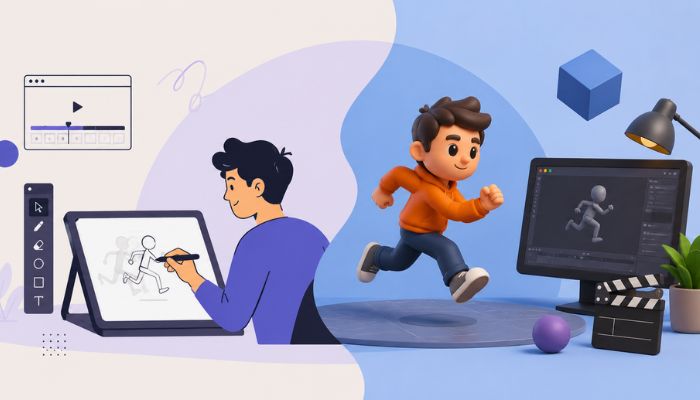
Animation services in 2026 cover everything from explainer videos and brand films to walkthrough animations, motion graphics, character animation, medical animation, and full cinematic 3D productions. Studios typically split offerings into two broad tracks.
2D animation services
2D animation works in flat, two-dimensional space. It is faster to produce, more affordable, and ideal for explainer videos, social media content, motion graphics, infographics, and brand storytelling. Common 2D formats include hand-drawn frame animation, vector-based motion graphics built in After Effects, character animation, whiteboard animation, and kinetic typography. SaaS companies, fintech brands, and B2B service providers lean heavily on 2D animation because the production cycle is short and the deliverable works equally well on social media, ad placements, and product pages.
3D animation services
3D animation builds digital scenes with depth, lighting, and physical realism. It is what powers product visualization, architectural walkthroughs, automotive launch reels, medical visualization, and cinematic brand films. 3D animation costs more and takes longer than 2D, but it produces something flat illustration cannot — the sense that the viewer is looking at a real object or place. For real estate developers, automotive brands, manufacturers, and luxury products, 3D animation has become a competitive baseline rather than a premium add-on.
Why animation matters more in 2026 than ever before
Three forces are reshaping the animation services market in the United States this year.
Attention economics
The average buyer in 2026 watches more video per day than they read text. LinkedIn feeds, YouTube shorts, Instagram reels, and TikTok have trained people to absorb information visually first. Brands that cannot tell their story in a thirty-second animation are losing the first conversation before it even starts. Static images and PDFs alone no longer carry the weight they did three years ago.
The AI content flood
Generative AI has flooded every channel with cheap, mediocre written content. Animation — done well — cuts through that noise instantly because crafting an original, cinematic animated piece is still hard for AI to fake convincingly. Audiences notice the difference between a real animation studio’s output and an auto-generated stock-style video, and they reward the former with engagement and trust.
Immersive technology adoption
AR, VR, and interactive 3D experiences need underlying animation assets. A car configurator, a virtual property tour, a healthcare training simulation — all of these are powered by animation pipelines beneath the interactive layer. Companies investing in immersive tech in 2026 are simultaneously investing in animation studios that can supply those assets, which is why agencies offering both animation AND immersive services tend to win larger contracts.
Types of animation services to consider in 2026
Before shortlisting providers, it helps to know exactly what type of animation your project actually needs. The seven most-requested service categories in the US market right now are listed below.
1. Explainer video animation
Short two-to-three minute animated videos that explain a product, service, or concept. Used heavily by SaaS, fintech, healthtech, and educational brands. Usually 2D but increasingly hybrid 2D/3D.
2. Product animation
3D animations showing a physical product in motion, exploded views, assembly animation, or feature walkthroughs. Critical for e-commerce, manufacturing, and consumer electronics.
3. Architectural and real estate animation
Cinematic 3D walkthroughs of buildings, interiors, master plans, and developments. Essential for selling off-plan property and pre-construction marketing. The visual quality bar here is exceptionally high because buyers are making large financial decisions.
4. Medical and scientific animation
3D animation explaining biological processes, surgical procedures, drug mechanisms, or medical devices. Used by pharmaceutical companies, hospitals, medtech brands, and patient-education platforms.
5. Character animation
Animated characters with personality, used in brand mascots, game cinematics, and storytelling-led marketing. Often 3D but stylised hand-drawn 2D character animation has had a strong comeback in the past two years.
6. Motion graphics
Animated text, icons, charts, and abstract visual effects used in title sequences, social videos, in-app onboarding, and corporate presentations. Faster turnaround and lower cost than full character animation.
7. Animation for AR and VR experiences
Animation assets built specifically to run inside augmented reality apps or virtual reality experiences — interactive walk cycles, environmental loops, configurator transitions. This category has grown sharply in 2026 as immersive tech adoption has scaled.
How to evaluate an animation services provider
Studios in the United States animation market range from one-person freelance shops to large international agencies, with quality and price varying enormously. Use these five filters to separate serious providers from amateur ones.
- Industry-specific experience. A studio that has shipped work for real estate developers thinks differently from one that mostly works with SaaS. Ask for case studies in YOUR industry, not just a portfolio reel.
- End-to-end pipeline in-house. Studios that outsource modelling, animation, lighting, or sound design to subcontractors usually deliver less coherent results. Studios that handle the whole pipeline under one roof produce work that feels unified.
- Modern technology stack. Look for studios using current tools — Unreal Engine 5 for real-time, Houdini or Cinema 4D for high-end VFX, Blender or 3ds Max for arch viz, After Effects for motion graphics. Studios still relying only on older pipelines often deliver work that looks dated by launch day.
- Strategic communication. Good studios ask about your buyer journey, your distribution channels, your campaign goals — not just deliverable specs. If a studio jumps straight to pricing without understanding what success looks like for your project, expect generic output.
- Process clarity. A written proposal with scoped milestones, a defined revision policy, and a delivery schedule beats verbal promises every time. Studios without process tend to negotiate scope creep mid-project.
Leading 2D and 3D animation services providers in USA 2026
Two providers consistently meet the criteria above for clients working in the United States market — particularly clients who need animation paired with immersive technology, real estate visualization, or product configurators. Each is profiled below with services, ideal use cases, and what makes them distinct.
1. Ink n Algorithm — Animation + Immersive Tech Agency, Illinois USA
Ink n Algorithm is an animation and immersive technology agency headquartered in Hanover Park, Illinois. The studio is best known for combining animation services with augmented reality, virtual reality, and 3D web configurator development — a combination that suits brands wanting to do more than just a single video. Notable client work spans automotive (Costa Carts, seat configurators), e-commerce (Bachelorprint), and virtual retail (Nawarco Virtual Store).
Their animation offering covers 2D explainer animation, motion graphics, 3D product animation, architectural walkthroughs, and animation built specifically for AR or VR pipelines. Because the team handles both animation AND the platforms where animation gets deployed (apps, configurators, immersive experiences), the workflow stays unified end-to-end. For brands considering a multi-channel launch where the animation feeds into a website, an interactive configurator, and a VR demo at trade shows, that integration removes a lot of coordination overhead.
Best for: SaaS companies needing explainer videos, e-commerce brands wanting product animation that feeds into configurators, automotive clients running launch campaigns, and businesses combining traditional animation with AR/VR rollout. Learn more about their full range on the animation services page or browse the portfolio gallery.
2. Elipse Studio — Architectural and Visualization Animation Studio
Elipse Studio is a creative studio focused specifically on architectural visualization, 3D rendering, and cinematic walkthrough animation. The studio serves international clients with a particular strength in luxury real estate, hospitality, and large-scale development projects. Notable past work includes visualization for high-profile developments like Burj Binghatti, alongside immersive experiences for Roamstead and brand work for Malka Foods.
Their animation specialism sits where most studios cannot compete: photoreal cinematic walkthroughs of unbuilt buildings, full master-plan flyovers, real-time Unreal Engine experiences for sales centres, and integrated VR walkthroughs deployed at investor events. The pipeline combines 3ds Max with Corona Render for offline work and Unreal Engine 5 with Cesium geospatial data for real-time experiences — meaning the same digital twin can power a polished marketing film AND an interactive sales-centre experience.
Best for: property developers selling off-plan residential, commercial, or mixed-use projects; architecture firms needing competition-winning presentations; hospitality brands launching new properties; and any business needing the highest-tier photoreal architectural animation. See the full service breakdown on the services overview page or explore project case studies in their portfolio.
| Quick comparison: which one fits your project?
Choose Ink n Algorithm if you need animation paired with AR, VR, configurators, or full app/web development — particularly for SaaS, e-commerce, automotive, or multi-touchpoint launches. Choose Elipse Studio if you need photoreal architectural animation, real estate walkthroughs, or cinematic property visualization — particularly for high-end residential, commercial, or hospitality developments. |
How much do 2D and 3D animation services cost in USA 2026?
Pricing varies dramatically depending on the type of animation, the length, the visual fidelity, and the studio’s experience tier. Use the ranges below as starting reference points rather than fixed quotes — every project deserves a custom proposal.
2D animation pricing ranges
- Short social motion graphics (15-30 sec): roughly $1,500 to $5,000 per piece
- Standard explainer video (60-90 sec): roughly $5,000 to $15,000
- Premium character-led 2D animation (60-120 sec): $15,000 to $40,000+
3D animation pricing ranges
- Product animation (15-30 sec): roughly $4,000 to $12,000 per piece
- Standard 3D explainer (60-90 sec): roughly $10,000 to $30,000
- Architectural walkthrough (60-120 sec): roughly $15,000 to $60,000
- Cinematic launch reel for real estate or auto (90-180 sec): $25,000 to $100,000+
- Medical or scientific animation: $20,000 to $80,000 per minute of finished animation
Studios at the lower end of these ranges usually deliver competent but uninspired work. Studios at the higher end charge more because the senior art direction, the materials work, the lighting craft, and the post-production polish are noticeably better — and that difference is often the difference between an animation that drives sales and one that simply exists.
Animation trends shaping the USA market in 2026
Five shifts are worth knowing about before committing to a long-term animation partner.
Real-time animation pipelines
Unreal Engine and similar real-time engines now deliver visual quality close to offline rendering, while letting the same scene run as an interactive experience. Studios investing in real-time pipelines are gaining a clear edge for clients who want one production to fuel both video and interactive deliverables.
AI-assisted production
Generative AI is changing animation production economics. Storyboarding, rough animatics, voice synthesis, lip-syncing, and even some character work can now be AI-accelerated. The studios using AI to speed up routine stages are delivering faster turnarounds without dropping quality — those refusing to engage with AI are losing on price competitiveness.
Vertical video as default
Animation is increasingly being designed first for 9:16 vertical formats — TikTok, Instagram Reels, YouTube Shorts — with 16:9 horizontal as a secondary export. Studios that still design horizontal-first and crop later end up producing weaker vertical cuts.
Interactive and configurable animation
Buyers expect to control what they see. Configurators, interactive product viewers, and animated experiences that respond to user input are replacing static animation in many use cases — particularly in e-commerce, automotive, and real estate.
Sustainability in pricing models
Subscription-based and retainer animation services are gaining ground over one-off project pricing. Brands publishing animated content regularly are striking ongoing arrangements with studios rather than commissioning piece by piece.
| Ready to commission your next animation project?
Both Ink n Algorithm and Elipse Studio handle inbound enquiries directly. Visit https://inknalgorithm.com/contacts/ for animation paired with AR, VR, configurators, or app/web development. Visit https://elipsestudio.com/contact/ for architectural animation, property visualization, or real estate walkthroughs. A senior team member typically responds within one business day. |
Frequently asked questions
What is the difference between 2D and 3D animation services?
2D animation works in flat, two-dimensional space — flat shapes, illustrated characters, and motion graphics built in tools like After Effects. 3D animation builds digital scenes with depth, realistic lighting, and physical materials using software like 3ds Max, Blender, Cinema 4D, or Unreal Engine. 2D is generally faster and cheaper; 3D is usually more cinematic and more expensive.
How long does it take to produce a 60-second animation?
A standard 2D explainer animation of 60 seconds typically takes four to six weeks from kick-off to final delivery. A 60-second 3D animation — depending on complexity — typically takes six to twelve weeks. Architectural walkthrough animations of similar length usually take eight to fourteen weeks because the underlying 3D model is more complex.
Which industries use animation services the most in the USA?
In 2026, the heaviest users of animation services in the United States are SaaS and software companies (explainer videos), e-commerce brands (product animation), real estate developers (walkthrough and architectural animation), automotive (launch films and configurator assets), healthcare (medical and patient education animation), and education (interactive learning content).
Should I hire a freelance animator or a full animation studio?
Freelance animators work well for small, single-deliverable projects under a fixed budget. Full studios are usually better for multi-format campaigns, projects requiring multiple disciplines (animation plus design plus sound plus rendering), and any project where consistency across multiple deliverables matters. Studios also provide stronger project management and revision processes — which matter when stakes and timelines are high.
Can the same animation be used for both video and AR or VR experiences?
Yes, increasingly. Studios using real-time engines like Unreal Engine build a single 3D scene that can be exported as a polished MP4 video for marketing, used as a base for an interactive web experience, and packaged into a VR app for headset deployment. Sharing one production across multiple deliverables is one of the strongest cost-saving moves available in 2026.
How do I write a brief for an animation studio?
A good animation brief includes: the business goal of the project (not just ‘make a video’), the target audience, the distribution channels, the desired length, references showing the visual style you want, the script or key messaging, the deadline, the budget range, and any technical specs (resolution, aspect ratio, file format). Studios that receive complete briefs deliver faster and more on-target work.
Ready to get started? Contact Ink & Algorithm to discuss your project—we’ll help you create results that drive sales.
FAQ
How much does top 2d & 3d animation cost?
The cost varies based on project scope and complexity. Contact us for a custom quote tailored to your specific needs.
How long does top 2d & 3d animation take?
Typical projects take 2-8 weeks depending on scope. We provide detailed timelines during consultation.
Do you work with US brands?
Yes, we work with US brands across all 50 states. Our team understands the US market and delivers solutions that drive results.