
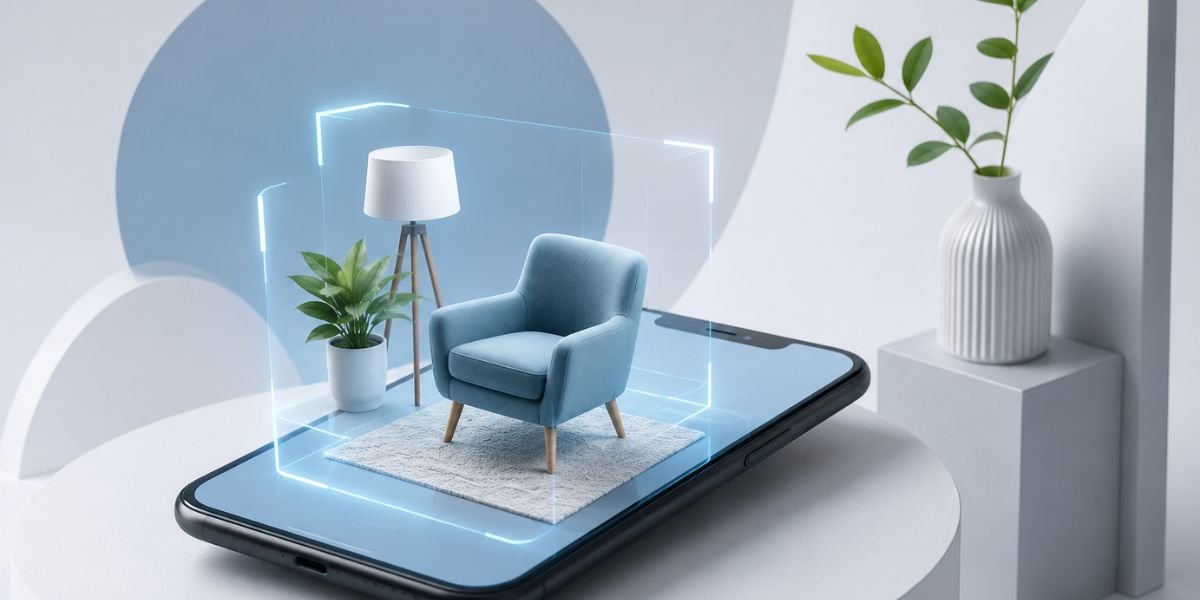
TL;DR: How AR Development Improves User Experience in USA 2026. Learn about costs, features, ROI, and how US brands use this technology in 2026.
Introduction
There is a quiet revolution happening in how people interact with digital products and brands, and it is not being driven by a flashier app store algorithm or a new social media platform. It is being driven by augmented reality development — a technology that is fundamentally rewriting the rules of what a user experience can be. Augmented reality overlays digital information, objects, and interactions onto the real physical world that a person actually inhabits. And when it is done well, it does not feel like technology at all. It feels like magic. It feels like the world just got smarter, more helpful, and more interesting, all at once.
In 2026, AR development has crossed a threshold that changes everything for businesses and their users. The hardware is mature — smartphones powerful enough to render high-fidelity AR experiences are now in the pockets of billions of people globally. The software frameworks have evolved to the point where AR app development is faster, more stable, and more capable than at any previous point in the technology’s history. And critically, consumer familiarity with AR has grown dramatically through years of exposure to AR filters, gaming, and retail try-on tools, removing the friction of novelty from the adoption equation. The technology is ready. The users are ready. The only question is whether your brand is ready to meet them there.
At Ink N Algorithm, we have been building augmented reality solutions for businesses across retail, real estate, education, manufacturing, and eCommerce for years. We have seen firsthand how thoughtfully designed AR user experiences transform engagement metrics, reduce purchase anxiety, lift conversion rates, and build the kind of genuine brand affinity that every marketing team dreams about but rarely achieves with conventional digital tools. In this comprehensive guide, we are going to break down exactly how AR development improves user experience in 2026 — covering the psychology, the technology, the industry applications, and the practical considerations that any business needs to understand before investing in this space.
Whether you are exploring augmented reality for business for the first time or looking to deepen an existing AR strategy, this article will give you the honest, detailed, and genuinely useful perspective you need to make confident decisions about this technology in 2026.
What Is AR Development and Why Does It Matter for UX?
Before we dive into the how, it is worth being precise about the what. Augmented reality development is the process of designing and building software applications that use a device’s camera, sensors, and display to overlay digital content — graphics, text, animations, 3D models, data visualisations — onto the user’s view of the real world in real time. Unlike virtual reality, which replaces the physical environment entirely, AR enhances it — adding a digital layer to reality rather than substituting a simulated one.
The user experience implications of this distinction are profound. Because AR experiences happen in the user’s actual physical environment — their living room, their workplace, their face, their street — they carry an immediacy and personal relevance that no screen-based experience can match. When an AR application places a piece of furniture in your actual living room, you are not imagining whether it will fit; you are seeing it fit — or not. When an AR navigation tool overlays directional arrows onto the real street in front of you, you are not interpreting a map; you are following a guide that lives in your world. This contextual integration is the fundamental UX superpower of augmented reality, and it is why well-executed AR app development consistently produces user engagement and satisfaction metrics that conventional digital interfaces struggle to match.
The Core Technologies Behind Modern AR Development
Modern AR development draws on several interconnected technologies that have all advanced substantially by 2026. Computer vision algorithms allow devices to understand the geometry and surfaces of physical environments, enabling virtual objects to be placed accurately and to interact convincingly with real-world physics. SLAM (Simultaneous Localisation and Mapping) technology allows AR applications to track a user’s position and orientation in real time, ensuring that virtual overlays remain stable and correctly positioned even as the user moves. Machine learning models power object recognition, face tracking, and body pose estimation that make advanced AR UX design features possible. And GPU rendering capabilities in modern smartphones have reached the level where photorealistic virtual objects can be composited convincingly into live camera feeds at frame rates smooth enough to feel seamless.
For businesses commissioning AR app development, there are now several mature frameworks to build on: Apple’s ARKit for iOS, Google’s ARCore for Android, and increasingly capable WebAR frameworks like 8th Wall and Zappar that deliver AR experiences directly through mobile browsers without requiring app downloads. This last development — WebAR — is arguably the most commercially significant of 2026, because it removes the single biggest barrier to consumer AR adoption: the friction of downloading a dedicated application. A WebAR experience can be accessed by clicking a link, opening a QR code, or tapping a product page, making it as frictionless as clicking a button.
| AR Development Impact on User Experience — 2026 Data | Measured Outcome |
| Increase in product page time-on-site with AR visualisation | +3.2x average |
| Reduction in product return rates when AR try-on is available | −26% avg |
| Lift in purchase conversion rate from AR product configurators | +34% avg |
| Consumer preference for AR try-before-buy over static images | 74% prefer AR |
| Increase in brand recall after interactive AR brand experience | +68% uplift |
| User satisfaction score improvement with AR-guided onboarding | +41 NPS pts |
| Reduction in customer support queries with AR instruction overlays | −35% avg |
| WebAR experiences accessed without app download vs native AR app | 3.8x more users |
How AR Development Directly Improves User Experience: 8 Key Ways
1. Eliminating Purchase Uncertainty with Real-World Visualisation
The single most commercially impactful way that AR development improves user experience is by eliminating the uncertainty that sits at the heart of most online purchase decisions. Whether a customer is buying a sofa, a pair of glasses, a piece of industrial equipment, or a kitchen appliance, the fundamental question is always the same: will this product actually work in my context? Will it look the way I think it will look in my space? Will it fit? Will the colour work with what I already have? This uncertainty is not irrational — it is a completely reasonable response to the limitations of static product photography and written specifications.
An AR product visualisation tool — one that lets a customer point their phone at the relevant real-world context and see a photorealistic 3D model of the product at full scale, in that actual environment — resolves this uncertainty in the most direct and convincing way possible. The customer does not need to imagine; they see. And seeing generates a quality of purchasing confidence that no amount of photography, video, or written copy can replicate. Businesses that have deployed AR for eCommerce consistently report both higher conversion rates and lower return rates, because customers who have seen a product in their actual context arrive at purchase with realistic expectations and genuine confidence in their choice.
2. Making Complex Products Immediately Understandable
Complexity is one of the greatest enemies of good user experience. When a product or service involves technical specifications, configuration options, assembly requirements, or operational processes that are difficult to convey through text or 2D images, users disengage, make mistakes, or abandon the journey entirely. AR development provides a uniquely powerful solution to this problem by replacing abstract information with contextual, spatial, interactive guidance that is anchored to the real object or environment the user is actually working with.
Consider an industrial equipment manufacturer whose products require complex setup procedures. Rather than providing a 50-page PDF manual that users consistently fail to navigate correctly, an AR application can overlay step-by-step assembly instructions directly onto the physical equipment, highlighting the specific component the user needs to interact with at each stage and confirming correct completion before advancing to the next step. The instruction does not exist in an abstract document that the user has to mentally map to the object in front of them — it exists on the object itself, in real time. The cognitive load is dramatically reduced, the error rate falls, and user satisfaction with both the setup experience and the product overall improves significantly.
3. Creating Deeply Personalised Experiences at Scale
Personalisation has been a central promise of digital marketing for over a decade, but most implementations remain superficial — a user’s name in an email subject line, a product recommendation based on browsing history. AR development makes a fundamentally different and much more powerful kind of personalisation possible: contextual personalisation that responds to the user’s actual physical environment, body, and real-time behaviour rather than to inferred preferences from historical data.
AR beauty apps that show users exactly how a specific lipstick shade looks on their actual face, in real time, with their actual skin tone and lighting conditions, are delivering a personalised experience that no static swatch chart or filtered photograph can approach. AR wardrobe apps that let users virtually try on clothing on a model that matches their body shape and size are personalising the fashion discovery experience at a level that no recommendation engine can replicate. This contextual, physical personalisation — made possible by AR UX design — creates a sense of being genuinely understood and served by a brand that drives loyalty and advocacy at a depth that algorithmic personalisation alone cannot achieve.
4. Transforming Onboarding and Product Education
The period immediately after a customer acquires a new product or service is one of the highest-risk moments in the customer relationship. If the onboarding experience is confusing, intimidating, or frustrating, customers disengage before they have had a chance to experience the value the product is capable of delivering. AR development transforms this critical moment by making onboarding contextual, visual, interactive, and guided — precisely the qualities that drive successful user adoption.
An AR onboarding experience does not ask users to read a setup guide and then figure out how to apply those instructions to the physical object in front of them. It overlays the guidance directly onto the object, in the user’s actual environment, updating in real time as the user progresses through the setup. Smart home device manufacturers using AR app development for setup guidance report significant reductions in customer support call volume and substantial improvements in first-week engagement rates — both indicators that users are succeeding with products they might previously have returned or abandoned. For software and app products, AR overlays on real-world workflows — showing users exactly how a digital tool integrates with their physical work environment — reduce adoption friction in ways that traditional screen-based tutorials simply cannot.
5. Elevating Navigation and Wayfinding
Navigation and wayfinding represent one of the oldest and most consistently frustrating UX challenges in both physical and digital environments. Reading a map and mentally translating its abstract representation into real-world movement is cognitively demanding and error-prone. AR navigation removes this translation layer entirely by overlaying directional guidance directly onto the user’s view of the real world. Rather than looking at a map and then looking at the street and trying to reconcile the two, an AR wayfinding application shows the user where to go by drawing arrows, highlights, or guides directly into their view of the environment they are actually navigating.
The applications of this capability extend from consumer navigation apps to high-stakes enterprise contexts. Airport and hospital AR wayfinding systems reduce the stress and error rate of navigating complex, high-pressure environments. Retail AR systems guide customers directly to the products they are looking for, improving in-store experience and reducing the frustration of wandering. Manufacturing and warehouse AR systems guide workers to the correct inventory locations with spatial precision that increases efficiency and reduces picking errors. In every one of these contexts, the AR development investment delivers measurable improvements in user experience quality that translate directly into operational and commercial outcomes.
6. Bridging the Physical and Digital for Seamless Brand Experiences
One of the most exciting opportunities in augmented reality for business is the ability to create seamless, connected experiences that span physical and digital touchpoints. A product packaging that comes alive with AR content when viewed through a phone camera. A print advertisement that triggers an AR experience when scanned. A physical retail space where AR overlays provide product information, reviews, personalised recommendations, and promotions that respond to what the user is physically looking at in real time. These phygital experiences — physical and digital integrated — create a continuity of brand experience that reinforces brand identity at every touchpoint and makes every physical brand asset an active digital channel.
For brands that have invested in physical retail, packaging, events, or out-of-home advertising, AR development transforms these existing assets from passive communication vehicles into active, interactive, data-generating brand experiences. The physical asset becomes the trigger; the AR layer delivers the experience. And the data generated by how users interact with these AR experiences — what they engage with, for how long, what they choose to explore — provides a quality of consumer insight into real-world behaviour that purely digital analytics cannot capture.
7. Supercharging Social Sharing and Organic Reach
User-generated content has become one of the most valuable assets in modern brand marketing, and well-designed AR experiences are extraordinarily effective generators of shareable UGC. A brilliant AR filter that makes users look surprising, beautiful, funny, or awe-inspiring is something users want to share with their networks immediately and instinctively. A spectacular AR brand activation that places something visually extraordinary in a user’s real-world environment generates the kind of “you have to see this” social sharing moment that no paid media campaign can buy.
The social sharing dynamic of AR development works because the experiences are genuinely personal — they happen to specific users in their specific environments, making every piece of AR-generated content unique and contextually authentic. When someone shares a video of a virtual piece of furniture in their actual living room, or their face transformed by an AR brand filter, they are sharing something that is genuinely about them, not just a generic brand message. This authenticity is what makes AR-generated social content so much more engaging and credible than traditional branded content — and it is why the organic reach generated by a great AR experience consistently outperforms equivalently budgeted paid campaigns.
8. Reducing Errors and Improving Task Performance in Enterprise Contexts
The user experience benefits of AR development extend far beyond consumer-facing applications into enterprise and industrial contexts where the cost of errors is not just a negative review but a safety incident, a failed product, or an expensive remediation. AR guidance overlays for manufacturing assembly, maintenance procedures, quality inspection, surgical assistance, and construction verification represent some of the highest-impact and most thoroughly validated applications of augmented reality technology in 2026.
When a technician performing a complex maintenance procedure on an aircraft engine has AR overlays highlighting the exact component to interact with, showing the correct torque specification for each fastener, and confirming correct completion at each step — their error rate falls dramatically, their task completion time improves, and their confidence in the correctness of their work increases substantially. When a surgeon has AR navigation guidance overlaid on their actual view of a patient’s anatomy, the precision and safety of the procedure improves in ways that have direct consequences for patient outcomes. These enterprise AR UX design applications demonstrate that augmented reality is not just a marketing novelty — it is a genuine operational capability with measurable human and commercial impact.
AR Development Across Industries: Real Applications in 2026
AR in Retail and eCommerce
Retail and eCommerce represent the sector where consumer-facing AR development has achieved the deepest commercial penetration and the most extensive body of performance data. The use case spectrum is broad: virtual try-on for fashion, eyewear, jewellery, and beauty; AR furniture and home decor placement for interior products; AR product customisation and configuration for complex or personalised products; and AR-enhanced in-store experiences that connect physical retail to digital services. Retailers that have deployed AR for eCommerce at scale report consistent improvements across the metrics that matter most: session depth, conversion rate, average order value, return rate, and customer satisfaction. The data is no longer theoretical — it is a well-established commercial reality in 2026 that AR UX design in retail contexts generates measurable, significant, and durable improvements in commercial performance.
AR in Real Estate and Architecture
Real estate and architecture have embraced augmented reality development as a solution to one of the sector’s most persistent challenges: helping buyers and tenants make confident decisions about spaces they cannot fully evaluate through photographs or floor plans. AR property tours that overlay furniture configurations and finish options onto empty physical spaces allow prospective buyers to understand how a space would actually feel inhabited. AR architectural visualisation tools that show proposed developments at real scale within their actual physical context allow planning stakeholders to evaluate proposals with spatial accuracy no rendering can provide. These applications reduce the information asymmetry that creates friction and delay in property transactions, improving the experience for buyers, sellers, architects, and developers simultaneously.
AR in Education and Training
Education and professional training represent one of the highest-potential application areas for AR technology 2026, because the core challenge of effective learning — connecting abstract information to practical, contextual application — is precisely what AR is designed to solve. Medical students learning anatomy through AR overlays on physical models develop spatial understanding of body structures that 2D textbook illustrations cannot convey. Engineering students using AR applications to interact with virtual machinery develop operational intuitions that classroom instruction alone cannot build. Corporate training programs that use AR simulations of real workplace scenarios produce knowledge retention rates significantly higher than conventional e-learning formats, because the learning happens in contexts that mirror the conditions under which the knowledge will actually need to be applied.
AR in Manufacturing and Field Service
Manufacturing, field service, and maintenance represent the enterprise AR development applications with the clearest and most directly measurable ROI. AR guidance overlays that provide technicians with real-time, step-by-step visual instructions during complex assembly or maintenance tasks reduce task completion time, error rates, and the expertise requirements for performing those tasks correctly. Remote expert assistance via AR — where a specialist in a different location can overlay annotations and guidance directly into the field technician’s view of the equipment they are working on — expands the reach of scarce expertise without requiring costly travel. These AR for business applications deliver ROI that is straightforward to calculate and consistently compelling: fewer errors, faster task completion, reduced training costs, lower dependence on specialist personnel. For costs, features and real US deployments, see our guide to field service AR applications.
AR vs Traditional Digital Experience: A Clear Comparison
| UX Dimension | Traditional Digital Experience | AR-Enhanced Experience |
| Product Visualisation | Static images or 2D video | Real-scale 3D in user’s actual space |
| Purchase Confidence | Uncertainty remains pre-purchase | Visual confirmation eliminates doubt |
| Onboarding / Setup | PDF manual or video tutorial | Contextual overlay on actual product |
| Navigation | Map + mental translation to reality | Directional overlay in real-world view |
| Personalisation | Data-driven content recommendations | Contextual response to physical reality |
| Learning Retention | Reading or watching | Doing, in context, with visual guidance |
| Social Shareability | Screenshot or screen-recorded clip | Unique AR moment in personal environment |
| User Error Rate | Baseline — depends on instructions | Significantly reduced with AR guidance |
| Session Engagement | Baseline | 3x+ higher with interactive AR content |
| Return Rate (eCommerce) | Industry average remains high | −26% with AR visualisation |
What Makes AR Development UX-First? Design Principles That Matter
Anchoring to Real-World Context
The most fundamental principle of great AR UX design is that every digital element introduced into the user’s environment must feel like it belongs there. Virtual objects should respond to real-world lighting conditions. They should cast appropriate shadows. They should maintain their position and orientation accurately as the user moves around them. They should interact with real surfaces believably. When these elements are executed well, the virtual content feels like a natural extension of reality rather than a digital overlay that does not quite fit. When they are executed poorly, the immersion breaks and the experience feels cheap and distracting. This quality of environmental anchoring is what separates AR applications that genuinely enhance user experience from those that merely demonstrate the technology’s existence.
Minimal Friction Interaction Design
Every interaction step in an AR experience that requires a user to switch between the AR view and other parts of the interface is a friction point that degrades the experience and risks losing the user’s engagement. The best AR development practice minimises these friction points by designing interactions that work within the AR view itself: tap-to-place, pinch-to-resize, swipe-to-cycle-options, and voice commands that all function while the camera view is active. This frictionless interaction design is what makes the difference between an AR experience that feels like a natural evolution of the product and one that feels like a clunky prototype.
Performance Above All
The user experience in an AR application is deeply sensitive to performance. A frame rate drop that would be barely noticeable in a conventional app creates a jarring, nauseating experience in an AR context where the digital overlay’s stability relative to the real world is visually critical. Latency in the AR tracking system that causes virtual objects to drift or jitter breaks the illusion of presence immediately and completely. This is why performance engineering is not an afterthought in quality AR development — it is a foundational design requirement. At Ink N Algorithm, our AR development process includes rigorous performance testing across the full range of target devices at every stage of production, not just at launch, because performance on the lowest-capability device in the user base defines the floor of the experience for a significant portion of the audience.
The Future of AR Development and User Experience Beyond 2026
The AR development landscape of 2026 is impressive, but it represents a point on a trajectory that is still accelerating. Several developments currently in progress will define the next phase of augmented reality capability and user experience impact.
Lightweight AR Wearables: The Glasses Moment
Smartphone-based AR has a fundamental limitation: the user must hold or mount the phone in front of their face to interact with the AR experience. This creates a posture and ergonomic constraint that limits the contexts in which AR is comfortable and practical. Lightweight AR glasses that deliver the AR overlay through lenses — leaving the user’s hands free and their head comfortably positioned — remove this constraint entirely, opening up a vastly wider range of practical use cases. In 2026, several companies are at advanced stages of developing consumer-grade AR glasses that are small, stylish, and capable enough for mainstream adoption. When this hardware reaches the market at accessible price points, it will unlock a new generation of AR UX design that is genuinely ambient, always-available, and hands-free — a fundamental change in the nature of the human-computer interface.
AI-Powered Contextual Intelligence in AR
The integration of generative and contextual AI with AR development is one of the most exciting frontiers in the field. AI that can understand what a user is looking at, infer their intent, and proactively surface relevant AR overlays without explicit user commands would transform AR from a tool that responds to deliberate user actions into an intelligent assistant that anticipates and addresses user needs in real time. Imagine a maintenance technician whose AR glasses automatically recognise the piece of equipment in their field of view and overlay the relevant maintenance history, current fault codes, and recommended procedure — without the technician needing to search for or select anything. This proactive, context-aware AI-AR integration is moving from research to early commercial application in 2026 and will define the dominant AR user experience paradigm of the next decade.
WebAR: Making AR Universal
Perhaps the single most democratising development in AR technology 2026 is the continued maturation of WebAR — augmented reality experiences delivered directly through the mobile web browser without any app download required. As WebAR frameworks advance in capability and the browser-based AR rendering pipeline becomes more powerful, the gap between native AR application experiences and WebAR experiences is closing rapidly. This matters enormously for brands, because app download friction has been the single biggest barrier to consumer AR adoption at scale. When any AR experience is accessible via a link or QR code — opening instantly in the user’s existing browser with no installation step — the audience accessible to AR development expands from the fraction of users willing to download a dedicated app to essentially the entire smartphone-using population. This is the moment when AR becomes genuinely mass-market.
Why Ink N Algorithm Is the Right AR Development Partner for Your Business
Choosing the right partner for your AR development project is one of the most important decisions you will make in the process — because the gap between a compelling AR user experience and a disappointing one is almost always a function of design thinking and technical execution quality, not of the underlying technology’s capability. At Ink N Algorithm, we build augmented reality solutions that are designed from the first conversation to achieve specific, measurable business outcomes — not to showcase technology for its own sake.
Our AR development capabilities span the full technical spectrum: native ARKit and ARCore development for iOS and Android, WebAR experiences for browser-based frictionless delivery, and integration of AR interfaces with web configurators, VR environments, and mobile applications for clients who need a connected multi-platform immersive experience ecosystem. We bring 3D content creation, interaction design, UX strategy, software engineering, and commercial measurement expertise together in a single integrated team — because the best AR user experiences require all of these disciplines working in genuine collaboration, not sequential handoffs between specialists who never share a room.
We have delivered AR development projects for clients in retail, real estate, manufacturing, education, and brand experiential marketing — and across every engagement, we have maintained the same commitment: to build AR experiences that people genuinely want to use, that deliver the outcomes businesses actually need, and that represent the standard of craft and performance that the technology is capable of achieving. If you are ready to explore what augmented reality development could do for your users and your business, we would love to start that conversation.
| “The best AR experiences do not feel like technology. They feel like the world just got smarter.” — Ink N Algorithm Design Team |
Conclusion: AR Development Is Not the Future — It Is the Present
In 2026, augmented reality development has definitively moved from the category of emerging technology to established commercial capability. The hardware is ready. The frameworks are mature. The consumer familiarity is sufficient. The ROI data is compelling. And the competitive dynamics are clear: brands that invest in genuinely excellent AR user experiences are building advantages in conversion, loyalty, and brand perception that conventionally designed digital experiences simply cannot match.
The user experience improvements that AR development delivers are not marginal or speculative — they are fundamental. Eliminating purchase uncertainty, making complex information immediately understandable, personalising at the level of individual physical context, transforming onboarding, enabling seamless navigation, bridging physical and digital touchpoints, generating organic social sharing, and reducing enterprise error rates: each of these is a significant, measurable, commercially valuable improvement that well-executed AR UX design reliably produces. Together, they represent a transformation in what a user experience can be — one that is available to any business willing to invest thoughtfully in this capability in 2026.
The only meaningful question is not whether AR development improves user experience. The answer to that question is clear and well evidenced. The meaningful question is whether your brand will be the one leading that improvement for your users — or watching your competitors do it first. At Ink N Algorithm, we are ready to help you lead. Explore our augmented reality services and get in touch with our team to start building the AR experience your users deserve.
| Ready to elevate your user experience with AR development? Visit inknalgorithm.com/augmented-reality-ar/ to explore our work and start your project today. |
Frequently Asked Questions: AR Development and User Experience
Q1. What is AR development and how is it different from VR?
AR development involves building applications that overlay digital content onto the real physical world through a device’s camera and display. Unlike VR, which replaces physical reality with a fully simulated environment, AR enhances the real world by adding contextual digital layers. The key UX difference is that AR happens in the user’s actual environment, giving digital information immediate physical relevance and context.
Q2. How does AR improve conversion rates for eCommerce businesses?
AR reduces purchase uncertainty by allowing customers to see products in their actual environment at real scale before buying. This visual confirmation resolves the key anxiety that holds online shoppers back from committing to purchases, particularly for furniture, fashion, and home decor. Businesses deploying AR product visualisation consistently report conversion rate increases in the range of 25 to 40 percent, alongside meaningful reductions in return rates.
Q3. What is WebAR and why is it important in 2026?
WebAR refers to augmented reality experiences delivered directly through a mobile web browser, without requiring the user to download a dedicated application. This matters enormously because app download friction has historically been the biggest barrier to consumer AR adoption at scale. With WebAR, any AR experience becomes accessible via a link or QR code, expanding the potential audience from app-willing users to essentially all smartphone users.
Q4. How long does AR app development take and what does it cost?
Development timelines and costs vary significantly based on scope, platform, feature complexity, and 3D content requirements. A focused WebAR experience might be completed in six to ten weeks. A full native AR application with complex tracking and interaction design may require four to six months of development. The right agency partner will scope your specific requirements carefully before providing a timeline and investment estimate that reflects your actual project needs.
Q5. What industries benefit most from AR development?
Retail and eCommerce, real estate and architecture, manufacturing and field service, education and training, healthcare, and brand experiential marketing are among the sectors seeing the clearest commercial returns from AR development investment in 2026. Any industry where users need to visualise products in context, understand complex spatial information, learn practical skills, or navigate physical environments is a strong candidate for meaningful AR UX improvement.
Ready to get started? Contact Ink & Algorithm to discuss your project—we’ll help you create results that drive sales.