
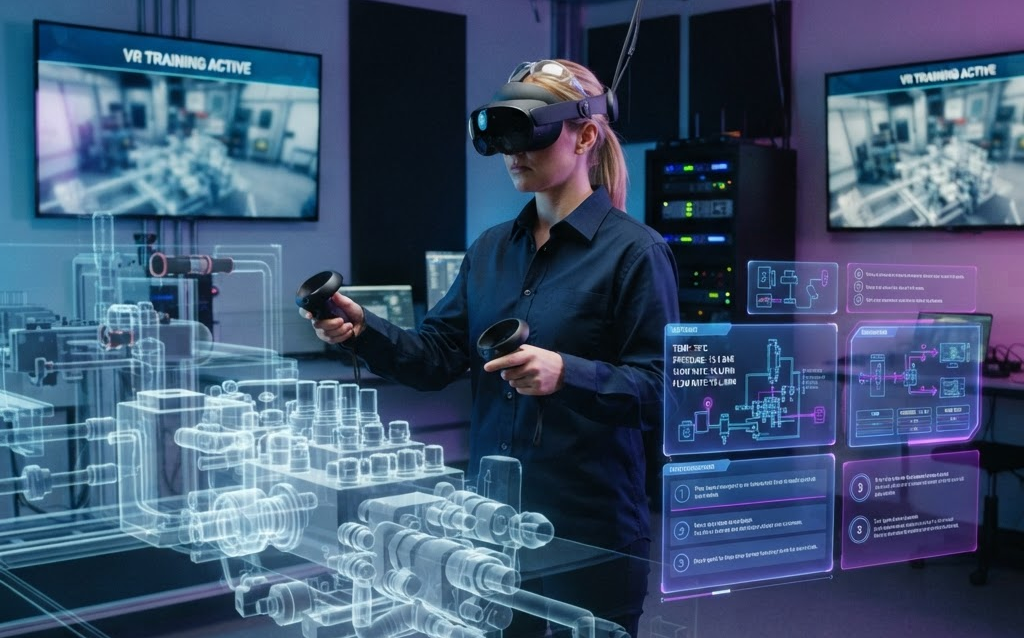
TL;DR: VR training simulations let employees practice dangerous, expensive, or complex tasks in a risk-free virtual environment—no real equipment, no safety risk, no travel. US companies using VR training report 40% faster onboarding, 60% better knowledge retention, and 50% lower training costs. From surgery to forklift operation, VR is transforming how America trains its workforce in 2026.
Traditional training has a fundamental problem: you can’t safely practice dangerous things until you’re competent, but you can’t become competent without practicing. VR training breaks this paradox by creating realistic simulations where mistakes have zero consequences. A surgeon-in-training can perform a virtual operation 100 times before touching a patient. A forklift operator can crash into virtual shelves without damaging real inventory. A pilot can engine failure procedures without risking a real aircraft.
How VR Training Works
A VR training simulation puts the employee in a fully immersive 3D environment using a headset (Meta Quest 3, HTC Vive, Apple Vision Pro). The employee interacts with virtual equipment, tools, and scenarios using hand controllers or natural hand tracking. The simulation responds to their actions in real time:
- Procedure training — step-by-step guidance through a task with real-time feedback
- Free practice — open-ended practice without guidance to build muscle memory
- Scenario simulation — emergency scenarios, equipment failures, and edge cases that can’t be safely practiced in real life
- Assessment — automated scoring of performance with detailed analytics
- Multiplayer training — teams train together in the same virtual environment from different locations
Where VR Training Delivers the Most ROI
Healthcare and Medical Training
VR lets medical professionals practice surgical procedures, emergency response, and patient examination without risk. A resident can perform a virtual appendectomy 50 times, building muscle memory and decision-making skills before their first real operation. Studies show VR-trained surgeons make 40% fewer errors in their first real procedures.
Manufacturing and Industrial Safety
Factory workers practice operating heavy machinery, handling hazardous materials, and responding to emergencies—all in VR. A forklift operator trains on a virtual forklift, learning controls, safety protocols, and spatial awareness without risking real equipment or inventory. Companies report 70% reduction in training-related accidents.
Oil, Gas, and Energy
Workers practice emergency shutdown procedures, fire response, and equipment maintenance on virtual oil rigs and refineries. These environments are too dangerous and expensive to replicate physically. VR simulations recreate the exact facility, letting workers train on the specific equipment they’ll use.
Aviation and Aerospace
Pilots have used flight simulators for decades, but VR makes simulation accessible to smaller airlines and training programs. VR cockpit simulations provide the same training value as $20 million physical simulators at a fraction of the cost.
Retail and Customer Service
Employees practice customer interactions, conflict resolution, and sales scenarios with virtual customers. A new hire at a bank practices handling an angry customer, a difficult transaction, or a security situation—building confidence before facing real customers.
Military and Law Enforcement
VR provides tactical training, shoot/don’t-shoot scenarios, and situational awareness practice without the cost of live ammunition or physical training facilities.
Cost Comparison: VR Training vs Traditional Training
| Factor | VR Training | Traditional Training |
|---|---|---|
| Initial development cost | $25,000–$150,000 per simulation | $5,000–$50,000 per course |
| Per-employee training cost | $0–$10 (no marginal cost) | $200–$2,000 (instructor, materials, travel) |
| Equipment needed | $300–$500 per headset | $10,000+ specialized equipment |
| Training time | 40% faster | Standard |
| Knowledge retention | 60% better (hands-on practice) | Standard (passive learning) |
| Safety risk | Zero (virtual environment) | Real risk during practice |
| Scalability | Unlimited (deploy to any location) | Limited by instructor availability |
ROI: What Companies Are Measuring
- 40% faster onboarding — new employees reach competency in days instead of weeks
- 60% better knowledge retention — hands-on VR practice beats classroom lectures
- 50% lower training costs — no instructors, no travel, no physical equipment
- 70% fewer training accidents — mistakes happen in VR, not in reality
- Unlimited practice — employees repeat scenarios until mastery, at no additional cost
- Consistent training quality — every employee gets the same training, every time
Cost of VR Training Development
| Simulation Type | Cost | Timeline |
|---|---|---|
| Single procedure simulation | $25,000–$80,000 | 6–12 weeks |
| Multi-scenario training program | $80,000–$250,000 | 12–24 weeks |
| Enterprise VR training platform | $200,000–$750,000+ | 6–12 months |
| Multiplayer collaborative training | $100,000–$400,000 | 16–32 weeks |
FAQ: VR Training Simulations
Do employees need special equipment for VR training?
Employees need a VR headset (Meta Quest 3 at $300–$500 is the most common choice) and a clear space to use it. No specialized training facility, no expensive equipment, no travel. The headset connects to a content management system that delivers training modules, tracks progress, and records performance analytics. Headsets can be shared across employees and locations.
How much does VR training cost to develop?
A single procedure simulation costs $25,000–$80,000. A multi-scenario training program with multiple modules costs $80,000–$250,000. Enterprise platforms with CMS, analytics, and multiplayer support cost $200,000–$750,000+. The per-employee training cost after development is near zero—deploying to 1,000 employees costs the same as deploying to 10.
Is VR training effective for knowledge retention?
Yes. Studies consistently show VR training produces 60% better knowledge retention than classroom or video-based training. The reason is experiential learning—doing the task in VR builds muscle memory and procedural knowledge that passive learning cannot. Employees who practice in VR perform better in real situations than those who only watched videos or read manuals.
Can VR training replace physical training entirely?
For most procedural and scenario-based training, VR can replace 70–90% of physical training. The remaining 10–30% involves physical equipment feel, material properties, and real-world variability that VR can’t fully replicate. The best approach is VR for initial training and practice, followed by a shorter physical session for final competency verification.
Can VR training track employee performance?
Yes. VR training platforms record detailed performance metrics: completion time, error count, step accuracy, decision-making speed, and consistency across repetitions. These analytics feed into your LMS (Learning Management System) and HR systems, providing data-driven training assessment that traditional training cannot match.
Getting Started with VR Training
- Identify your highest-risk, highest-cost training — the procedure where mistakes are most dangerous or expensive
- Start with one simulation — build a single procedure module and measure the ROI
- Use Meta Quest 3 — the most cost-effective headset with the largest content ecosystem
- Measure retention and performance — compare VR-trained vs traditionally-trained employees
- Scale from there — once the first simulation proves ROI, expand to full training programs
The companies adopting VR training in 2026 aren’t just saving money—they’re building better-trained, more confident employees who make fewer mistakes in high-stakes situations. The ROI is proven. The technology is ready. The question is which companies will lead and which will follow.
Ready to build VR training simulations? Contact Ink & Algorithm to discuss your project—we’ll help you create VR training that cuts costs and improves performance.