
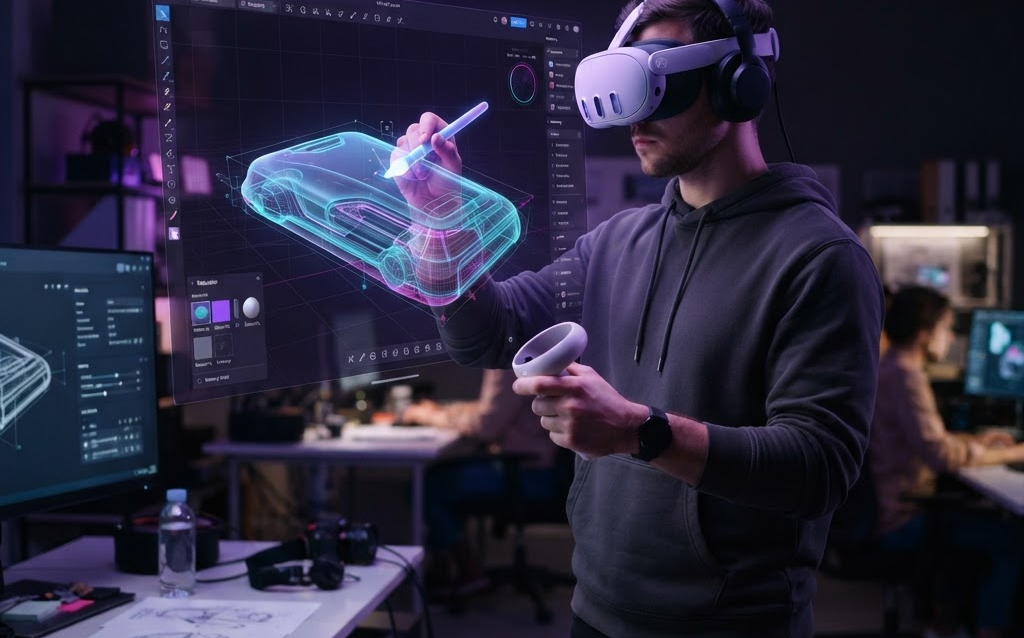
TL;DR: VR product design lets engineers and designers sculpt, test, and iterate on 3D product prototypes in virtual reality—before any physical manufacturing. Brands using VR prototyping report 50% fewer physical prototypes, 30% faster time-to-market, and $100,000+ saved per product development cycle. Here’s how VR is transforming product design in 2026.
Traditional product prototyping is expensive and slow. Each physical prototype costs $5,000–$50,000 and takes 2–4 weeks to produce. A typical product goes through 5–10 prototype iterations before final approval—that’s $50,000–$500,000 and months of delay per product.
VR product design eliminates most of this cost. Designers put on a headset and sculpt, modify, and test products in virtual 3D space. A prototype that took 3 weeks to physical produce can be created and iterated in VR in hours—for free.
How VR Product Design Works
Virtual Sculpting and Modeling
Designers use VR controllers or hand tracking to shape 3D forms in virtual space—like sculpting clay, but digital. Push, pull, smooth, and carve geometry with natural hand movements. Tools like Gravity Sketch and Adobe Substance 3D Modeler let designers create complex 3D forms in VR faster than traditional CAD software.
Ergonomic Testing at Human Scale
In VR, you can hold a virtual product at real scale and test its ergonomics. A designer prototyping a game controller can hold it in VR, feel its proportions, and check button reach—before any physical unit exists. This catches ergonomic issues early, when they’re free to fix.
Design Review and Collaboration
Teams gather in a shared VR space to review designs. The designer presents the 3D model, stakeholders walk around it at scale, and everyone can point, measure, and suggest changes in real time. This is far more effective than reviewing 2D renders on a screen—everyone sees the product in 3D and at true scale.
Material and Color Testing
Apply different materials, colors, and finishes to the virtual prototype and see the result instantly under different lighting conditions. Test how a product looks in retail lighting, outdoor sunlight, and home environments—all in VR.
Function Simulation
Beyond appearance, VR can simulate how products work. Mechanical assemblies can be tested virtually—doors opening, mechanisms moving, parts fitting together. This catches interference and clearance issues before physical prototyping.
The VR Product Design Workflow
- Concept design in VR — sculpt initial forms in virtual space (Gravity Sketch, Adobe Substance)
- Refine in CAD — export VR concept to SolidWorks, Fusion 360, or Rhino for engineering refinement
- Ergonomic review in VR — test the product at human scale for comfort and usability
- Design review — stakeholders review in shared VR session
- Material and color selection — test finishes in VR under multiple lighting conditions
- Function simulation — test mechanical assemblies and clearances virtually
- Final physical prototype — produce one physical prototype for final validation
This workflow reduces physical prototypes from 5–10 to 1–2 per product development cycle.
VR Design Tools in 2026
| Tool | Best For | Price |
|---|---|---|
| Gravity Sketch | Concept design, automotive, footwear | $25/month |
| Adobe Substance 3D Modeler | Organic sculpting, product forms | $30/month (Creative Cloud) |
| NVIDIA Omniverse | Enterprise collaboration, CAD review | Free (enterprise add-ons) |
| Unity + VR | Custom design review apps | Free–$2,000/year |
| Unreal Engine 5 | Photorealistic product reviews | Free (royalty >$1M) |
| ShapesXR | Collaborative design sessions | $10–$25/user/month |
ROI: What Brands Are Measuring
- 50% fewer physical prototypes — most iterations happen in VR, not in the factory
- 30% faster time-to-market — virtual prototyping is days, not weeks per iteration
- $100,000+ saved per product — eliminating 4–8 physical prototypes at $10K–$50K each
- Better designs — ergonomic testing in VR catches issues that 2D reviews miss
- Faster stakeholder approval — VR design reviews are more effective than screen reviews
Cost of VR Product Design Implementation
| Scope | Cost | Timeline |
|---|---|---|
| Starter kit (headsets + tools) | $1,500–$5,000 per designer | 1–2 days |
| Custom VR design review app | $20,000–$80,000 | 4–10 weeks |
| Enterprise VR design platform | $80,000–$300,000 | 8–20 weeks |
| VR + CAD integration pipeline | $30,000–$120,000 | 6–14 weeks |
FAQ: VR for Product Design
Do I need to replace my CAD software with VR?
No. VR complements CAD—it doesn’t replace it. Most workflows use VR for concept design, ergonomic review, and stakeholder presentations, then export to traditional CAD (SolidWorks, Fusion 360) for engineering refinement. VR accelerates the early stages of design; CAD handles the technical precision.
Which VR headset is best for product design?
Meta Quest 3 ($300–$500) is the most popular choice—it’s affordable, standalone, and supports all major design tools. For enterprise teams, HTC Vive XR Elite or Apple Vision Pro offer higher fidelity and better collaboration features. Most design tools work on Meta Quest, making it the safest starting point.
How much does VR product design cost?
Starting costs are low: $1,500–$5,000 per designer for a headset and software subscription. Custom VR design review apps cost $20,000–$80,000. Enterprise platforms with CAD integration and multi-user collaboration cost $80,000–$300,000. The ROI typically comes from eliminated physical prototype costs.
Can VR replace physical prototyping entirely?
For most of the design process, yes—80–90% of iterations can happen in VR. The final 10–20% requires a physical prototype to validate material feel, weight, and real-world performance. The goal isn’t to eliminate physical prototyping but to reduce it from 5–10 prototypes to 1–2 per product.
Can my existing CAD files work in VR?
Yes. Most VR design tools import standard CAD formats (STEP, IGES, SolidWorks, Fusion 360). NVIDIA Omniverse and Unreal Engine’s Datasmith plugin handle CAD import natively. Your existing CAD models can be reviewed in VR without rebuilding them.
Getting Started
- Buy a Meta Quest 3 for each designer ($300–$500 each)
- Install Gravity Sketch or Adobe Substance 3D Modeler
- Run a pilot project — design one product entirely in VR and compare to your traditional workflow
- Measure prototype reduction — count how many physical prototypes you eliminated
- Scale to the full team — once ROI is proven, deploy VR design across all product lines
Ready to bring VR into your product design process? Contact Ink & Algorithm to discuss your project—we’ll help you build a VR design workflow that cuts prototyping costs and accelerates time-to-market.