
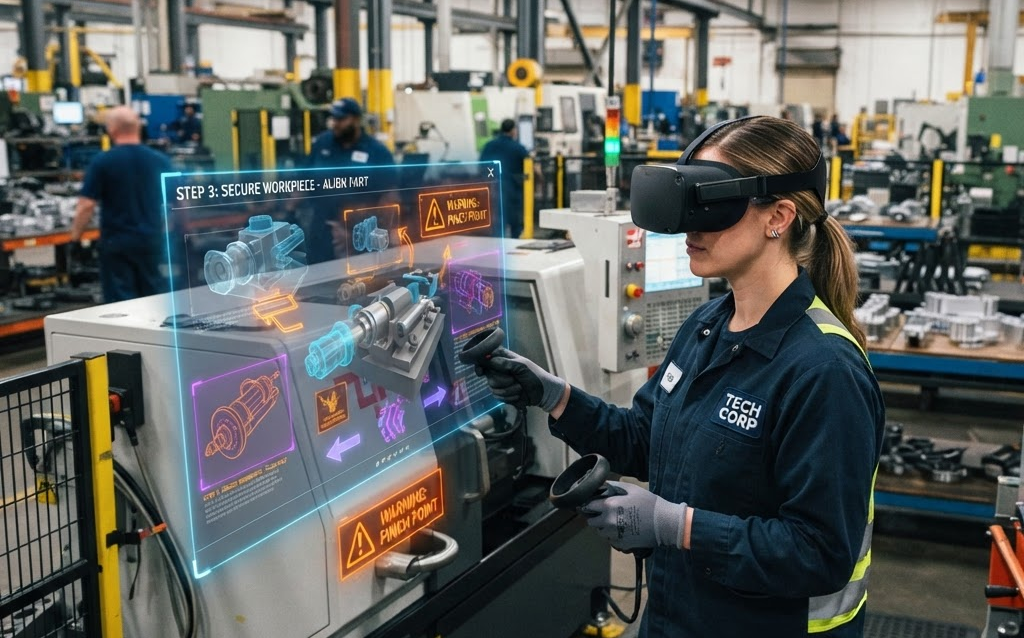
TL;DR: VR manufacturing training lets factory workers practice operating machinery, following safety protocols, and handling emergencies in risk-free virtual simulations. US manufacturers using VR training report 50% faster onboarding, 60% fewer training accidents, and 40% lower training costs. Here’s how VR is transforming factory workforce development in 2026.
Manufacturing training is expensive, slow, and risky. New workers need weeks of supervised practice on real machinery—machinery that costs millions and can’t be taken offline for training. Safety training requires simulated emergencies that are dangerous to replicate. VR solves all of this by creating realistic factory simulations where workers train without risk to themselves or equipment.
What VR Manufacturing Training Includes
- Machinery operation training — practice starting, operating, and shutting down equipment in a virtual factory
- Safety protocol drills — simulate fire, chemical spill, equipment failure, and evacuation scenarios
- Assembly line training — learn step-by-step assembly procedures with visual guides and feedback
- Quality inspection training — practice identifying defects and measuring tolerances on virtual parts
- Lockout/tagout procedures — practice energy isolation and equipment maintenance safely
- Forklift and crane operation — practice heavy equipment operation without risking damage
- Performance tracking — measure completion time, error rate, and protocol adherence
Why Manufacturers Need VR Training
Zero-Risk Training Environment
In VR, a trainee can make mistakes without consequences. A wrong button press, a missed safety step, or a forklift collision in VR costs nothing. The same mistake in a real factory can cost thousands in equipment damage—or worse, cause injury.
Faster Onboarding
Traditional manufacturing onboarding takes 4–8 weeks of supervised training. VR compresses this to 1–2 weeks—workers arrive on the factory floor already familiar with equipment operation and safety procedures. Manufacturers report 50% faster onboarding.
Training Without Production Downtime
Training on real machinery requires taking equipment offline. VR training happens entirely in virtual space—real machinery stays in production. This eliminates the hidden cost of production downtime during training.
ROI of VR Manufacturing Training
| Metric | Traditional Training | VR Training |
|---|---|---|
| Onboarding time | 4–8 weeks | 1–2 weeks |
| Training accidents | Baseline | 60% fewer |
| Cost per trainee | $2,000–$5,000 | $500–$1,500 |
| Equipment downtime | Required | None |
| Knowledge retention | 40–60% | 75–90% |
Cost of VR Manufacturing Training
| Scope | Cost | Timeline |
|---|---|---|
| Single-machine VR training module | $20,000–$60,000 | 4–10 weeks |
| Multi-machine training platform | $80,000–$300,000 | 10–20 weeks |
| Full factory simulation (safety + operations) | $150,000–$500,000+ | 16–32 weeks |
| VR headsets (Meta Quest 3 per trainee) | $300–$500 each | 1–2 days |
FAQ: VR Manufacturing Training
How much does VR manufacturing training cost?
A single-machine VR training module costs $20,000–$60,000. A multi-machine platform costs $80,000–$300,000. A full factory simulation with safety and operations training costs $150,000–$500,000+. VR headsets (Meta Quest 3) cost $300–$500 per trainee.
Do workers need VR experience to use the training?
No. VR training modules are designed for workers with no VR experience. Tutorials and guided interactions make the experience intuitive. Most workers are comfortable in VR within 10–15 minutes of their first session.
Can VR training replace all physical training?
VR replaces 70–80% of training—procedure learning, safety drills, and equipment familiarization. The remaining 20–30% (physical feel of controls, real-world material handling) still requires some hands-on practice. VR reduces physical training time from weeks to days.
How do you track training progress in VR?
VR training platforms track completion time, error rate, protocol adherence, and decision-making. Managers see dashboards showing each trainee’s performance, areas needing improvement, and certification status. This data-driven approach is impossible with traditional training.
Which VR headset is best for manufacturing training?
Meta Quest 3 ($300–$500) is the most popular choice—standalone, affordable, and supports all major training platforms. For enterprise deployments, HTC Vive XR Elite or Pico 4 Enterprise offer better management features. Most manufacturing training works well on Quest 3.
Getting Started
- Identify your highest-risk training — the procedure where mistakes are most costly
- Build one VR training module — focus on a single machine or safety protocol
- Measure onboarding speed and error reduction — compare VR-trained vs traditionally-trained workers
- Scale to full factory — once ROI is proven, expand to all training scenarios
Ready to bring VR training to your factory? Contact Ink & Algorithm to discuss your project—we’ll help you create immersive training that upskills workers faster and safer.