
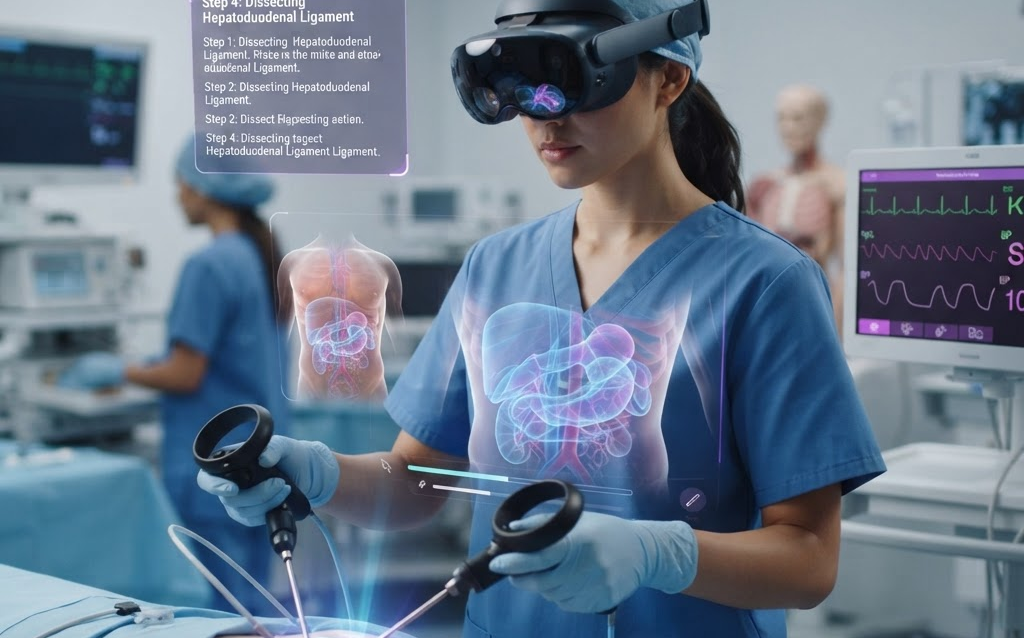
TL;DR: VR healthcare training lets medical staff practice surgeries, emergency response, and patient care in risk-free virtual simulations. US hospitals using VR training report 50% faster skill acquisition, 40% fewer medical errors, and 60% lower training costs. Here’s how VR is transforming medical education in 2026.
Medical training has always required a trade-off between realism and safety. Practicing on real patients is dangerous. Practicing on mannequins lacks realism. VR breaks this trade-off—medical staff practice in fully realistic virtual environments where mistakes have zero consequences and scenarios can be repeated unlimited times.
What VR Healthcare Training Includes
- Surgical simulation — practice procedures with realistic anatomy, tissue response, and surgical tools
- Emergency response drills — simulate cardiac arrest, trauma, mass casualty, and code blue scenarios
- Patient communication — practice bedside manner with virtual patients of varying temperaments
- Anatomy education — explore the human body in 3D, dissect layers, and understand spatial relationships
- Equipment operation — learn to operate MRI, CT, and ventilation machines virtually
- Hand hygiene and infection control — practice protocols with feedback on compliance
- Performance tracking — measure decision time, accuracy, and protocol adherence
Why Hospitals Need VR Training
Zero-Risk Skill Practice
A trainee surgeon can practice a procedure 100 times in VR before touching a real patient. Each repetition builds muscle memory and confidence. Mistakes in VR cost nothing—mistakes in real surgery can be catastrophic.
50% Faster Skill Acquisition
Traditional surgical training requires observing and assisting before operating. VR lets trainees practice the full procedure from day one. Hospitals using VR training report 50% faster time to competency—residents reach independent operating ability in months, not years.
Consistent, Standardized Training
Every trainee gets the same VR scenario with the same patient presentation and complications. This standardization is impossible with real patients, where every case is different. VR ensures every staff member is trained to the same standard.
ROI of VR Healthcare Training
| Metric | Traditional Training | VR Training |
|---|---|---|
| Time to competency | 6–12 months | 3–6 months |
| Medical errors | Baseline | 40% fewer |
| Training cost per resident | $10,000–$30,000 | $2,000–$8,000 |
| Repetition possible | Limited (patient availability) | Unlimited |
Cost of VR Healthcare Training
| Scope | Cost | Timeline |
|---|---|---|
| Single procedure VR module | $30,000–$80,000 | 6–12 weeks |
| Multi-procedure training platform | $100,000–$400,000 | 12–24 weeks |
| Full hospital training suite | $200,000–$750,000+ | 20–36 weeks |
| VR headsets per trainee | $300–$1,500 | 1–2 days |
FAQ: VR Healthcare Training
How much does VR healthcare training cost?
A single procedure VR training module costs $30,000–$80,000. A multi-procedure platform costs $100,000–$400,000. A full hospital training suite costs $200,000–$750,000+. VR headsets cost $300–$1,500 per trainee.
Can VR replace cadaver training?
VR complements cadaver training but doesn’t fully replace it. VR provides unlimited repetition and scenario variety, while cadavers provide real tissue feel. Most programs use VR for 70–80% of practice and cadavers for the final 20–30% to validate tactile skills.
Is VR medical training validated by medical boards?
Yes. The American Board of Surgery and AMA have recognized VR simulation as a valid training tool. Multiple peer-reviewed studies show VR-trained residents perform better on real procedures. Several VR training modules have FDA clearance for specific procedures.
Which VR headset is best for medical training?
Meta Quest 3 ($300–$500) works for most training scenarios. For surgical simulation requiring precise hand tracking, HTC Vive XR Elite or Varjo XR-4 offer higher fidelity. Most hospitals standardize on Meta Quest for cost efficiency.
Can VR training track resident performance?
Yes. VR platforms track decision time, accuracy, tool usage, and protocol adherence. Program directors see dashboards showing each resident’s progress, areas needing improvement, and readiness for real procedures.
Getting Started
Start with your highest-risk procedure—the one where training errors are most costly. Build a VR module for that procedure, measure skill acquisition speed, and compare error rates between VR-trained and traditionally-trained residents.
Ready to bring VR training to your hospital? Contact Ink & Algorithm to discuss your project—we’ll help you create immersive medical training that improves outcomes.