
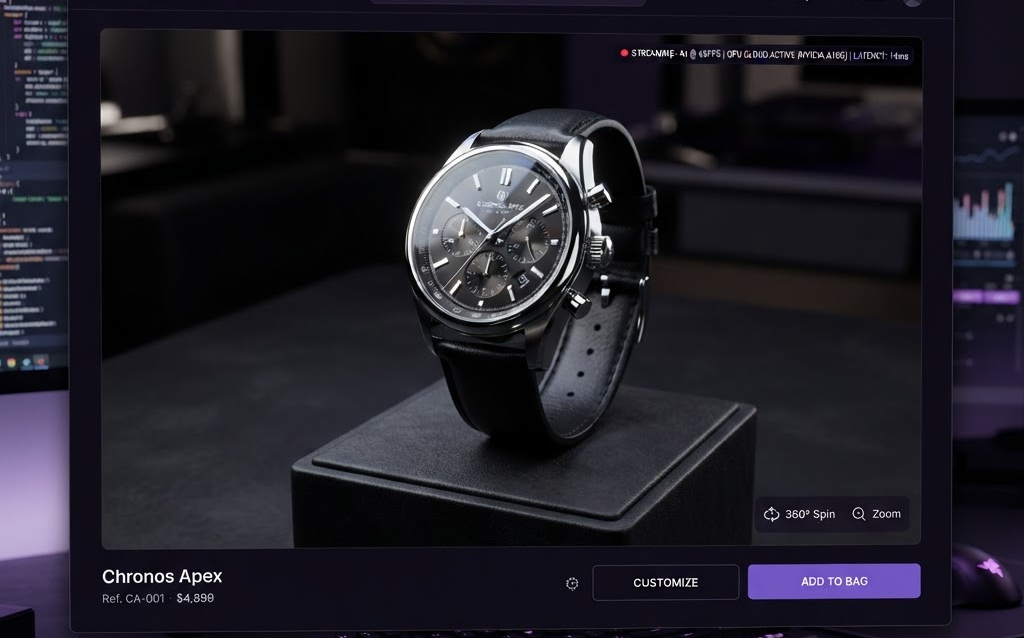
TL;DR: Unreal Engine 5 Pixel Streaming renders photorealistic 3D product experiences on cloud GPUs and streams them to any browser—no download, no powerful device needed. Brands like Audi, Porsche, and IKEA use Pixel Streaming to deliver film-quality configurators that run on any phone. Here’s how the technology works, what it costs, and when to use it in 2026.
The challenge with Unreal Engine 5 is that it requires a powerful GPU to run. A customer browsing a car configurator on a $300 laptop can’t render real-time ray tracing locally. Pixel Streaming solves this by running Unreal Engine on cloud GPUs (NVIDIA GPUs in data centers) and streaming the rendered output to the customer’s browser as video—while sending their mouse and keyboard inputs back to the server.
The result: the customer gets a film-quality 3D experience in their browser, with real-time ray tracing, photorealistic materials, and smooth 60fps interaction—regardless of their device’s capabilities. All the heavy lifting happens in the cloud.
How Pixel Streaming Works
The Architecture
- Cloud GPU server — Unreal Engine 5 runs on an NVIDIA GPU in a data center (AWS, Azure, or specialized GPU cloud providers)
- Rendering — the server renders the 3D scene at 60fps with ray tracing, Lumen global illumination, and Nanite geometry
- Streaming — the rendered video is encoded (H.264 or H.265) and streamed to the customer’s browser via WebRTC
- Input — the customer’s mouse, keyboard, and touch inputs are sent back to the server in real time
- Browser — the customer sees the 3D experience in their browser as a video stream with interactive controls overlaid
The customer’s device needs only a browser and a decent internet connection (10+ Mbps). The GPU work happens entirely in the cloud.
Why Brands Choose Pixel Streaming
Photorealistic Quality on Any Device
Pixel Streaming delivers Unreal Engine 5 quality—ray-traced reflections, accurate materials, film-grade lighting—to every customer, regardless of their hardware. A customer on a Chromebook gets the same visual experience as one on a $3,000 gaming PC.
No App Download
Everything runs in the browser. No app to download, no plugin to install, no system requirements to check. The customer opens a URL and the 3D experience loads. This zero-friction delivery is critical for e-commerce conversion.
Unlimited Complexity
Because rendering happens on a powerful cloud GPU, the 3D scene can be as complex as needed—full automotive interiors, architectural environments, multiple product configurations—without performance concerns. The browser device never struggles.
Cross-Platform Consistency
Every customer sees the same quality. There’s no “your device isn’t powerful enough” message. The experience is identical on iOS, Android, Windows, Mac, and Linux browsers.
Use Cases for Pixel Streaming in 2026
Automotive Configurators
Audi, Porsche, and Mercedes-Benz use Pixel Streaming for their car configurators. Customers configure paint, wheels, and interior in photorealistic 3D with real-time ray tracing. The reflection of the showroom environment on the car’s paint is accurate to real-world physics—something that can’t be achieved with standard web rendering.
Premium Product Configurators
High-end watches, jewelry, and furniture brands use Pixel Streaming to show products with photorealistic materials. A diamond’s fire and brilliance, a leather’s grain and sheen, a metal’s reflective properties—all rendered with physical accuracy.
Virtual Showrooms and Architecture
Real estate developers and architecture firms use Pixel Streaming to deliver immersive virtual walkthroughs of buildings. Clients walk through photorealistic spaces with accurate lighting, materials, and proportions—no headset needed, just a browser.
Interactive Product Launches
For major product launches, brands create Pixel Streaming experiences that let customers explore a new product in 3D—rotating, zooming, and activating features—with film-quality visuals. This creates a premium launch experience that static images can’t match.
Cost of Pixel Streaming
Development Cost
| Scope | Cost | Timeline |
|---|---|---|
| Single product configurator (Unreal + Pixel Streaming) | $80,000–$250,000 | 10–20 weeks |
| Multi-product platform | $200,000–$500,000+ | 16–32 weeks |
| Virtual showroom (full environment) | $100,000–$400,000 | 12–24 weeks |
Streaming Cost (Ongoing)
| Provider | GPU Type | Cost per Hour | Cost per Session (10 min) |
|---|---|---|---|
| AWS (NVIDIA T4) | T4 (entry) | $0.50–$0.90 | $0.08–$0.15 |
| AWS (NVIDIA A10G) | A10G (good) | $1.00–$1.50 | $0.17–$0.25 |
| Azure (NVIDIA T4) | T4 (entry) | $0.50–$1.00 | $0.08–$0.17 |
| NVIDIA GFN / Pure Web | RTX (premium) | $1.00–$3.00 | $0.17–$0.50 |
| Specialized (PureWeb, Polystream) | Various | $0.50–$2.00 | $0.08–$0.33 |
For a configurator with 10,000 sessions/month at 10 minutes each, streaming costs $800–$5,000/month depending on GPU tier.
When to Use Pixel Streaming vs Standard Web 3D
| Factor | Pixel Streaming | Three.js (client-side) |
|---|---|---|
| Visual quality | Film-grade (ray tracing) | Very good (no ray tracing) |
| Device requirements | Any device with browser + 10Mbps | Any device with WebGL support |
| Cost | $80K+ build + $0.10–$0.50/session | $30K+ build + $0/session |
| Latency | 50–100ms (network dependent) | 0ms (local rendering) |
| Best for | Premium brands, automotive, jewelry | Most e-commerce configurators |
Rule of thumb: Use Three.js for most e-commerce configurators. Use Pixel Streaming when visual quality is a brand differentiator (premium automotive, luxury goods, architecture) and the per-session cost is justified by the product’s price point.
FAQ: Unreal Engine Pixel Streaming
What internet speed is needed for Pixel Streaming?
A minimum of 10 Mbps download speed is recommended for smooth 1080p streaming at 60fps. At 20+ Mbps, the experience is nearly indistinguishable from local rendering. The stream uses adaptive bitrate—slower connections get lower resolution but still maintain interactivity.
How much does Pixel Streaming cost per customer?
Each streaming session costs $0.08–$0.50 per 10-minute session, depending on the GPU tier used. For a configurator with 10,000 monthly sessions averaging 10 minutes each, total streaming costs range from $800 to $5,000/month. Premium GPUs (RTX-class) cost more but deliver higher quality.
Can Pixel Streaming handle thousands of simultaneous users?
Yes, with proper infrastructure scaling. Each concurrent user requires a dedicated GPU instance. Auto-scaling groups on AWS or Azure can spin up additional GPU instances based on traffic. For large-scale events (product launches), pre-provision capacity to handle traffic spikes. Most deployments use GPU pools that scale between 10–100 concurrent users.
Is Pixel Streaming better than Three.js for product configurators?
It depends on your priorities. Pixel Streaming offers significantly better visual quality (ray tracing, Lumen) but costs $0.10–$0.50 per session. Three.js is free per session but can’t match Unreal’s visual fidelity. For premium brands where visual quality drives sales (automotive, luxury), Pixel Streaming is worth the cost. For most e-commerce, Three.js is sufficient.
Do customers notice they’re watching a video stream?
If the internet connection is good (20+ Mbps), the experience feels like local rendering—smooth 60fps with minimal latency (50–100ms). On slower connections, there may be slight quality reduction or latency. The best implementations use adaptive streaming to maintain smooth interaction regardless of connection quality.
Getting Started with Pixel Streaming
- Build the 3D experience in Unreal Engine 5 — model, materials, lighting, and interaction
- Set up cloud GPU infrastructure — AWS, Azure, or specialized GPU cloud providers
- Configure Pixel Streaming — Unreal’s built-in Pixel Streaming plugin handles the streaming protocol
- Deploy a web frontend — a simple page that receives the stream and sends user input
- Test across devices — verify quality on phones, tablets, and low-end laptops
Pixel Streaming is the technology that makes Unreal Engine 5 viable for web-based e-commerce. It removes the device limitation—every customer gets the same premium experience regardless of their hardware. For brands where visual quality is a competitive advantage, Pixel Streaming is the delivery mechanism that makes it possible.
Ready to build an Unreal Engine Pixel Streaming experience? Contact Ink & Algorithm to discuss your project—we’ll help you deliver film-quality 3D to every customer’s browser.