
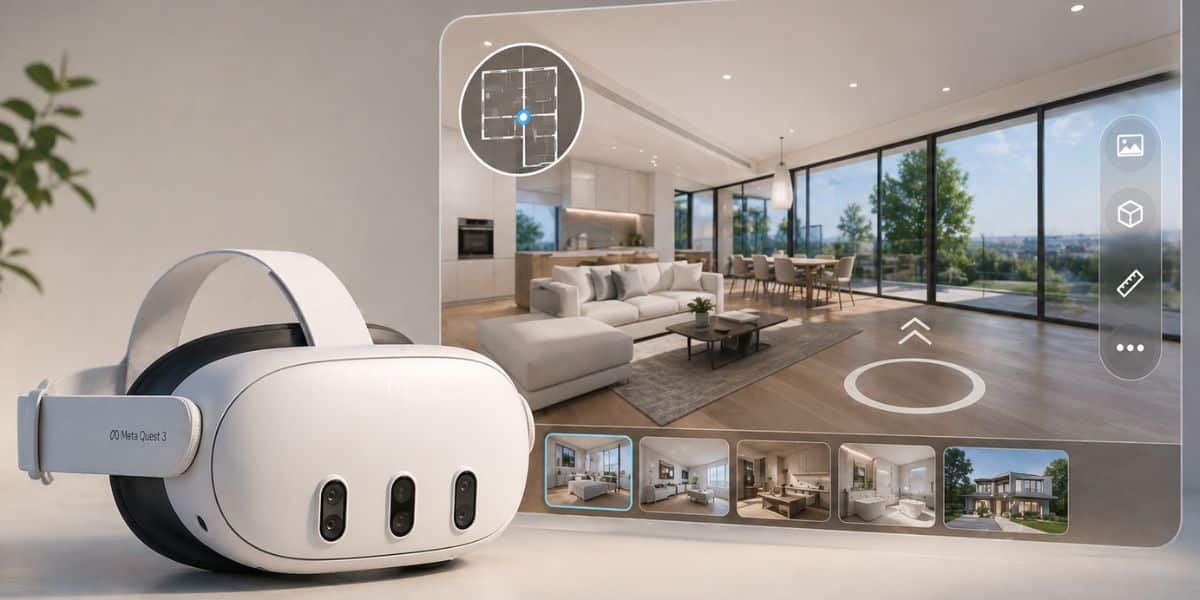
TL;DR: Top Virtual Reality (VR) Software for Real Estate Virtual Tours. Learn about costs, features, ROI, and how US brands use this technology in 2026.
Imagine walking through your dream home — opening closet doors, stepping out onto the balcony, and feeling the afternoon light fill the living room — all without leaving your couch. That’s exactly what virtual reality VR software for real estate virtual tours makes possible today. And for real estate professionals, this isn’t just a cool gadget anymore. It’s a serious competitive advantage.
The real estate market has always been about location, location, location. But in today’s fast-moving, digitally driven world, experience, experience, experience is quickly becoming the new mantra. Buyers are no longer content with a handful of flat photos and a Sunday afternoon open house. They want to feel a property before they commit to a viewing — and certainly before they sign any paperwork.
Why VR Is Transforming Real Estate in 2026
This is where virtual reality (VR) technology for real estate has stepped in and changed everything. According to industry analysts, listings that feature immersive virtual property tours receive significantly more online engagement than those with static imagery alone. Buyers spend more time exploring the listing, ask more informed questions, and tend to move through the decision-making process faster.
For real estate agents and developers, VR virtual tours solve a genuine problem: how do you show a property to a buyer in Tokyo, London, or Dubai when the property is in Chicago? How do you showcase a floor plan that doesn’t yet exist on a construction site? How do you differentiate a listing in a crowded market? The answer, increasingly, is immersive 3D virtual reality real estate tours.
| Industry Statistics: VR in Real Estate |
| • 3× more inquiries on listings with VR virtual tours vs. photos only |
| • 74% of buyers say immersive tours help them make faster purchase decisions |
| • 40% reduction in unnecessary property viewings for agents using VR |
| • 25–30% faster average sale time reported by agencies using VR property tours |
Beyond just selling existing properties, VR technology also empowers property developers to sell off-plan homes and commercial spaces with confidence. Prospective buyers can walk through a development that exists only as a blueprint — experiencing room sizes, materials, finishes, and layouts as though the building were already complete. This has become one of the most powerful use cases of real estate VR software in 2026.
What to Look for in Real Estate VR Software
Before diving into the top platforms, it’s worth understanding what separates truly great VR software for real estate virtual tours from average alternatives. Not all VR tools are built equal — and choosing the wrong platform can mean poor image quality, frustrated buyers, and wasted budget.
Here are the key features to evaluate when selecting virtual reality property tour software for your agency or development firm:
- Image & render quality — High-resolution 360° photography or photorealistic 3D rendering is non-negotiable. Blurry, pixelated environments break buyer trust instantly.
- Ease of use — Can your team create tours without a technical background? Look for drag-and-drop builders and guided workflows.
- Headset compatibility — The best platforms support Oculus/Meta Quest, HTC Vive, and browser-based experiences so buyers can engage without specialist equipment.
- CRM & MLS integration — Seamless connection to your existing real estate tools saves enormous time.
- Analytics & reporting — Understanding how buyers navigate your virtual tours provides invaluable marketing data.
- White-labeling — Agency branding within the tour experience builds professionalism and trust.
Top VR Software for Real Estate Virtual Tours
| 01 | Matterport | Best Overall |
| When most real estate professionals think of virtual property tours, Matterport is the name that immediately comes to mind — and for very good reason. Matterport has essentially defined the modern standard for immersive 3D real estate tours. Using its proprietary Pro3 camera or compatible third-party 360° cameras, it generates stunning, dimensionally accurate digital twins of any space. | ||
| What makes Matterport exceptional is its “dollhouse view” — a fully navigable 3D model of the entire property that buyers can examine from the outside before stepping inside virtually. Every room, every hallway, every closet becomes explorable. Agents can add information hotspots — clicking on a window reveals the energy rating, clicking on a kitchen surface reveals the countertop material. It transforms a passive viewing into an active discovery experience. | ||
| Matterport also integrates with major real estate platforms including Zillow, Realtor.com, and multiple MLS systems, making it a genuinely practical tool rather than just a novelty. Its analytics dashboard tells agents exactly which rooms buyers explore most and where they drop off — data that can reshape how a home is staged and marketed. | ||
| Key Features: | ||
| ✓ Industry-leading 3D digital twin technology | ||
| ✓ Dollhouse, floorplan, and walkthrough viewing modes | ||
| ✓ Works on web browsers, VR headsets, and mobile devices | ||
| ✓ Deep integration with Zillow, CoStar, and MLS platforms | ||
| ✓ AI-powered automated room labeling and measurements | ||
| ✓ White-label embedding available for agency websites | ||
| 02 | Kuula | Best Value |
| If Matterport is the premium flagship, Kuula is the smart, budget-conscious alternative that punches well above its weight for real estate virtual tour creation. Kuula is a cloud-based platform that allows agents to upload 360° photos — taken with any compatible camera — and assemble them into fully navigable virtual tours in minutes. | ||
| What Kuula lacks in raw 3D scanning capability it more than compensates for with its simplicity, speed, and affordability. The platform’s editor is genuinely intuitive. You can add hotspots that link to other rooms, embed videos, include floor plans, and even drop in ambient audio to enhance the atmosphere of a home. | ||
| Importantly, Kuula tours are fully embeddable on any website and shareable via social media. A potential buyer can click a link in an Instagram story and be walking through a property on their phone within seconds. That kind of frictionless accessibility dramatically increases the reach of any listing. | ||
| Key Features: | ||
| ✓ Upload 360° photos from any compatible camera | ||
| ✓ Drag-and-drop tour builder with no coding required | ||
| ✓ Custom branding and white-label options | ||
| ✓ Hotspots, floor plans, and audio integration | ||
| ✓ Embed-ready and social media shareable | ||
| ✓ Affordable monthly subscription plans starting from $16/month | ||
| 03 | Roundme | Best for Global Sharing |
| Roundme is a platform that has carved out a strong niche in the virtual real estate tour space by focusing on high-quality, community-enabled sharing of 360° experiences. The platform allows real estate professionals to create rich virtual spaces that can be distributed to a global audience through its public sharing network as well as private, password-protected links for exclusive listings. | ||
| For luxury real estate agents in particular, Roundme offers something genuinely special: the ability to present a property as a curated visual story rather than just a collection of rooms. You can sequence the tour narrative — drawing the viewer’s eye from the grand entrance hall through the living spaces to the outdoor entertaining area — in a way that feels more like high-end property journalism than a standard listing tour. | ||
| Key Features: | ||
| ✓ High-fidelity 360° tour creation and hosting | ||
| ✓ VR headset compatible including Oculus and HTC Vive | ||
| ✓ Password-protected tours for exclusive listings | ||
| ✓ Intuitive storytelling and hotspot system | ||
| ✓ Broad device compatibility including mobile and tablet | ||
| 04 | iStaging | Best for AR + VR Combined |
| iStaging is one of the most versatile tools in the real estate virtual reality software landscape precisely because it bridges the gap between virtual reality and augmented reality in a single platform. This dual capability makes it particularly compelling for real estate developers and furniture brands wanting to offer buyers a complete ‘what if’ experience. | ||
| With iStaging, a buyer can take a VR tour of a property and then, using the AR functionality, place virtual furniture within the actual space through their smartphone camera. Want to see whether a particular sofa fits in the living room? Point your phone at the floor and place it there virtually. This kind of end-to-end immersive experience is where VR and AR technology for real estate becomes genuinely transformative. | ||
| iStaging also supports VR headset viewing, 360° video tours, and has a dedicated iPad stand mount system that makes in-agency property viewing impressively professional. | ||
| Key Features: | ||
| ✓ Combines VR tours with AR furniture staging | ||
| ✓ 360° video and photo tour support | ||
| ✓ Compatible with Meta Quest, iOS, and Android | ||
| ✓ Real-time property customization for buyers | ||
| ✓ Works offline for in-agency headset demonstrations | ||
| ✓ Suitable for off-plan property sales | ||
| 05 | EyeSpy360 | Best for Live Virtual Tours |
| EyeSpy360 stands apart from most other VR real estate tour platforms by offering a genuinely innovative feature: the ability to host live, guided virtual tours. Rather than a buyer navigating a recorded environment alone, an agent can lead them through the property in real time — pointing out features, answering questions, and creating a human connection within an entirely digital space. | ||
| For international buyers who cannot visit in person, this hybrid approach — the visual richness of a 3D VR property tour combined with the personal touch of a live agent — is extraordinarily effective. Studies show that buyers engaged in live virtual tours are significantly more likely to request an in-person viewing or make an offer than those who simply browse a static tour independently. | ||
| EyeSpy360 also integrates with popular real estate portals and offers robust floor plan tools, measurement overlays, and embedded video capabilities. Its tours work seamlessly on desktop, mobile, and VR headsets, ensuring maximum accessibility. | ||
| Key Features: | ||
| ✓ Live guided virtual tour functionality | ||
| ✓ Co-browsing with agent and buyer simultaneously | ||
| ✓ Measurement tools and floor plan overlays | ||
| ✓ Works on desktop, mobile, and VR headsets | ||
| ✓ Real estate portal integration | ||
| ✓ Built-in analytics and engagement tracking | ||
| 06 | Unreal Engine (with Real Estate Plugins) | Best for Off-Plan |
| For large-scale real estate developers and architectural firms, Unreal Engine — the same technology used to render cinematic video games and Hollywood film sets — has become a genuinely viable and extraordinarily powerful tool for creating photorealistic VR real estate experiences for properties that don’t yet exist. | ||
| When a developer wants to sell an apartment tower before a single floor has been poured, they can commission a fully interactive Unreal Engine virtual environment where prospective buyers walk through their future penthouse at sunset, change the wall colors in real time, open the sliding terrace doors, and look out across a photorealistic city skyline. This is VR real estate marketing at its absolute highest level of sophistication. | ||
| While Unreal Engine requires custom development work — typically delivered by specialist studios like Ink N Algorithm (inknalgorithm.com/virtual-reality-vr/) — the investment is justified for premium developments where the ability to pre-sell units at full price before construction completion can save enormous carrying costs. | ||
| Key Features: | ||
| ✓ Photorealistic rendering for off-plan developments | ||
| ✓ Real-time material and finish customization | ||
| ✓ Full VR headset immersion with haptic support | ||
| ✓ Ideal for luxury apartments, commercial spaces, and developments | ||
| ✓ Custom-built to exact architectural specifications | ||
| ✓ Scalable to multi-floor, multi-unit buildings | ||
| 07 | Zillow 3D Home | Best for MLS Agents |
| For agents already embedded in the Zillow ecosystem, Zillow 3D Home is a practical, accessible, and free entry point into virtual reality property tours. Using nothing more than a 360° camera or even a compatible smartphone, agents can create and upload tours directly to their Zillow listings with minimal effort. | ||
| What Zillow 3D Home lacks in raw sophistication it compensates for in sheer distribution — your virtual tour is immediately visible to the tens of millions of buyers actively browsing Zillow every month. Listings featuring Zillow 3D Home tours are algorithmically prioritized on the platform, meaning more organic visibility at zero additional cost. | ||
| Key Features: | ||
| ✓ Free to use for Zillow Premier Agents | ||
| ✓ Created with smartphone or Ricoh Theta camera | ||
| ✓ Integrated directly into Zillow listings | ||
| ✓ Prioritized placement in Zillow search results | ||
| ✓ Simple, guided creation process | ||
Quick Comparison: Top VR Real Estate Software
Here’s a fast reference comparing the top VR real estate software platforms across the criteria that matter most to agencies and individual agents:
| VR Software | Best For | Headset | Off-Plan | Live Tours | Free Plan |
|---|---|---|---|---|---|
| Matterport | Full-service agencies | Yes | No | No | Limited |
| Kuula | Budget-conscious agents | Yes | No | No | Yes |
| Roundme | Luxury international sales | Yes | No | No | Yes |
| iStaging | AR + VR staging combo | Yes | Yes | No | No |
| EyeSpy360 | Live guided tours | Yes | No | Yes | No |
| Unreal Engine | Off-plan luxury develop. | Yes | Yes | No | No |
| Zillow 3D Home | MLS / Zillow agents | No | No | No | Yes |
How to Choose the Right VR Software for Your Agency
With so many strong options available, selecting the right virtual reality software for your real estate business really comes down to understanding your specific context. There’s no single ‘best’ answer — only the best answer for your particular needs.
If you’re an independent agent looking to offer virtual tours without significant upfront investment, Kuula or Zillow 3D Home are your natural starting points. Both allow you to get professional-looking 360° property tours live quickly and affordably.
If you run a mid-size agency managing multiple listings across different price points, Matterport’s suite of tools provides the depth, analytics, and integration capabilities to run a serious virtual tour operation at scale. The ROI in reduced agent travel time and increased qualified leads typically justifies the investment within months.
If you’re a luxury agent or boutique firm dealing with high-value international clients, EyeSpy360’s live tour functionality combined with Roundme’s premium presentation environment creates an offering that genuinely feels first-class. International buyers want that human connection even within a digital experience.
If you’re a property developer selling off-plan or managing large multi-unit developments, the combination of iStaging for interactive customization and a custom Unreal Engine environment built by specialists represents the gold standard in pre-construction VR real estate marketing.
| Pro Tip for Real Estate Agents: |
| Don’t think of VR tours as a replacement for in-person viewings. Think of them as the qualifier. They filter out non-serious browsers and ensure that every in-person viewing is conducted with a buyer who has already emotionally connected with the space. That’s a game-changer for agent productivity and conversion rates. |
The Future of VR in Real Estate: What’s Coming Next
The virtual reality real estate technology landscape is moving fast — and the direction of travel is toward even greater immersion, greater personalization, and even tighter integration between the digital and physical experience of buying property.
AI-powered virtual staging is already arriving on platforms like Matterport and iStaging — where machine learning can automatically furnish an empty property with contextually appropriate furniture styles that match the architectural character of the space. For vacant properties, this eliminates the cost and logistics of physical staging entirely.
Spatial computing platforms like Apple Vision Pro are introducing a new frontier for real estate virtual tours. Rather than being confined to a headset strapped over your eyes, buyers will interact with property tours as layered overlays in their natural field of vision — sitting in their own living room while simultaneously exploring a potential new home at full spatial scale.
Social VR viewing is another emerging trend — where couples, families, or business partners located in different cities can simultaneously inhabit and explore the same virtual property space, pointing out features to each other and making collaborative decisions in real time.
For forward-thinking real estate professionals and developers, now is the time to build VR capability into your marketing stack. The agencies investing in virtual reality property marketing today will have a significant head start as these technologies become industry-standard expectations within the next three to five years.
Related VR planning guides
For a broader production scope, review our virtual reality services page. If your team is still choosing a technical stack, the Unity vs Unreal Engine for VR development comparison explains which engine fits real estate walkthroughs, standalone headsets and high-end PC VR.
Frequently Asked Questions (FAQ)
Q: What is VR software for real estate virtual tours?
VR software for real estate virtual tours refers to platforms and tools that allow real estate agents, developers, and agencies to create immersive, navigable 3D or 360° digital experiences of properties. These experiences can be viewed on standard web browsers, smartphones, or VR headsets, giving potential buyers the ability to explore a property remotely as though they were physically present.
Q: Do buyers actually need a VR headset to view virtual property tours?
Not at all. Most leading VR real estate platforms — including Matterport, Kuula, and EyeSpy360 — are designed to work seamlessly on standard desktop browsers and mobile devices without any headset required. A VR headset enhances the experience but is by no means a barrier to entry for buyers wanting to explore a virtual property tour.
Q: How much does real estate VR software typically cost?
Costs vary widely depending on the platform. Entry-level tools like Kuula start from as little as $16 per month. Mid-tier platforms like Matterport typically cost between $69–$309 per month depending on plan features. Custom Unreal Engine experiences for off-plan developments are project-based and can range from several thousand to tens of thousands of dollars depending on complexity and scale.
Q: Can VR virtual tours work for commercial real estate as well?
Absolutely. VR virtual tours are just as effective — and arguably even more valuable — in commercial real estate contexts. Office space, retail units, warehouses, and hospitality venues all benefit significantly from immersive virtual touring, particularly for international or out-of-town tenants and investors who cannot easily make site visits.
Q: What camera do I need to create a virtual real estate tour?
For entry-level 360° tours (suitable for Kuula, Zillow 3D Home, EyeSpy360), cameras like the Ricoh Theta Z1 or Insta360 X3 produce excellent results at accessible price points. For Matterport’s full 3D scanning capability, their Pro3 camera delivers the most complete and accurate results. For photorealistic off-plan VR environments, no physical camera is required — these are entirely computer-generated by specialist studios.
Q: How does VR technology help sell off-plan real estate?
VR technology for off-plan real estate allows developers to create fully navigable, photorealistic virtual representations of properties that are still under construction or at the planning stage. Buyers can walk through their future apartment, explore room proportions, change material finishes in real time, and develop a genuine emotional connection to the space — dramatically increasing the likelihood of committing to a purchase before the physical build is complete.
8. Final Thoughts: VR Is No Longer Optional in Real Estate
We’re well past the point where virtual reality tours for real estate are a novelty. They are rapidly becoming the baseline expectation of serious buyers and tenants, particularly in the higher price brackets and for international transactions. The agents and developers who embrace this technology now aren’t just offering a better experience — they’re building a structural competitive advantage that will compound in value year after year.
Whether you’re an independent agent taking your first steps with Kuula or a property developer investing in a bespoke Unreal Engine environment through a specialist partner, the right real estate VR software is out there for your needs and your budget. The key is to start — because your competition almost certainly already has.
At Ink N Algorithm, we help real estate businesses of all sizes build immersive virtual reality experiences that captivate buyers, accelerate sales cycles, and position your brand as a technology-forward leader. From custom VR tour development to full-scale off-plan visualization environments, our team brings the creative precision and technical depth that premium real estate marketing demands.
| Ready to Build Your Real Estate VR Experience? |
| Let Ink N Algorithm design and develop an immersive virtual property tour experience that converts browsers into buyers. We specialize in VR, AR, and 3D visualization for real estate. |
| Visit: https://inknalgorithm.com/virtual-reality-vr/ |
| Email: info@inknalgorithm.com |
| Phone: +1 618 965 8617 |
Ready to get started? Contact Ink & Algorithm to discuss your project—we’ll help you create results that drive sales.