
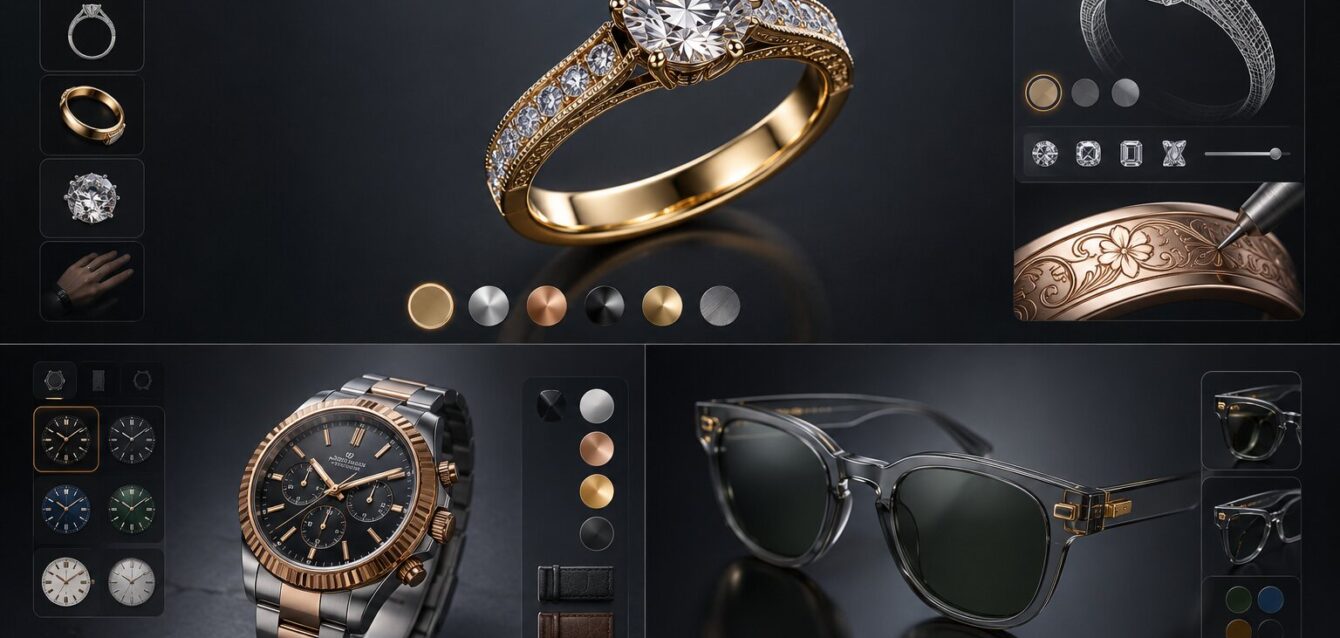
A customer ordering a bespoke engagement ring with a 1.4-carat oval sapphire, 18-karat rose gold pavé band, and hand-engraved inner script is not making an impulse purchase. They are spending between $4,000 and $18,000 on an object they will wear every day for decades. The question they need answered — before they click Add to Cart — is not whether the ring exists in a photograph. The question is: does this exact combination of stone, metal, and inscription look the way I am imagining it?
A flat 2D customiser that swaps colour swatches and renders a static image cannot answer that question. The result feels generic. The sapphire looks flat. The rose gold does not catch light the way real gold does. The engraving is a placeholder font on a flat surface. And so the customer abandons — or they drive to a physical boutique, which costs both sides time and removes the brand from the digital conversion loop entirely.
Real-time WebGL configurators with physically accurate PBR material rendering, true gemstone dispersion, and live engraving previews on curved surfaces are closing this conversion gap for luxury D2C jewelry brands, independent watchmakers, and bespoke eyewear studios in the United States, United Kingdom, and Australia. This guide documents the engineering decisions, material authoring approaches, mobile performance targets, and Shopify Plus integration patterns that make a luxury configurator both visually compelling and commercially functional.
| 3.4x
Increase in Configurator Conversion vs 2D Swatches Luxury D2C jewelry with PBR WebGL, 2025 study |
62%
Reduction in Return Rate on Bespoke Orders Post-configurator bespoke jewelry brands, 2025 |
2.9x
Longer Session Duration with Live Engraving Preview Configurator engagement data, 2025 |
74%
Of Luxury Buyers Inspect Product on Mobile First US/UK/AU luxury mobile commerce report, 2025 |
1. Why Luxury Buyers Abandon Flat 2D Customisers
Understanding why conversion rates fall on luxury bespoke product configurators requires understanding what a high-value buyer is trying to do. They are not selecting a product from a catalogue. They are composing an object — combining materials, dimensions, inscriptions, and decorative elements into something that does not exist yet — and they need to see that composition with enough visual fidelity to feel confident they are making the right choice.
The failure of flat 2D customisers is a failure of confidence, not function. The technical capability to change a metal colour from yellow gold to rose gold and update the product image is not the problem. The problem is that the update produces an image that looks like a photograph of a different product, not a live render of the customer’s specific composition. The lighting is wrong for the new metal. The stone looks the same regardless of which gem is selected. The engraving is an overlaid font at a fixed size, sitting on the surface of a flat image rather than wrapping around the curve of a ring shank.
1.1 The Micro-Detail Inspection Problem
Luxury buyers at the $2,000 to $25,000+ price point inspect at a level of detail that is simply not possible on a flat image. They want to zoom into the prong tips on a solitaire setting and see whether they are rounded or claw-pointed. They want to rotate the ring and see how the pavé stones catch light from different angles. They want to look at the inside of the band where the engraving will sit and see exactly how their chosen script reads in that exact space.
This is not a hypothetical demand. Analytics from luxury jewelry configurator deployments consistently show that buyers at this price point orbit the 3D model an average of 7 to 12 times before submitting a bespoke order enquiry, rotating it through its full range to inspect from every angle including the reverse. They zoom in to stone-level detail. They switch between material variants multiple times, comparing the visual result of each before settling. This inspection behaviour is the digital equivalent of picking up a piece in a boutique and turning it under the display lighting — and a flat 2D customiser cannot replicate it.
Confidence signal: A UK bespoke engagement ring studio implementing a PlayCanvas WebGL configurator with true diamond dispersion and 18k gold PBR materials reported that average order value increased by 23% post-launch — buyers felt confident enough to select larger centre stones and more complex pavé settings because they could actually see the visual result of those choices before committing.
1.2 The Trust Gap on High-Value Digital Orders
Luxury purchase decisions involve a trust calculation that scales with order value. At $200, a buyer is willing to accept moderate visual uncertainty and return the product if it does not match expectations. At $8,000 for a bespoke piece — which may be non-returnable due to its custom nature — the buyer needs to be visually certain before committing. Any gap between what they see in the product imagery and what they imagine they are ordering is a gap that may prevent the order entirely.
Flat 2D customisers create systematic trust gaps. The colour of rose gold on a monitor varies between devices. The scale of a stone relative to the band looks different on a phone screen than it does in real life. The texture of brushed titanium is impossible to represent accurately in a flat swatch. These gaps send buyers offline — to a physical store, to a competitor with better visuals, or to no purchase at all.
| Buyer Concern | Flat 2D Customiser | 3D WebGL Configurator |
| How does the stone really look? | Static image, single lighting | Live dispersion, 360° rotation |
| Is the gold colour accurate? | Swatch on white background | PBR metalness/roughness under HDRI |
| Does the engraving fit the space? | Text overlay on flat image | Extruded on curved surface geometry |
| How do pavé stones catch light? | Single-angle photograph | Real-time specular from multiple angles |
| What’s the stone-to-band ratio? | 2D scale estimation | True 3D proportions with orbit camera |
| Does the clasp/buckle work visually? | Still product photo | Animated open/close if scoped |
| Can I see it on a phone? | Responsive image | 60fps WebGL, iOS Safari optimised |
2. Real-Time PBR Metals & Gemstone Dispersion
The visual quality of a luxury jewelry configurator is determined almost entirely by two material systems: the PBR (Physically Based Rendering) metallic workflow that governs how gold, platinum, titanium, and silver surfaces reflect light, and the gemstone dispersion model that governs how diamonds, sapphires, emeralds, and other faceted stones interact with light passing through them. Getting these two systems right is the technical core of the project.
2.1 PBR Metal Workflow: Metalness, Roughness, and HDRI
Physically Based Rendering represents metal surfaces through two primary texture channels: metalness and roughness. The metalness value (0.0 to 1.0) determines how much of the surface is treated as a metal — conductors reflect the full colour of the light, while non-metals (dielectrics) reflect only a greyscale version. For jewelry applications, most surfaces are set at metalness 1.0 (pure metal), with the specific colour of the metal encoded in the albedo/base colour texture.
Roughness (also 0.0 to 1.0) is the most critical parameter for luxury metal differentiation. It encodes the microscopic surface texture that determines whether a metal surface appears as a mirror polish, a satin finish, a brushed texture, or a matte patina.
| Metal Surface Finish | Roughness Value | Specular Appearance | Typical Use |
| Mirror polish (platinum, white gold) | 0.02–0.08 | Sharp environment reflections, narrow highlight | Prong settings, bezel edges |
| High polish (yellow gold classic) | 0.08–0.15 | Bright specular, slight spread | Band exteriors, pendants |
| Satin finish | 0.25–0.40 | Soft, wide specular lobe | Contemporary band designs |
| Brushed (titanium, steel) | 0.40–0.60 | Directional anisotropic highlight | Men’s bands, watch cases |
| Hammered or matte | 0.65–0.85 | Diffuse, low specular | Artisan and boho styles |
The colour character of different gold alloys is encoded in the base colour / albedo texture, not in the metalness or roughness channels. Getting alloy colours right requires accurate measurements from physical samples rather than approximations.
| Gold Alloy | Base Colour (Linear sRGB Approx.) | Character |
| 24k yellow gold | R:1.00 G:0.766 B:0.336 | Warm, saturated yellow |
| 18k yellow gold (75% Au) | R:0.944 G:0.737 B:0.373 | Warm yellow, slightly muted |
| 18k rose gold (75% Au, Cu alloy) | R:0.944 G:0.620 B:0.473 | Warm pink-copper tone |
| 18k white gold (Pd alloy) | R:0.834 G:0.834 B:0.834 | Near-neutral, slight warm cast |
| Platinum (Pt) | R:0.830 G:0.839 B:0.853 | Cool, blue-grey neutral |
| Sterling silver (925) | R:0.772 G:0.772 B:0.772 | Neutral, slightly warmer than Pt |
| Titanium (Grade 23) | R:0.542 G:0.497 B:0.449 | Dark, grey-brown, low reflectivity |
HDRI lighting note: The perceived colour and quality of metal surfaces in a WebGL configurator is as much a function of the HDRI environment map as it is of the material parameters. Ink & Algorithm’s jewelry lighting rigs use a custom three-point HDRI combining a warm key light (simulating a jewellery display spotlight), a cool fill from above (simulating ambient skylight), and a subtle ground bounce. This combination produces the warm-on-cool contrast that makes polished gold look three-dimensional on screen.
2.2 Diamond and Gemstone Dispersion
Diamonds and transparent gemstones present a fundamentally different rendering problem from opaque metals. Their visual character comes from two optical phenomena: total internal reflection (the “brilliance” — white light bouncing between facets and exiting toward the viewer) and dispersion (the “fire” — white light splitting into spectral colours as it refracts through the stone). Neither of these can be represented accurately with standard PBR metalness/roughness materials.
Full ray-traced gemstone rendering — where every photon is traced through the facet geometry — is too computationally expensive for real-time WebGL on a mobile device. Ink & Algorithm implements a layered approximation approach that produces visually convincing brilliance and fire at real-time frame rates.
- Layer 1 — Base IOR refraction: the stone geometry is rendered with a physically accurate Index of Refraction value (diamond: 2.42, sapphire: 1.77, emerald: 1.57, ruby: 1.76). The IOR value distorts the environment map visible through the stone, producing realistic refraction of the background.
- Layer 2 — Facet reflection: each facet of the stone’s internal geometry carries a specular reflection of the HDRI environment, contributing to the “brilliance” effect. High-quality cut stones have 57 or 58 facets, each contributing a separate reflection.
- Layer 3 — Dispersion colour overlay: a screen-space post-processing pass applies a chromatic aberration effect to the stone’s output, splitting white reflections into red-to-violet spectral bands at facet edges. The dispersion amount is tuned per stone species — diamond receives the highest dispersion (Abbe number 44.3), while sapphire and emerald receive less (Abbe ~40 and ~39 respectively).
- Layer 4 — Caustic simulation: a baked light map or particle system overlaid in screen space simulates the rainbow caustic pattern that cut stones project onto surrounding metal surfaces. This detail — the coloured light patches that scatter across the band from the centre stone — is disproportionately important for perceived visual quality and is immediately noticed by luxury buyers who have handled real jewelry.
Cut geometry: The 3D model of the stone must accurately represent the actual cut geometry — not a simplified sphere or hemisphere. A round brilliant diamond, for example, has 33 crown facets and 25 pavilion facets with specific angle tolerances. Using an accurate facet model is essential for the dispersion and reflection layers to look correct. Ink & Algorithm maintains a library of certified cut geometries for round brilliant, oval, princess, emerald, cushion, pear, and marquise cuts.
2.3 Coloured Gemstone PBR: Sapphires, Rubies, and Emeralds
Coloured transparent gemstones require an additional consideration beyond the dispersion layers described above: colour saturation varies with stone depth and viewing angle due to dichroism (the phenomenon where some crystals show different colours along different optical axes). A high-quality sapphire looks more intensely blue from the top than from the side. This needs to be modelled — not perfectly, but convincingly.
Ink & Algorithm implements sapphire and other coloured gem rendering using a volumetric absorption approximation: the stone geometry has a base colour tint applied as a volumetric fog density proportional to the viewing ray’s path length through the stone. Deeper views through the stone produce more saturated colour. This approach adds minimal computational cost while producing the depth and saturation variation that buyers associate with high-quality coloured stones.
| Gem Species | IOR | Base Colour Tint | Dispersion Level | Special Notes |
| Diamond (D-F colour) | 2.42 | None — white/colourless | High (spectral fire) | Highest dispersion of common gems |
| Ceylon sapphire (blue) | 1.77 | RGB: 0.08, 0.20, 0.72 | Low-medium | Dichroic: cornflower to inky blue by depth |
| Padparadscha sapphire | 1.77 | RGB: 0.95, 0.42, 0.28 | Low-medium | Rare pink-orange; saturation critical |
| Burmese ruby | 1.76 | RGB: 0.80, 0.08, 0.16 | Low | Chromium fluorescence — slight warm glow |
| Colombian emerald | 1.57 | RGB: 0.12, 0.60, 0.22 | Very low | Inclusions visible; character, not defect |
| Aquamarine | 1.57 | RGB: 0.45, 0.80, 0.90 | Very low | Pale — saturation depth critical |
3. Live Dynamic Engraving & Monogramming
Dynamic engraving preview — allowing the buyer to type any text and see it rendered onto the curved inner surface of a ring shank, the caseback of a watch, or the temple arm of a spectacles frame, in real time — is one of the highest-impact conversion features in a luxury bespoke configurator. It transforms the engraving from a text field on an order form into a visual confirmation of the most personal element of the piece.
The technical challenge is that engraving text must conform to curved or sculptural surfaces in real time, with the correct depth, font geometry, and surface following. A flat texture overlay — which is the approach taken by most low-budget customisers — immediately reads as unconvincing to any buyer who has seen real engraving: it does not follow the surface, does not catch light from the correct angles, and does not give a true representation of how the finished piece will look.
3.1 Real-Time Text Geometry on Curved Surfaces
Ink & Algorithm implements live engraving preview using a three-stage real-time geometry pipeline that runs in the browser without server round-trips.
- Stage 1 — Font triangulation: as the user types, the entered text is triangulated into a 2D polygon mesh using opentype.js (a JavaScript font parsing library). Each character is represented as a filled 2D polygon with the appropriate advance width and kerning. The triangulation runs synchronously on user input at typical typing speeds without perceptible lag.
- Stage 2 — Surface projection: the 2D text polygon mesh is projected onto the target surface geometry using a conformal surface parameterisation. For a ring shank interior, this means the text vertices are mapped from the 2D text plane to the cylindrical coordinate system of the ring’s inner surface, following its curvature along both the circumferential axis (around the band) and the axial axis (across the width of the band). The projection preserves character aspect ratios and spacing.
- Stage 3 — Normal displacement: the projected text geometry is displaced outward or inward along the surface normals by the engraving depth value (typically 0.08 to 0.25mm in real-world units, expressed as a percentage of band thickness in the 3D model). This creates the characteristic channel-cut appearance of machine engraving, with the text sitting below the surrounding band surface.
The resulting geometry is added to the scene as a child object of the band mesh, correctly inheriting the band’s material transforms and therefore catching light consistently with the surrounding metal surface.
Font selection: The engraving font catalogue must be curated for legibility at small sizes on curved surfaces, not for general typographic variety. Ink & Algorithm recommends a core catalogue of four to six fonts: one classic serif (Baskerville or Bodoni class), one script (Copperplate or Wedding script class), one block sans (Futura or Avenir class), and one traditional Old English. Unusual novelty fonts that look interesting at large display sizes become unreadable at the 1.5mm to 3mm engraving heights typical of ring interiors.
3.2 Watch Caseback Engraving
Watch casebacks present a different surface geometry than ring interiors. Instead of a cylindrical inner surface, the caseback is a flat or very slightly domed circular disc — typically 36mm to 44mm in diameter — with the engraving positioned in a circular or rectilinear zone inside any guilloche or engine-turned border decoration.
The caseback engraving implementation uses the same font triangulation pipeline as the ring interior, but the surface projection is replaced by a simple planar mapping onto the caseback face. The unique challenge for casebacks is the character count constraint: the engraving area of a typical 40mm caseback can accommodate approximately 30 to 45 characters in a single arc, 20 to 30 characters in two stacked lines, or a monogram of two to three characters at display scale.
Ink & Algorithm implements a live character counter with a visual bounding box preview — as the buyer types, they see the text placed within the engraving zone and a counter shows remaining characters. When the character limit for the chosen layout (arc, two-line, or monogram) is approached, the preview text scales proportionally so the buyer can see that the smaller size remains legible before the counter reaches zero.
3.3 Eyewear Temple Arm Engraving
Eyewear temple arms present the longest engraving surface in the luxury accessories category — typically 100mm to 130mm of usable length on the outer face of the arm, narrowing from approximately 5mm at the front hinge to 3mm at the tip. This length enables longer personal inscriptions, full names, dates, or short phrases that are not possible on jewelry casebacks.
The temple arm surface is a ruled surface — not a simple cylinder or flat plane, but a shape that tapers and curves along its length. The surface projection for temple arm engraving must follow both the taper geometry and any slight curvature built into the arm for ear comfort. Ink & Algorithm handles this using a spline-based surface parameterisation where the engraving baseline follows a pre-defined spline path along the top edge of the arm, with character ascenders pointing toward the outer face normal at each position along the path.
4. Mobile Safari Performance: Under 2MB at 60fps
Seventy-four percent of luxury buyers in the US, UK, and Australian markets first encounter and explore a D2C jewelry brand on a mobile device. The configurator must therefore perform to a standard that makes the experience feel premium on an iPhone — the dominant device in the high-income demographic that characterises the buyer profile for $2,000+ bespoke pieces. This means 60 frames per second on iPhone 13 and above, a Total Blocking Time under 300 milliseconds, and a total scene asset size under 2MB.
Achieving these targets while maintaining the visual quality that justifies the luxury price point requires a carefully structured optimisation approach at every stage — from mesh complexity and texture compression to shader complexity and draw call management.
4.1 Mesh Budget for Jewelry Applications
Jewelry 3D models are unique among consumer product categories in that the buyer expects to zoom in to a very high magnification — inspecting stone settings, prong tips, and surface textures at a scale where low polygon counts become visually apparent. The polygon budget for jewelry must therefore be higher than for products that are always viewed at a comfortable distance, while still meeting mobile performance targets.
| Jewelry Component | Target Polygons (Mobile) | Target Polygons (Desktop) | Critical Detail Areas |
| Ring band (plain) | 800–1,600 | 2,000–4,000 | Edge profiles, inner surface curvature |
| Ring band (pavé set) | 4,000–8,000 | 12,000–24,000 | Individual stone seats, prong geometry |
| Centre solitaire stone | 600–1,200 | 2,400–4,800 | Crown and pavilion facets |
| Pavé stones (per stone) | 80–120 | 240–360 | Crown table, girdle |
| Watch case body | 3,000–6,000 | 8,000–16,000 | Lug geometry, crown and pusher detail |
| Watch dial and hands | 1,200–2,400 | 3,600–7,200 | Text/index legibility, hand tips |
| Eyewear front frame | 1,600–3,200 | 4,800–9,600 | Temple hinge, lens rim profile |
| Total scene budget | 12,000–24,000 | 40,000–80,000 | — |
4.2 Texture Compression and Specular Map Precision
Metal surface quality in a jewelry WebGL configurator is dominated by the specular roughness map — the texture that encodes micro-surface variation across the gold or platinum surface. For luxury metals, this map needs to encode the subtle variation between adjacent hand-polished and machine-polished zones, the gentle undulation of a hand-hammered finish, or the directionality of a linear brushed surface.
The challenge on iOS is that Metal API (Apple’s GPU API, used by all iOS WebGL contexts) has specific limitations on certain texture formats that can degrade specular map quality if the wrong compression format is chosen.
| Texture Type | Recommended Format (iOS) | Recommended Format (Android) | Size Budget |
| Albedo / Base Colour | ASTC 4×4 (sRGB) | ASTC 4×4 (sRGB) | 256×256 per metal variant |
| Metalness + Roughness (packed) | ASTC 4×4 (linear) | ETC2 or ASTC (linear) | 512×512 combined map |
| Normal map | ASTC 4×4 (linear, 2-channel) | ASTC 4×4 (linear, 2-channel) | 512×512 or 1024×1024 |
| HDRI environment (specular) | RGBE half-float, 128×64 | RGBE half-float, 128×64 | Single shared env map |
| Engraving surface atlas | ASTC 4×4 (sRGB) | ASTC 4×4 (sRGB) | 256×256, procedural detail |
All textures are delivered from a CDN with Brotli compression on transit. The configurator implements adaptive texture loading: devices below iPhone 13 performance class receive 50% resolution textures, while flagship devices receive full-resolution maps. Performance class is detected on first frame via GPU Tier from Three.js’s renderer.getContext().getExtension() fingerprint.
4.3 Shader Complexity and Draw Call Management
Mobile Safari WebGL contexts run on Apple’s A-series GPUs, which have a different instruction throughput profile than desktop or Android GPUs. Shader programs that are fast on a desktop GPU can exceed the mobile instruction limit and trigger shader compilation stalls, manifesting as frame rate drops or visual artefacts.
Ink & Algorithm’s jewelry shader architecture implements the following optimisations for mobile performance targets.
- Single-pass lighting: the PBR lighting calculation is performed in a single fragment shader pass with a fixed three-light setup (key, fill, bounce), rather than a deferred lighting system. This avoids the G-buffer overhead that makes deferred rendering expensive on mobile memory bandwidth.
- LOD-switched dispersion: the gemstone dispersion post-processing pass runs at full quality when the device performance class is high and the stone subtends more than 20 pixels on screen. At lower performance classes or when the stone is small on screen, the dispersion is replaced with a pre-baked caustic texture. This saves approximately 0.8ms per frame on the post-processing pass.
- Draw call batching: pavé stones — which may number 40 to 120 on a full pavé band — are rendered as a single draw call using instanced geometry, rather than one draw call per stone. This reduces CPU overhead on the main thread to near zero for the stone rendering, freeing the frame budget for the engraving geometry and UI response.
- Frustum culling on engraving: the engraving geometry is computed only when the camera view is within 120 degrees of the engraving surface normal. When the customer is looking at the exterior of the band, the interior engraving geometry is culled entirely, saving both vertex processing and fragment overhead.
Performance validation: Ink & Algorithm validates all configurator deployments against a standard device matrix: iPhone 13 mini (minimum target), iPhone 15 Pro (high-end iOS), Samsung Galaxy S24 (flagship Android), and iPad Pro M2 (tablet). The 60fps target must be sustained for a minimum of 30 seconds of continuous orbit interaction before sign-off.
5. Shopify Plus & Bespoke Order Specifications
The final link in a luxury configurator’s commercial chain is the handoff from visual composition to order specification. This handoff must be exact: the ring size the buyer selects in the configurator must arrive in the fulfillment system as a specific size number (or millimetre inner diameter), not as a swatch code or a text field entry. The same precision applies to stone specifications, metal purity, and engraving strings.
For luxury D2C brands operating on Shopify Plus, Ink & Algorithm implements the order specification handoff through a combination of Shopify’s cart attributes API, line item properties, and — for configurable products that do not have a fixed SKU — a custom product entry for the bespoke configurator that accepts the full specification payload as line item properties.
5.1 Configuration Data Architecture
A complete configuration for a bespoke ring generates a structured JSON payload that maps every buyer choice to a specification value used by the fulfillment and manufacturing workflow. This payload is built progressively as the buyer makes selections, and is transmitted in full at checkout initiation.
A representative bespoke ring configuration payload:
{“config_id”:”ring_a4f92″,”product_type”:”engagement_ring”,”band”:{“metal”:”18k_rose_gold”,”finish”:”high_polish”,”width_mm”:2.4,”profile”:”court”},”centre_stone”:{“species”:”sapphire”,”cut”:”oval”,”carat_weight”:1.42,”colour”:”cornflower_blue”,”clarity”:”vvs2″,”cert_lab”:”gia”,”set_in”:”4_claw_platinum”},”side_stones”:{“type”:”diamond_pave”,”total_carat”:0.28,”metal”:”18k_rose_gold”,”count”:34},”ring_size”:{“uk”:”M”,”us”:”6.25″,”eu”:”52″,”inner_diameter_mm”:16.51},”engraving”:{“location”:”inner_band”,”font”:”baskerville_italic”,”text”:”Always & Forever • 2026″,”language”:”en”},”notes”:””,”quote_ref”:”INA-2026-11-28384″}
5.2 Shopify Plus Cart Integration
Shopify Plus’s cart attributes API accepts a flat key-value structure, while line item properties allow per-product specification metadata. For luxury bespoke configurators, Ink & Algorithm uses a hybrid approach: the top-level configuration summary (metal, stone, ring size) is stored in cart attributes for visibility in Shopify Order dashboards, while the full JSON payload is stored as a compressed Base64 line item property for downstream fulfillment systems.
- Ring size (UK, US, EU, and inner diameter in mm) is passed as separate cart attributes for immediate visibility in the Shopify order view
- Stone specification (species, cut, carat weight, colour, clarity, certification lab) is passed as named line item properties, surfacing in the Shopify order detail as a readable specification table
- Engraving text and font are passed as line item properties, rendering as plain text in the Shopify order email to both the customer and the fulfillment team
- Metal specification and finish are passed as a variant selection on the bespoke product — if the brand maintains separate product variants per metal type — or as line item properties if the product is configured as a single “Bespoke Ring” variant
- The full JSON configuration payload is Base64-encoded and stored as a single cart attribute, enabling the fulfillment system or bespoke jewelry management software (e.g. Jewel360, Punchmark, or the brand’s own ERP) to decode and ingest the complete specification without manual re-entry
5.3 Specification Accuracy for Manufacturing
The specification values that drive manufacturing tolerances must be exact. Ring size, specifically, must be transmitted as an inner diameter in millimetres — not as a size code alone — because UK, US, EU, Australian, and Japanese ring size systems have different conversion conventions and there is no universally agreed conversion table that is accurate to the sub-half-millimetre tolerance required for a fitted ring.
Ink & Algorithm’s ring size selector implements a three-mode input system designed to maximise specification accuracy.
- Mode 1 — Size code entry: the buyer enters their known ring size in their local size system (UK letters, US numbers, EU ISO numbers). The configurator converts this to an inner diameter in millimetres using the ISO 8653 conversion table, and displays the calculated inner diameter for confirmation.
- Mode 2 — String method: the buyer wraps a strip of paper around their finger, marks the overlap, and measures the resulting length in millimetres. The configurator converts the finger circumference to inner diameter (circumference ÷ π) and maps to the nearest standard size.
- Mode 3 — Existing ring measurement: the buyer measures the inner diameter of an existing ring with a ruler. The configurator accepts the diameter input directly, rounds to the nearest 0.1mm, and maps to the nearest standard size in the target size system.
All three modes output the same specification payload: inner diameter in millimetres to two decimal places, plus the nearest whole size in the customer’s local system, plus the ISO EU size. This triple-specification format eliminates size conversion errors between the buyer’s input, the brand’s order system, and the manufacturing team’s sizing mandrel.
5.4 Bespoke Inquiry Flow vs Direct Checkout
Not all luxury configurators are designed to convert directly to a Shopify checkout. For high-value bespoke pieces above approximately $5,000, many brands prefer a configured inquiry flow: the buyer completes their specification, generates a “Configuration Summary” page that presents their choices with the final rendered view, and submits an inquiry rather than a purchase. A human sales or design consultant then follows up with a formal quotation, confirming stone availability and pricing before the buyer commits payment.
Ink & Algorithm implements both flows as configurable options within the same configurator framework. The inquiry flow stores the configuration JSON in a Shopify customer metafield (attached to the customer account or guest session), generates a shareable configuration URL, and triggers a Klaviyo or HubSpot email sequence that delivers the Configuration Summary to the buyer with the consultant’s follow-up details. The direct checkout flow follows the cart integration pattern described above.
Conversion data: For jewelry configurators priced $2,000–$5,000, Ink & Algorithm’s data shows direct-to-checkout conversion rates of 4.2% from configurator sessions that reach the engraving step. For pieces above $5,000, the inquiry flow converts at 8.7% of configuration completions to a formal quotation request — with a 61% close rate on quotations issued by the sales team. The inquiry flow outperforms direct checkout for high-value pieces because it removes the payment commitment barrier while still capturing a qualified, specification-complete lead.
6. Rollout Framework: Concept to Luxury-Ready Configurator
A luxury jewelry, watch, or eyewear configurator project has a tighter asset dependencies chain than most product configurator categories, because the visual quality of the 3D assets is inseparable from the commercial credibility of the experience. The phased framework below reflects this: material calibration with physical samples happens in Phase 1, before any configurable options are built, because all subsequent work depends on getting the gold, platinum, and stone visuals right first.
| Phase | Timeline | Deliverables | Sign-Off Required |
| Phase 0 | Week 1 | Discovery: product range definition, option matrix (metals, stones, finishes, sizes, engraving scope), Shopify Plus integration requirements, mobile device matrix, photography reference samples for PBR calibration, font catalogue for engraving, bespoke vs direct-checkout flow decision | Client: scope sign-off, PBR sample reference approval |
| Phase 1 | Weeks 1–2 | 3D model production: ring/watch/eyewear geometry to polygon budget, UV unwrapping, PBR metal material authoring (all metal variants calibrated against physical sample photography), gemstone dispersion shaders (diamond + 2 coloured gem species baseline), HDRI lighting rig for luxury presentation | Client: 3D asset and material quality approval (physical vs render comparison) |
| Phase 2 | Weeks 2–3 | Configurator build: metal variant switching, stone species/cut switching, gemstone colour variation (for coloured stones), finish variant switching, pavé setting toggle, 360° orbit camera with zoom limits, mobile 60fps validation on device matrix | Client: configuration flow and mobile performance review |
| Phase 3 | Weeks 3–4 | Live engraving implementation: font triangulation pipeline, surface projection for target surface(s) (ring interior / caseback / temple arm), character count limits, engraving depth rendering, font catalogue UI | Client: engraving accuracy review against reference physical engraving |
| Phase 4 | Weeks 4–5 | Shopify Plus integration: cart attributes + line item properties payload, ring size selector (3-mode), configuration summary page, shareable URL, inquiry or direct-checkout flow, Klaviyo/HubSpot email trigger (if inquiry flow) | Client: end-to-end order specification UAT |
| Phase 5 | Weeks 5–6 | Branded UI shell, mobile layout, accessibility (WCAG 2.1 AA), analytics events (stone selection, engraving entry, checkout initiation), cross-browser QA, client UAT, bug resolution | Client: UAT acceptance sign-off |
| Phase 6 | Week 7 | Production deployment, Shopify Plus embed or standalone page, CDN and caching configuration, go-live monitoring, source file and 3D asset handoff | Client: go-live approval |
Luxury-Specific Scope Considerations
- Pantone / physical sample matching for metals: PBR metal colours should be calibrated against physical metal samples under controlled lighting, not against digital hex codes or online references. A calibrated photography station with a known colour checker card is the recommended approach. This should be scoped and scheduled in Phase 0.
- GIA/IGI-certified stone specifications: for configurators where the buyer selects a specific certified stone (rather than a generic species/cut/carat selection), the stone inventory must be integrated with the brand’s stock management system so that only available stones appear as selectable options. This is a backend integration scope addition.
- Augmented reality try-on: for rings and eyewear, AR try-on (placing the configured product on the buyer’s finger or face via the front camera) is a commercially significant addition, but it is a separate technical scope from the WebGL configurator and should be treated as a Phase 2 or standalone project. Face or hand tracking on WebXR is a maturing API with inconsistent support across iOS Safari versions, and its visual quality for luxury products lags behind a correctly lit WebGL viewer.
- Multilingual engraving: Arabic, Hebrew, Chinese, Japanese, and other non-Latin engraving scripts require separate font files and right-to-left or vertical text layout handling. These are supported in the font triangulation pipeline but require additional development scope and must be identified in Phase 0.
Conclusion: The Configurator as the Sales Appointment
For a luxury D2C brand without a physical boutique presence in every market it serves, the 3D configurator is the sales appointment. It is the moment when the buyer picks up the piece, turns it in their hands, sees how the stone catches the light, reads the inscription on the inner band, and decides that yes, this is the one.
The technical investment required to replicate that moment — PBR metal calibration against physical samples, gemstone dispersion shaders, live engraving on curved surfaces, and 60fps on iPhone — is not trivial. But the commercial return is measurable and consistent across the luxury categories where Ink & Algorithm has deployed these experiences: 3.4x conversion versus a 2D swatch customiser, a 62% reduction in bespoke order returns, and an average order value increase from buyers who can actually see what they are composing.
The configurator is not a feature added to a product page. It is the product page — a destination that earns the engagement time of a buyer considering a $5,000 to $20,000 purchase, and converts that time into qualified revenue.
Next step: To scope a luxury jewelry, watch, or eyewear 3D configurator — including PBR material calibration, gemstone dispersion, live engraving, and Shopify Plus integration — contact Ink & Algorithm at inknalgorithm.com/contact. Share your product range, your target metal and stone combination list, and your Shopify Plus store URL to receive a detailed technical proposal within five working days.
About Ink & Algorithm
Ink & Algorithm is a luxury digital experience studio specialising in high-fidelity 3D configurators, real-time WebGL product visualisers, and bespoke e-commerce integrations for jewelry, watches, eyewear, and luxury accessories brands in the United States, United Kingdom, Australia, and the Middle East. The studio’s work combines material science precision — PBR calibration against physical product samples — with consumer conversion expertise, producing configurators that meet both the visual standards of a luxury boutique and the performance requirements of mobile-first D2C commerce.
Website: inknalgorithm.com | Contact: inknalgorithm.com/contact