
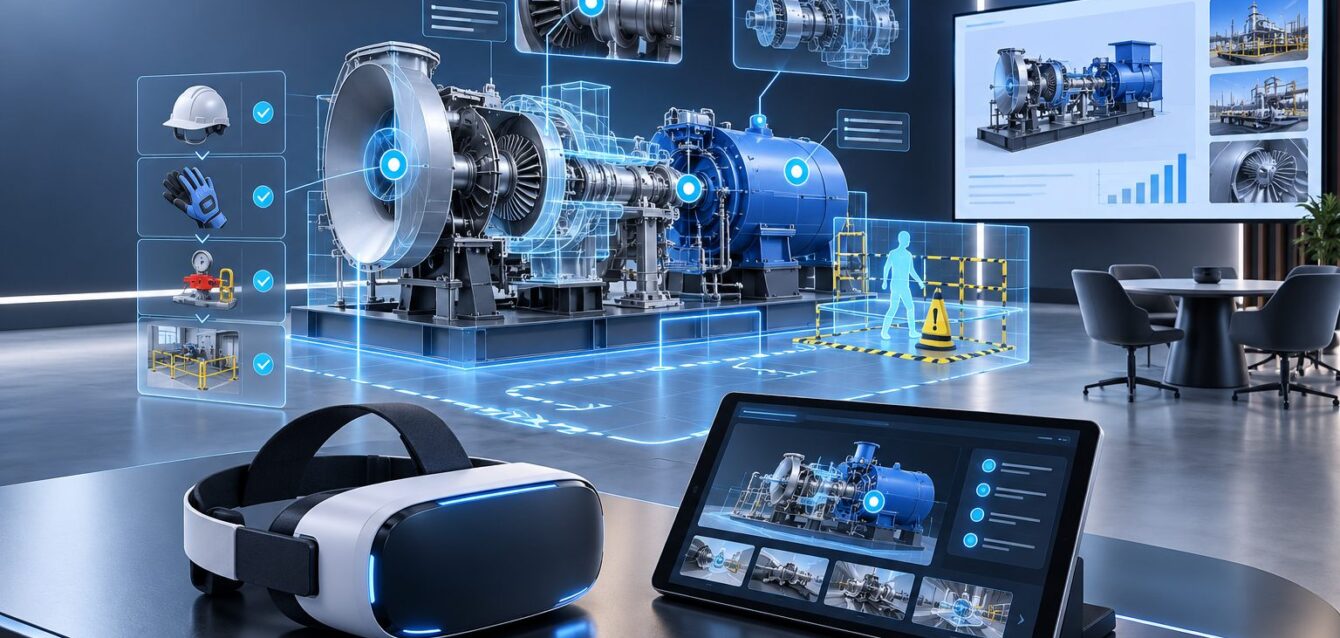
Virtual reality is becoming a practical tool for companies that need to explain complex products, train teams, and support sales conversations without relying only on slides, videos, or physical demos. When buyers or employees can step inside a simulated environment, they understand product scale, workflow, safety steps, and value much faster.
For enterprise teams, VR is most useful when it solves a specific business problem. The strongest use cases are not built around novelty. They are built around training consistency, sales clarity, reduced travel, fewer physical prototypes, and better decision-making.
Why VR Works for Product Training
Training often becomes expensive when teams need physical equipment, repeated instructor time, or access to a real jobsite. VR can recreate those conditions in a controlled environment, allowing learners to practice procedures before they work with expensive products or safety-sensitive systems.
- Teams can repeat the same scenario until the process feels familiar.
- Instructors can standardize training across locations.
- New employees can practice without interrupting production.
- Safety risks can be introduced without putting anyone in danger.
This makes VR especially useful for manufacturing, healthcare devices, industrial equipment, architecture, and field service teams.
How VR Improves Sales Demonstrations
Many products are hard to explain because they are large, customized, technical, or difficult to transport. VR helps sales teams show scale, context, and usage without bringing the physical product into every meeting.
A buyer can walk through a product environment, inspect important components, compare configurations, or understand how a solution fits into their own workflow. This is more persuasive than a static deck because the buyer experiences the product instead of only hearing about it.
For teams that also use browser-based demos, a web-based 3D configurator can support earlier research while VR supports deeper sales meetings and training sessions.
Where VR Creates Business Value
The best VR projects connect immersive visuals to measurable outcomes. Before building, teams should decide what the experience needs to improve: training speed, buyer understanding, sales close rate, onboarding quality, safety compliance, or product demonstration consistency.
- Reduced travel for product demos and stakeholder reviews.
- Lower reliance on physical mockups or prototypes.
- Faster onboarding for technical products and procedures.
- Better knowledge retention through active practice.
- More consistent messaging across sales and training teams.
Plan the VR Experience Around the User Journey
A useful VR experience is not just a 3D model placed inside a headset. It needs a clear flow. The user should know where to look, what to do next, and how each interaction supports the goal of the experience.
For training, this may include guided steps, task validation, scenario branching, and performance tracking. For sales, it may include product hotspots, comparison views, configuration options, and a clear path to the next action.
Keep Hardware and Deployment Practical
VR planning should include hardware availability, setup time, support requirements, and who will run the experience. A trade show demo has different needs than an internal training program or a sales enablement tool used by regional teams.
Some companies may also need a mixed approach: VR for immersive sessions, WebGL for browser access, and video or animation for follow-up material. Our virtual reality services page explains how immersive experiences can fit into broader product visualization and business workflows.
Common Mistakes to Avoid
- Building a visually impressive demo without a clear business goal.
- Ignoring comfort, navigation, and motion sickness risks.
- Using too much detail in models and hurting performance.
- Forgetting analytics or feedback loops after launch.
- Designing only for headsets without considering sales follow-up assets.
Final Takeaway
VR can be a serious business tool when it is planned around training outcomes, buyer education, and measurable workflow improvements. The goal is not to replace every sales or training asset. The goal is to give teams a more immersive way to explain complex products and help users understand them with confidence.