

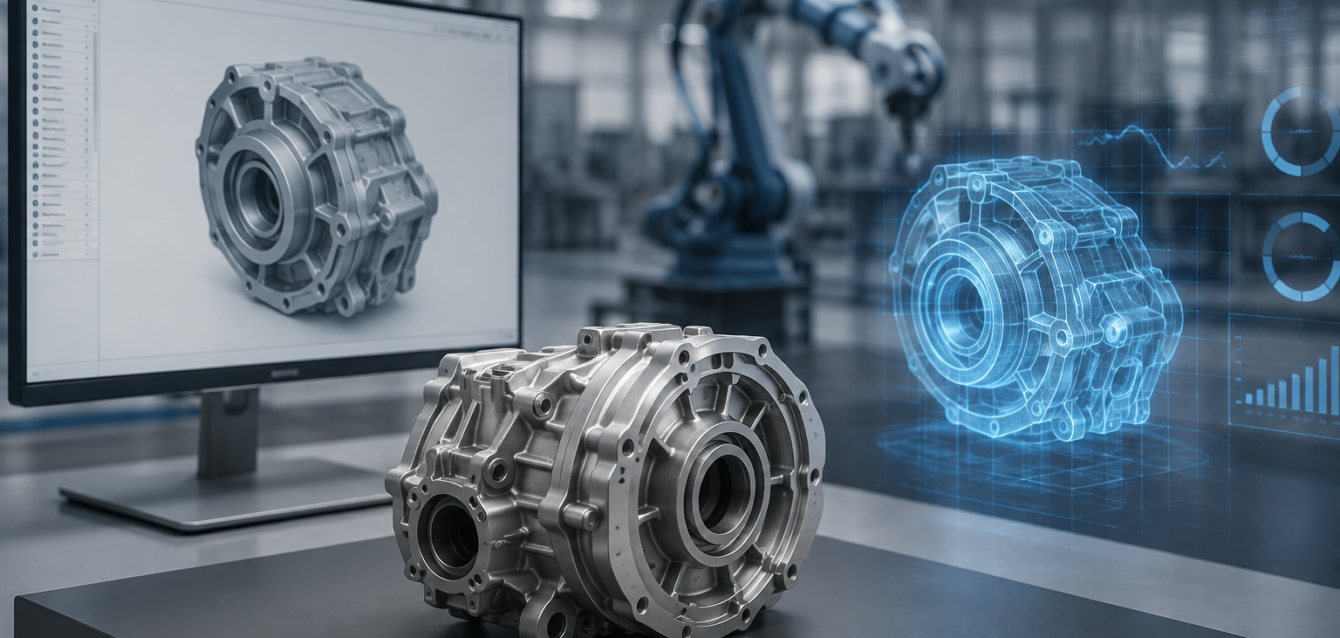
Quick Answer: US manufacturers use 3D visualization in 2026 across four commercial applications: CAD-accurate product renders replacing photography for B2B catalogs, interactive 3D sales configurators for custom product configuration, VR training simulations for equipment operation, and digital twins for factory floor monitoring and predictive maintenance. This guide explains each application with US manufacturer cost data and ROI outcomes. By Ink & Algorithm, Hanover Park, Illinois.
Why US Manufacturers Are Adopting 3D Visualization
US manufacturers face a specific commercial challenge that 3D visualization solves: their products are complex, customizable, and often impossible to photograph efficiently at every variant. A US industrial equipment manufacturer with 200 configuration options cannot photograph every combination. A US hardware brand with 40 finish options and 12 size variants produces 480 distinct SKUs — impossible to manage with traditional product photography.
3D visualization produces every variant — every finish, every size, every configuration — from a single CAD-accurate 3D model. One production investment generates the entire product catalog’s visual library. And because the 3D model is built from the manufacturer’s actual engineering files, what buyers see is geometrically accurate to what the factory produces.
| 60%
Average reduction in product photography cost for US manufacturers switching to 3D visualization |
∞
Variant renders from a single 3D model — any finish, size, or configuration combination |
94%
Higher B2B buyer conversion when interactive 3D configurator is available vs static spec sheet |
40%
Reduction in equipment training time for US manufacturers using VR simulation vs classroom methods |
Four 3D Visualization Applications for US Manufacturers
1. CAD-Accurate Product Renders — Replacing Photography
The most direct 3D visualization application for US manufacturers is replacing product photography with CAD-accurate renders. Photoreal 3D renders built from the manufacturer’s actual engineering CAD files (STEP, SolidWorks, Catia, Creo) produce every product variant — every finish, coating, material, and accessory configuration — from a single model.
For US B2B manufacturers, the impact is most visible in catalog production. A US industrial fastener brand with 300 SKUs that previously produced an annual printed catalog using photography now generates the entire visual catalog from 3D renders — new SKUs added to the catalog at zero incremental photography cost. US distributors and buyers receive photoreal images for every product in the range.
Cost: $1,500–$8,000 per 3D model depending on complexity (simple geometry vs complex assembly). Each additional variant render: $200–$600. First-year total for a 50-product catalog: $20,000–$60,000 — typically recovered in Year 1 through photography cost elimination.
2. Interactive 3D Sales Configurators for B2B Manufacturing
US B2B manufacturers with customizable products are deploying interactive 3D sales configurators — tools that allow B2B buyers to specify their configuration options (dimensions, material, coating, accessories) and see the configured product render in real time, then generate a spec sheet or RFQ directly from the configurator.
The B2B manufacturing configurator serves a different function from a consumer ecommerce configurator — it is primarily a specification tool, not a purchase tool. B2B buyers use it to verify that the configured product meets their application requirements before submitting a purchase order. US manufacturers report that B2B buyers who use a 3D configurator generate orders with 40% fewer specification errors and 25% faster PO generation compared to buyers working from PDF spec sheets.
3. VR Training Simulations for Manufacturing Equipment
US manufacturers with complex, dangerous, or expensive-to-run equipment are using VR training simulations to train operators without putting trainees on live equipment. A VR simulation of a CNC machining center allows trainees to practice setups, tool changes, and emergency stops without the risk of part damage, tool breakage, or injury. A VR simulation of an industrial press operation trains the complete operating sequence before the trainee touches the actual machine.
The cost benefit for US manufacturers is straightforward: a CNC machining center running at $200/hour production cost requires approximately 40 hours of supervised training per operator. VR simulation reduces the supervised equipment time by 40–60% — saving $3,200–$4,800 per trained operator in direct equipment opportunity cost alone, before factoring in part scrap and reduced injury risk.
4. Factory Digital Twins — Visualization for Operations
A factory digital twin is a 3D visualization of the physical manufacturing facility — updated in real time or near-real time with sensor data from the production floor. US manufacturers use factory digital twins for production monitoring (visualizing which stations are running, idle, or in fault state), layout planning (testing equipment repositioning in 3D before physical rearrangement), and predictive maintenance visualization (highlighting equipment approaching service intervals on a 3D facility map).
US automotive, aerospace, food processing, and pharmaceutical manufacturers are the primary adopters of factory digital twin visualization — sectors where production floor complexity is high and the cost of unplanned downtime is measured in thousands of dollars per minute.
Cost: Digital twin visualization for a single production facility: $45,000–$150,000+ depending on facility size and sensor integration depth. Timeline: 16–30 weeks.
How to Evaluate 3D Visualization Vendors for US Manufacturing
Three questions that identify whether a 3D visualization vendor can serve a US manufacturing client:
- ‘Can you work from our engineering CAD files?’ Manufacturing 3D visualization requires actual engineering file input (STEP, SolidWorks, Catia, Creo, NX). Vendors who work only from reference photography produce geometry that is not accurate to manufacturing tolerances — commercially unusable for B2B specification purposes.
- ‘Can you render every variant without rebuilding the model?’ The commercial value of 3D visualization for US manufacturers is variant generation at scale — every finish, coating, and accessory option rendered from one model. Vendors who require a new model per variant are not using a proper PBR material pipeline.
- ‘Can the 3D model power a configurator and AR experience?’ For US manufacturers wanting to extend from product renders into interactive tools, the same 3D model should power a 3D configurator and a WebAR product placement experience — one production investment, three commercial applications.
Ink & Algorithm builds 3D visualization for US manufacturing brands — CAD-accurate renders, interactive configurators, VR training simulations, and factory digital twins. Based in Hanover Park, Illinois.
Ready to bring 3D visualization to your US manufacturing operation? Contact Ink & Algorithm →
📍 1812 McCormick Ln, Hanover Park, IL 60133 · info@inknalgorithm.com · inknalgorithm.com