

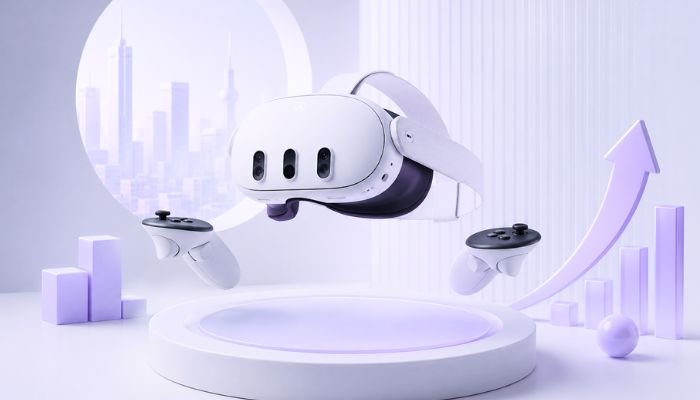
TL;DR: Why Businesses Are Investing in VR Services in USA 2026. Learn about costs, features, ROI, and how US brands use this technology in 2026.
01 — Introduction |
There is a moment in every technology cycle when a capability shifts from impressive-but-optional to genuinely-business-critical. For Virtual Reality in the United States, that moment is 2026. The proof is everywhere: in the training budgets of Fortune 500 manufacturers, in the marketing strategies of luxury real estate developers, in the clinical protocols of hospital systems, and in the onboarding programmes of fast-growing SaaS companies that need to get new employees productive faster than ever before.
VR is no longer the technology you demo at a trade show and wonder whether it has a real application. It is the technology you deploy because your competitors already have — and because the ROI data from early adopters is too compelling to ignore. US businesses invested in VR services are reporting training cost reductions of 40%, sales conversion improvements of 35%, and employee onboarding timelines cut in half. These are not projections from enthusiastic vendors. They are reported outcomes from real deployments across real industries.
This guide examines the business case for VR investment in the United States in 2026 — the market data, the use cases by industry, the ROI evidence, and the strategic reasons why companies that invest now will hold a durable advantage over those that wait. It also introduces the specific VR services that Ink N Algorithm builds for US businesses — and what makes our approach different.
| 📌 Definition
Virtual Reality (VR) services for business refer to the design, development, and deployment of immersive computer-generated environments — accessed through VR headsets, WebXR browsers, or hybrid platforms — that enable training, product demonstration, collaboration, marketing, and customer experience applications that deliver measurably superior outcomes compared to traditional 2D alternatives. |
At Ink N Algorithm, our Virtual Reality services are designed for exactly this commercial moment — when the business case for VR is proven, the hardware is accessible, and the companies that build their VR capabilities now are the ones that will define the competitive landscape for the next decade. Explore our full portfolio of immersive experiences to see what is possible for your industry.
02 — The Market
The Numbers Behind the US VR Investment Surge |
$87 Billion and Accelerating
The US Virtual Reality market has reached a scale that commands serious boardroom attention. Driven by hardware cost reductions that have brought enterprise-grade headsets below the psychological threshold of conventional training equipment, the democratisation of VR development platforms, and a growing body of ROI evidence that makes the financial case straightforward, US corporate VR adoption has accelerated beyond the forecasts that seemed optimistic just three years ago.
68% of US Businesses Now Deploying VR
Perhaps the most striking data point in the 2026 US VR landscape is the adoption rate among mid-market and enterprise businesses: 68% of US companies with revenues above $10 million are now actively deploying VR in at least one business function — training, marketing, product development, or customer experience. This is not a technology that is being watched from the sidelines by cautious procurement teams. It is a technology that is being funded, deployed, and expanded by the mainstream of American business.
The ROI That Moves CFOs
The metric that has accelerated VR’s journey from experimental budget line to standard capital allocation is the consistency of its return on investment. US businesses deploying VR for employee training are reporting average training cost reductions of 40% — while simultaneously improving retention and knowledge application outcomes. Businesses deploying VR for product demonstration and sales are reporting conversion rate improvements of 25 to 35%. These are not isolated case studies — they represent a pattern across industries and company sizes that CFOs are now taking seriously.
| $87B
US VR market value 2026 |
68%
US businesses adopting VR |
247%
Average 3-year VR ROI |
3×
Engagement vs 2D alternatives |
03 — Six Reasons
Why US Businesses Are Investing in VR Services Right Now |
The VR investment decision is not driven by a single compelling use case — it is driven by the convergence of six distinct business needs, each of which VR addresses more effectively than any previous technology. Understanding which of these resonates most strongly for your business is the starting point for a VR investment strategy.
Reason 1 — Immersive Training That Actually Sticks
Corporate training in the United States is a multi-billion dollar annual expenditure that delivers persistently disappointing outcomes. Study after study shows that knowledge retention from traditional instructor-led or video-based training drops below 20% within a week of completion. VR training changes this equation fundamentally — by placing the learner inside a simulated version of the situation they need to master, activating procedural memory rather than declarative memory. US companies deploying VR training report retention rates of 75 to 80% at the one-week mark. For skills that matter — safety procedures, medical protocols, customer service scenarios, technical maintenance — this retention difference has direct operational and financial consequences.
Reason 2 — Virtual Showrooms and Product Experiences
The physical showroom model — expensive real estate, limited inventory display, geographic constraints — is being disrupted by VR product experiences that are more comprehensive, more convenient, and in many respects more informative than a physical visit. Automotive brands allow customers to explore every configuration of a vehicle in photorealistic VR. Furniture companies allow customers to place full-scale, accurately rendered products in a virtual representation of their own home. Industrial equipment manufacturers allow procurement teams to operate and inspect complex machinery without shipping it to a sales meeting. The VR showroom turns every location into every showroom simultaneously.
Reason 3 — Medical, Therapy, and Wellness Applications
Healthcare is one of the most rapidly expanding VR investment categories in the United States. VR surgical simulation allows surgical trainees to perform complex procedures hundreds of times before entering an operating room — with outcomes that improve surgical performance and reduce complication rates. VR therapy applications for PTSD, anxiety, phobias, and chronic pain management are achieving clinical outcomes that compare favourably with traditional therapeutic approaches, with the additional advantages of standardised delivery and remote access. US hospital systems, medical schools, and therapeutic practices are deploying VR at scale — and the investment case is both clinical and financial.
Reason 4 — Architecture, Real Estate, and Construction
The ability to walk through a building before it is built — experiencing scale, light, material choices, and spatial relationships in an immersive VR environment — has transformed the commercial dynamics of high-value real estate development. Developers using VR pre-sales tools report shortened pre-sale timelines, higher reservation conversion rates, and reduced post-build complaint rates as buyers’ expectations are aligned with the finished product before construction begins. Architecture firms using VR for design review are catching design issues in the virtual environment that would have been expensive corrections in the physical one.
Reason 5 — Viral Brand Experiences and Marketing
VR brand experiences create the kind of emotional engagement and social sharing behaviour that no conventional advertising format can replicate. A consumer who has experienced a brand in an immersive VR environment — whether through a headset, a WebXR browser experience, or an event activation — carries a memory of that brand that is qualitatively different from a consumer who saw an ad. US brands deploying VR marketing experiences report significantly higher brand recall, social sharing rates, and downstream conversion metrics than their equivalent campaigns in traditional digital formats.
Reason 6 — Remote Collaboration and Virtual Workspaces
The post-pandemic US workforce has created permanent demand for collaboration tools that do more than video conferencing. VR collaboration platforms allow distributed teams to meet in shared virtual spaces — presenting 3D data, co-designing products, running training sessions, and building the interpersonal connection that video calls fail to replicate — with a presence and interaction quality that Zoom cannot approximate. For US companies with geographically distributed teams, VR collaboration is not a luxury — it is a productivity and culture investment. This complements the broader digital experience strategy that our App Development and Website Development teams help clients build across every channel.
04 — Training Deep Dive
VR Training vs Traditional Training — The ROI Is Undeniable |
Of all VR’s business applications, training consistently delivers the most consistent, most measurable, and most rapidly realised return on investment. This is why it is the entry point for most US companies making their first VR investment — and why companies that start with VR training almost universally expand their VR deployment into other functions within 18 months.
The Cost-Per-Trainee Reversal
The economics of VR training invert the traditional relationship between training quality and training cost. High-quality traditional training — live instructors, physical equipment, dedicated facilities, consumable materials, travel for distributed teams — is expensive and difficult to scale. VR training has a front-loaded development cost followed by near-zero marginal delivery cost per additional trainee. For organisations training hundreds or thousands of employees annually, the crossover point — where VR becomes cheaper per trainee than traditional methods — typically occurs within the first 12 to 18 months of deployment.
The Completion Rate Difference
Traditional e-learning completion rates in corporate environments average around 54% — meaning that nearly half of every training investment is wasted on content that employees start but do not finish. VR training completion rates average 92% across US deployments — driven by the immersive engagement of the medium, the removal of the passive viewing format that online training relies on, and the intrinsic motivation of an experience that feels genuinely different from a video or a quiz. Employees do not minimise VR training. They engage with it.
The 80% Retention Reality
The knowledge retention gap between VR and traditional training is the most commercially significant metric for US businesses evaluating the investment. Eight days after completing training, the average employee retains 38% of content learned through traditional methods. The same employee retains 80% of content learned through VR — a difference attributed to the embodied, experiential nature of VR learning, which encodes information through procedural and episodic memory systems rather than the declarative memory that fades fastest. For skills with safety, quality, or compliance implications, this retention difference is not an interesting academic finding — it is a risk management imperative.
| Training Metric | VR Impact |
| Training cost per employee | $1,200 traditional vs $320 VR (at scale) |
| Knowledge retention at 7 days | 38% traditional vs 80% VR |
| Programme completion rate | 54% traditional vs 92% VR |
| Average onboarding time | 14 days → 6 days with VR |
| Geographic scalability | Single location → Global deployment |
| Re-training marginal cost | Full cost again → Minimal update fee |
05 — Industries
Which US Sectors Are Investing Most Aggressively in VR? |
Healthcare — The High-Stakes VR Frontier
US healthcare is deploying VR across a spectrum of applications that range from surgical simulation and clinical training to patient therapy and wellness programmes. Surgical simulation VR allows trainees to perform complex procedures in a zero-risk virtual environment — with haptic feedback systems that simulate tissue resistance and instruments that respond realistically to technique. Hospital systems including major academic medical centres have reported measurable improvements in surgical outcomes for residents trained in VR simulation environments. On the therapy side, FDA-cleared VR applications for pain management, PTSD treatment, and anxiety disorders are achieving clinical outcomes that are changing the reimbursement landscape.
Real Estate and Architecture — Selling the Vision
US real estate developers have embraced VR as a pre-sales and design tool with particular enthusiasm, because the financial leverage of selling a unit before it is built — at prices that reflect the finished product rather than a construction site — is enormous. VR tours allow prospective buyers to experience completed apartments, homes, and commercial spaces in immersive detail months or years before completion. Developers using VR pre-sales consistently report higher reservation conversion rates and earlier sell-through of phases, improving cash flow and reducing development risk.
Manufacturing and Industrial Training
US manufacturing companies face the compounding challenges of a retiring skilled workforce, high new-hire training costs, and zero tolerance for training-related accidents on production lines and in hazardous environments. VR training addresses all three simultaneously: it transfers institutional knowledge into replicable digital form, dramatically reduces per-trainee training cost at scale, and eliminates the risk of training accidents by placing trainees in a virtual environment where mistakes carry no physical consequences. Assembly line simulation, equipment maintenance training, and safety procedure drills are the most widely deployed VR training applications in US manufacturing.
Retail, Luxury, and Consumer Brands
US retail brands are using VR in two primary modes: as a customer-facing experience tool that increases purchase confidence and conversion, and as an internal training and operations platform. Customer-facing VR — allowing shoppers to experience products in immersive 3D before purchase — is proving particularly powerful for high-consideration categories: luxury goods, furniture, automotive, and custom apparel. The ability to see, interact with, and emotionally connect with a product in VR reduces the uncertainty that drives online purchase abandonment and physical returns.
06 — VR Platforms
Standalone, Tethered, or WebXR — Choosing the Right Delivery |
One of the most common questions US business leaders ask when evaluating VR investment is: which type of VR is right for our use case? The answer depends on factors including the nature of the experience, the target audience, the deployment environment, and the budget available for hardware. Understanding the three primary delivery platforms is essential for making a sound investment decision.
Standalone VR — The Scalable Training Platform
Standalone VR headsets — typified by the Meta Quest product line — require no external PC or phone to operate. They are entirely self-contained, wireless, and can be deployed in any environment where a wall outlet is available for charging. Their relatively low unit cost (starting from $300 to $500 per device for enterprise configurations) and straightforward deployment logistics make them the preferred platform for corporate training programmes that need to scale across multiple locations and large numbers of trainees. The content library and development ecosystem for standalone VR is the largest and most mature of any VR platform category in 2026.
Tethered PC VR — The High-Fidelity Professional Tool
Tethered VR headsets — connected to a high-performance PC — deliver the highest visual fidelity and most sophisticated interaction capabilities available in any VR platform. For use cases where visual precision, complex physics simulation, or highly realistic rendering is critical — architectural design review, complex medical simulation, high-end product visualisation — tethered VR provides capabilities that standalone platforms cannot match. The per-station cost is higher (hardware plus PC), but for use cases where fidelity matters, the investment is justified.
WebXR — The Zero-Friction Entry Point
WebXR is the browser standard that allows VR experiences to be delivered directly through Safari, Chrome, or Firefox — on any device, without app installation or headset purchase. For marketing applications, virtual showrooms, and product demonstrations where reaching a broad audience is the priority, WebXR removes the hardware barrier entirely. A prospect can experience your VR product tour by clicking a link in a marketing email — on their laptop, their phone, or their VR headset if they have one. Ink N Algorithm’s Web Configurator and AR services complement our WebXR VR capability — giving clients a complete spectrum of immersive web experiences from lightweight browser-based AR to full 6DOF VR, all accessible without specialist hardware.
07 — Our Services
How Ink N Algorithm Builds VR Experiences That Deliver ROI |
Building a VR experience that delivers genuine business results — rather than an impressive demo that collects dust on a shelf — requires a partner who understands both the creative potential of immersive technology and the commercial realities of business investment. Ink N Algorithm is a technology studio that has been building VR experiences for US clients across healthcare, retail, manufacturing, education, and entertainment — with a consistent focus on measurable outcomes over technical spectacle.
Discovery and Experience Design
Every Ink N Algorithm VR project begins with a discovery phase — a structured process of understanding the business objective the VR experience should serve, the audience who will use it, the deployment environment and hardware context, and the success metrics that will determine whether the investment has worked. This discovery phase is not optional overhead: it is the foundation of an experience that achieves its commercial objectives rather than simply impressing in a demo. Read about our broader approach across all immersive services on our Virtual Reality services page.
Development — Unity, Unreal Engine 5, and WebXR
Our development team works across the full spectrum of VR development platforms — Unity for training applications and standalone VR, Unreal Engine 5 for photorealistic architectural visualisation and cinematic brand experiences, and the WebXR API for browser-delivered VR product tours and marketing experiences. Platform selection is driven by the requirements of the project, not by team preference — we build where the experience should live, not where it is easiest to build.
Hardware Consulting and Enterprise Deployment
For US companies building enterprise VR programmes — particularly training deployments that need to scale across multiple facilities and large numbers of headsets — Ink N Algorithm provides hardware consulting and deployment support alongside content development. We evaluate hardware options against your use case requirements, advise on device management software, support the logistics of equipment procurement and distribution, and ensure your content is optimised for the specific headset and operating system combination your programme uses.
Ongoing Optimisation and Content Updates
VR programmes are not static deployments — they evolve as products change, processes are updated, and usage data reveals opportunities for improvement. Ink N Algorithm provides ongoing content update services for all VR programmes we develop — ensuring that your training stays current with your procedures, your product visualisations reflect your current catalogue, and your brand experiences evolve with your marketing strategy. Explore our full project portfolio and read our blog for detailed insights on VR strategy, ROI measurement, and immersive technology trends.
08 — The Future
VR’s Trajectory — Why Now Is the Right Time to Invest |
The US VR market in 2026 is at the most commercially compelling point in its history — mature enough that the technology works reliably and the ROI is proven, but not yet so ubiquitous that VR capability is a commodity rather than a differentiator. The companies that invest in building VR capabilities now are building institutional knowledge, content libraries, and user familiarity that will be increasingly valuable as the technology continues to evolve.
AI-Powered Adaptive VR — The Near-Term Leap
The integration of generative AI with VR training platforms is already underway and will accelerate substantially in 2026 and 2027. AI-powered VR training adapts the difficulty, pacing, and content of training scenarios in real time based on the individual learner’s performance — creating a truly personalised training experience at scale. For US companies training diverse workforces with varying prior knowledge and skill levels, AI-adaptive VR training eliminates the one-size-fits-all problem that reduces the effectiveness of conventional training programmes.
Spatial Computing — The Platform Shift Ahead
The longer-term trajectory of VR points toward spatial computing — the merger of virtual and physical environments into a single interactive spatial layer. Apple Vision Pro has established the commercial foundation for this platform shift, and the coming years will see the hardware improve in comfort, battery life, and price accessibility while the software ecosystem matures. US businesses that have built VR capabilities and content libraries in 2026 are building the foundation they will need to operate in a spatial computing environment — where the distinction between a VR experience, an AR overlay, and a standard web interface has dissolved into a continuous spatial interaction model.
The Competitive Window Is Open — But Not Indefinitely
The most strategic reason for US businesses to invest in VR services in 2026 is the competitive window that current adoption rates create. With 68% of US businesses deploying VR, 32% have not yet done so — and in most industry categories, VR early adopters are achieving demonstrable competitive advantages in training efficiency, sales conversion, and brand experience that their non-adopting competitors cannot replicate with traditional tools. This window will not remain open indefinitely: as VR adoption approaches ubiquity, the advantage shifts from early adopters to those who have built the deepest experience libraries and most mature programmes. Contact our team at inknalgorithm.com to begin the conversation about your VR investment strategy before the window narrows further.
09 — FAQ
Frequently Asked Questions |
How much does a business VR experience cost to develop?
VR development costs span a wide range depending on the platform, the complexity of the experience, and the production quality required. A focused standalone VR training module for a single process or procedure typically starts from $15,000 to $35,000. A comprehensive multi-module VR training platform with custom environments and advanced interaction typically falls in the $60,000 to $150,000 range. Photorealistic architectural visualisation or cinematic brand experience projects are scoped individually. Ink N Algorithm provides fixed-price proposals after a discovery session — no open-ended retainers and no surprise scope changes.
Do my employees need to buy or own VR headsets?
It depends on the application. For training programmes, most companies purchase and manage a fleet of enterprise VR headsets — typically standalone devices — that are shared among trainees. For WebXR experiences (product tours, marketing activations, virtual showrooms), no headset is required: the experience runs in any modern browser on any device. Ink N Algorithm advises on hardware strategy as part of every VR project engagement, recommending the most cost-effective approach for your specific use case and deployment environment.
How do I measure the ROI of a VR investment?
VR ROI measurement should be defined before development begins — not after deployment. Key metrics depend on the use case: for training, track pre/post knowledge assessments, time-to-competency, error rates on the job, and training cost per head. For sales and marketing VR, track conversion rates, session dwell time, and social sharing. For product visualisation, track quote-to-sale conversion and return rates. Ink N Algorithm builds analytics instrumentation into all VR experiences, providing clients with the data needed to demonstrate ROI to internal stakeholders and optimise the experience over time.
How long does a VR development project take?
A focused standalone VR training module typically takes 8 to 14 weeks from discovery to deployment. A comprehensive multi-environment VR training platform with custom content typically takes 20 to 30 weeks. WebXR product visualisation and marketing experiences are typically faster — 6 to 10 weeks for a polished, production-quality deliverable. All Ink N Algorithm projects include detailed milestone timelines in the project proposal, with structured client review points at each stage of production.
10 — Conclusion
The Immersive Decade Has Arrived — Is Your Business Ready? |
The question US business leaders should be asking about Virtual Reality in 2026 is not ‘does VR work?’ — the answer to that question is settled by a body of commercial evidence that spans training, retail, healthcare, real estate, manufacturing, and entertainment. The question is: where in my business will VR create the most value, and who is the right partner to help me build it?
The businesses that will define the competitive landscape of the next decade are not necessarily the ones with the largest budgets or the longest planning cycles. They are the ones with the clarity to see where immersive technology creates real value for their specific operations, the courage to invest before that advantage is obvious to everyone, and the right development partner to translate that investment into experiences that actually work.
At Ink N Algorithm, we have built the technical expertise, the creative capability, and the commercial focus to be that partner for US businesses across every industry. Whether you need a VR training programme, a virtual showroom, a medical simulation platform, or an immersive brand experience, our Virtual Reality team is ready to design and build it. Start with a conversation — visit inknalgorithm.com/contacts to book your free VR strategy consultation.
| 🚀 Start Your VR Journey — Book a Free Strategy Call at inknalgorithm.com |
The immersive decade is not coming. It is here. The only question is whether your business leads it or follows it.
| About Ink N Algorithm
Ink N Algorithm is an innovative technology studio specialising in Virtual Reality (VR), Augmented Reality (AR), Web Configurators, App Development, and Website Development. We build immersive digital experiences that transform how US businesses train, sell, and connect — delivering measurable ROI across healthcare, manufacturing, retail, real estate, and enterprise applications. Based in Hanover Park, IL. Serving US clients nationwide. Virtual Reality • Augmented Reality • Web Configurators • App Development • Website Development |
Ready to get started? Contact Ink & Algorithm to discuss your project—we’ll help you create results that drive sales.