
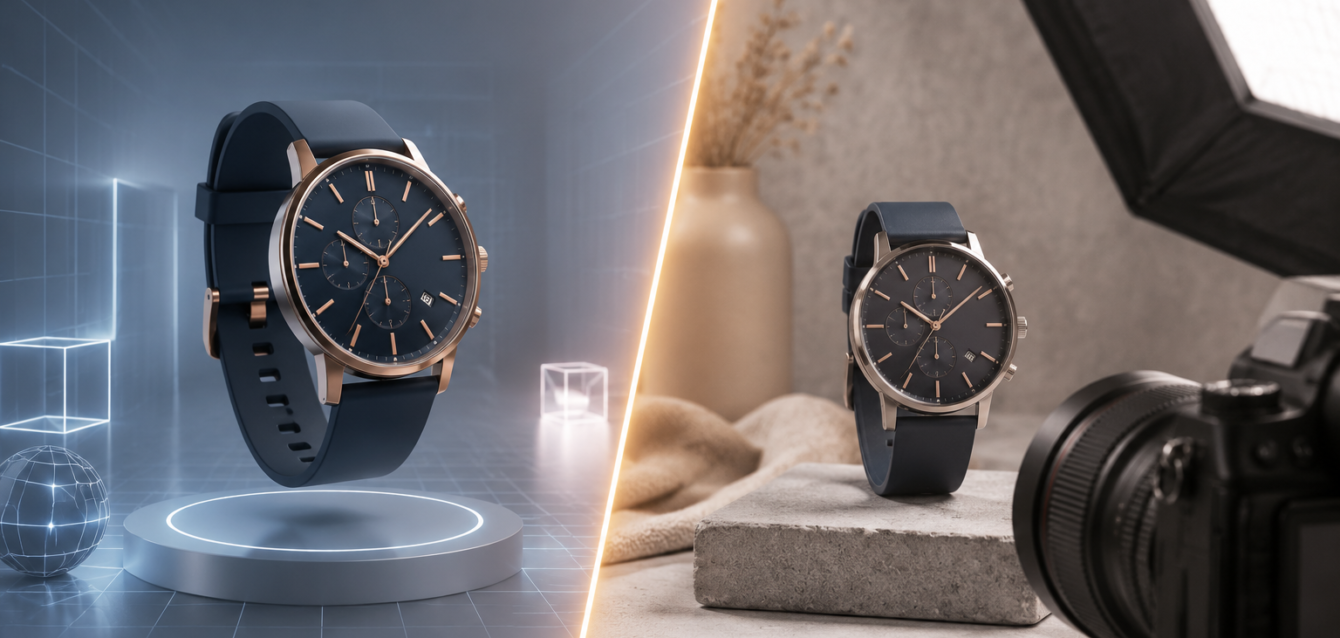
TL;DR: 3D rendering offers unlimited angles, instant material swaps, and zero reshoot costs—making it the better long-term investment for brands with growing catalogs. Traditional photography wins for speed-to-market on single products and authentic “real-world” feel. Most high-converting ecommerce brands in 2026 use a hybrid: 3D renders for configurators and AR, photography for hero shots and lifestyle imagery.
Every ecommerce brand faces the same challenge: how to show products online in a way that makes shoppers confident enough to buy. In 2026, two technologies dominate the visual content pipeline—3D rendering (CGI-generated product images) and traditional product photography (physical shoots with real products, cameras, and lighting). Both produce stunning visuals, but they differ dramatically in cost, flexibility, scalability, and conversion impact.
This guide compares 3D rendering vs traditional photography across every dimension that matters for ecommerce brands, so you can make an informed decision about where to invest your visual content budget.
What Is 3D Product Rendering?
3D product rendering is the process of creating photorealistic images from digital 3D models. A 3D artist builds a virtual model of your product, applies materials and textures, sets up virtual lighting, and renders the scene to produce images that are often indistinguishable from real photographs. The same 3D model can then be reused for 360° spins, AR experiences, product configurators, and animated videos.
The key advantage of 3D rendering is infinite flexibility. Once the model exists, you can render the product from any angle, in any color, with any material, in any environment—without ever touching a physical product or booking a studio.
What Is Traditional Product Photography?
Traditional product photography involves shooting real products in a studio with professional cameras, lighting, and backgrounds. A photographer sets up the scene, adjusts lighting for each shot, takes multiple exposures, and a retoucher cleans up the final images in post-production.
The strength of traditional photography is authenticity. Real products under real lighting capture nuances—fabric drape, glass refraction, metal reflections—that even the best CGI sometimes struggles to replicate perfectly. For lifestyle imagery (a model wearing apparel, a product in a real kitchen), photography remains the gold standard.
Head-to-Head: 3D Rendering vs Photography
1. Cost Comparison
Per-image cost: Traditional photography typically costs $50–$200 per final image, including studio time, photographer fees, and retouching. 3D rendering costs $30–$150 per image, but the cost drops dramatically as you render more angles from the same model—the first render might cost $300–$800 (including model creation), but each additional angle is just $20–$50.
For a 10-product catalog:
- Traditional photography (5 angles each): $2,500–$10,000
- 3D rendering (model + 5 angles each): $3,000–$8,000 upfront, but $500–$2,000 for additional SKUs
The break-even point is typically 8–15 images per product. Beyond that, 3D rendering becomes significantly cheaper because the model is already built and each new render is just a camera angle change.
2. Speed & Turnaround
Traditional photography is faster for small batches. A single product can be shot, retouched, and delivered in 2–5 days. But scaling to 50+ products requires multiple shoot days, studio bookings, and retouching queues—often 2–4 weeks.
3D rendering takes longer upfront—3–10 days to build a production-quality 3D model. But once the model exists, rendering 50 angles takes hours, not days. New color variants, material swaps, or angle changes can be delivered within 24 hours. For brands with large catalogs or frequent product updates, 3D rendering is dramatically faster at scale.
3. Flexibility & Iteration
3D rendering wins decisively. Want to show the product in 6 colors? Render each variant in minutes—no reshoot needed. Want a studio background change? Click a button. Want to add a new feature or updated packaging? Update the model once and re-render everything.
Traditional photography requires a full reshoot for any product change. New color variant? Book the studio again. Updated packaging? Reshoot every angle. This makes photography expensive for brands with frequent product iterations or customization options.
4. Visual Quality & Realism
This is where the gap has narrowed dramatically. In 2026, 3D rendering can achieve photorealism that fools even trained eyes. Advanced rendering engines like V-Ray, KeyShot, and Unreal Engine 5 simulate physical light behavior with such accuracy that CGI products are routinely used in major ad campaigns.
However, photography still wins in specific scenarios:
- Fabric and textiles—wrinkles, drape, and translucency are hard to simulate convincingly
- Food and beverages—steam, condensation, and texture often look more appetizing in real photos
- Lifestyle scenes with human models—real people in real environments still feel more authentic
- Products with complex surface interactions—frosted glass, iridescent finishes, anisotropic materials
5. Conversion Impact
Both approaches can drive strong conversion rates when executed well, but the data tells an interesting story:
- 3D renders with 360° spin increase conversion by 27–40% compared to static images alone
- 3D renders used in AR configurators drive the highest conversion lifts (40–94%) because shoppers can personalize and visualize products in their own space
- High-quality photography with lifestyle context increases conversion by 15–25%, with authenticity being the key driver
The highest-converting approach combines both: 3D renders for 360° spins, AR, and configurators, plus traditional photography for hero banner images and lifestyle context. This hybrid gives shoppers both the interactive exploration they want and the authentic “real product” reassurance they need.
6. Scalability
3D rendering is inherently more scalable. One 3D model can produce hundreds of images, a 360° spin, an AR experience, and an animated product video—all from a single digital asset. Adding a new product variant is a material swap, not a studio day.
Traditional photography scales linearly—each new product, color, or angle requires additional studio time. For brands with 100+ SKUs, the cost and time difference becomes enormous.
When to Choose 3D Rendering
- You have 10+ products that need multiple angles each
- Your products come in multiple colors, materials, or configurations
- You need 360° spins, AR experiences, or product configurators
- Your products are still in development and physical prototypes aren’t ready
- You frequently update or iterate on product designs
- You sell configurable products (furniture, jewelry, electronics, automotive parts)
When to Choose Traditional Photography
- You have a small catalog (under 10 products)
- You need lifestyle imagery with human models and real environments
- Your products are food, beverages, or textiles where physical textures matter
- You need images fast for a single product launch
- Your brand identity emphasizes craftsmanship and authenticity over digital precision
The Hybrid Strategy: Best of Both Worlds
Most successful ecommerce brands in 2026 don’t choose one or the other—they use both strategically:
- 3D renders for product detail pages, 360° spins, AR visualization, and configurators
- Traditional photography for hero banners, lifestyle editorial content, and social media
- 3D animation for product videos and explainer content
- Photography + 3D compositing for the best of both—real backgrounds with 3D-rendered products placed in them
This approach maximizes ROI: you get the scalability and flexibility of 3D rendering where it matters most (product pages, configurators, AR) while maintaining the authentic feel of photography for brand storytelling and social content.
Cost Comparison Summary
| Factor | 3D Rendering | Traditional Photography |
|---|---|---|
| Per-Image Cost | $30–$150 (drops with volume) | $50–$200 (flat per image) |
| Initial Model Cost | $300–$800 per product | $0 (no model needed) |
| Turnaround (first) | 3–10 days | 2–5 days |
| New Angle Cost | $20–$50 (render only) | $50–$200 (full reshoot) |
| Color Variant | Free (material swap) | $50–$200 (reshoot) |
| 360° Spin | Included (from model) | $200–$500 (specialized shoot) |
| AR Ready | Yes (same model) | No (requires separate 3D scan) |
FAQ: 3D Rendering vs Product Photography
Can 3D renders look as realistic as photos?
Yes. Modern rendering engines like V-Ray, KeyShot, and Unreal Engine 5 produce photorealistic images that are virtually indistinguishable from photography for most product categories. The main exceptions are products with complex physical textures like fabric drape, food, and certain glass effects, where photography may still hold a slight edge.
Is 3D rendering cheaper than product photography?
For small catalogs (under 8 products with few angles), traditional photography is often cheaper. For larger catalogs, configurable products, or brands that need many variants, 3D rendering becomes significantly cheaper because the 3D model is a one-time investment and each additional render costs a fraction of a reshoot.
Can I use 3D renders for Amazon product listings?
Absolutely. Amazon accepts 3D-rendered product images as long as they accurately represent the actual product. Many top-selling Amazon brands use 3D renders for their white-background product shots, 360° spins, and infographic images because they’re consistent, scalable, and cost-effective at volume.
Do I need to choose one approach exclusively?
No. The most effective strategy is a hybrid approach: use 3D rendering for product detail pages, 360° spins, AR experiences, and configurators, while using traditional photography for lifestyle imagery, hero banners, and social media content. This gives you both scalability and authenticity.
How long does a 3D model take to create?
A production-quality 3D model typically takes 3–7 days, depending on product complexity. Simple products (boxes, bottles, basic shapes) can be modeled in 1–2 days. Complex products (electronics with internal components, furniture with detailed upholstery, jewelry with intricate settings) may take 7–14 days.
Final Recommendation
For most ecommerce brands in 2026, 3D rendering is the strategic investment. It delivers the scalability, flexibility, and AR-readiness that modern ecommerce demands—while driving higher conversion rates through 360° spins and interactive configurators. Traditional photography remains valuable for lifestyle content and small catalogs, but as product catalogs grow and personalization becomes the norm, 3D rendering is the approach that scales with your business.
The smartest move? Build your 3D asset library now, supplement with photography where authenticity matters, and you’ll have a visual content engine that powers product pages, AR experiences, configurators, and social content from a single source.
Ready to create stunning 3D product visuals? Contact Ink & Algorithm to discuss your 3D rendering or product visualization project—we’ll help you build a visual content strategy that scales with your brand.