

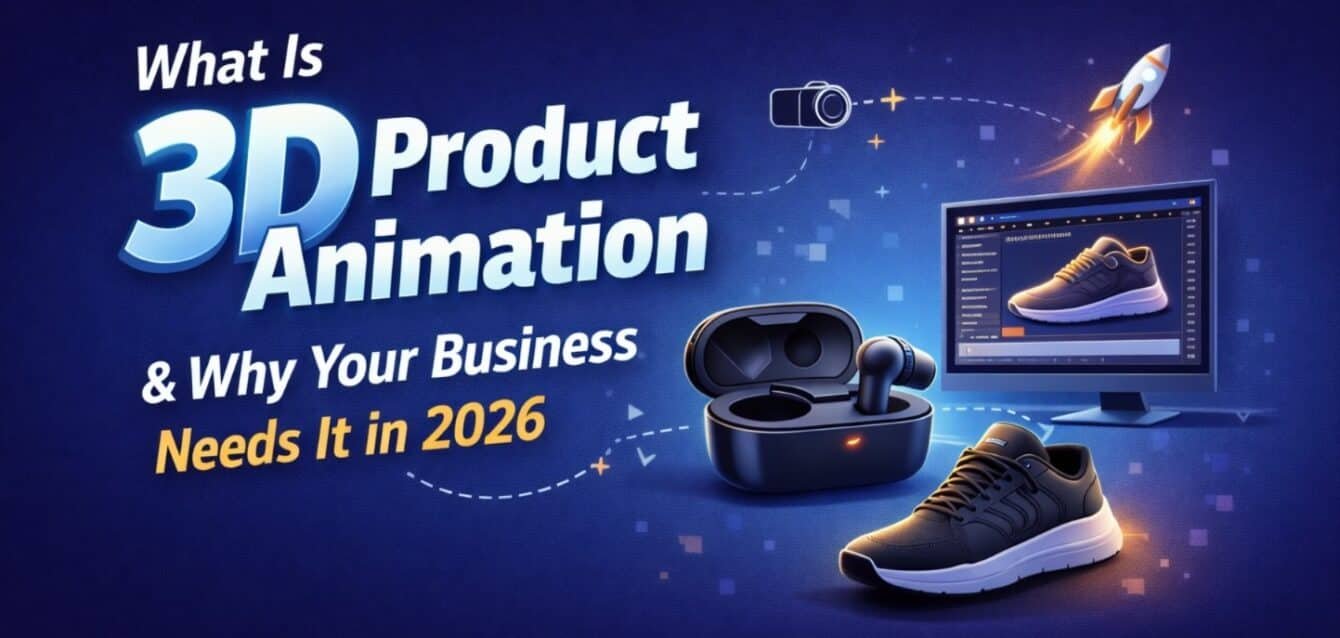
What Is 3D Product Animation?
At its core, 3D product animation is the art and science of creating computer-generated, three-dimensional moving visuals of a physical or conceptual product. Unlike a photograph that captures a single frozen moment from a single angle, a 3D animation gives your audience a complete, lifelike, fully controllable experience of what your product looks like, how it moves, how it functions — all without a physical prototype ever needing to exist.
Think of it this way: your brand has developed a next-generation wireless earbud. Instead of spending thousands on a photoshoot, coordinating a location, hiring a photographer, managing complex lighting, and then repeating the entire exercise when the colorway changes — you build a digital twin of the product. That digital twin can spin, float, fly apart into its components, and settle into a virtual living room. Once built, it costs almost nothing to iterate. That is the power of 3D product animation.
“A product people can see from every angle, in every context, without leaving the screen is a product they trust before they buy it.”
In 2026, this technology has become remarkably accessible. Platforms like Instagram Reels, TikTok, and even product pages on Amazon have trained consumers to expect dynamic, visually rich content. Static images are no longer enough to stop the scroll. Three-dimensional animation is how forward-thinking brands break through the noise.
How Does 3D Product Animation Work?
3D product animation is a digital process that brings products to life using advanced 3D modeling, rendering, and motion techniques. It allows businesses to showcase their products in a highly realistic and interactive way before they are physically manufactured or used.
The process starts with 3D modeling, where a digital version of the product is created with precise details, including shape, structure, and texture. Once the model is ready, designers apply materials, lighting, and textures to make it look realistic and visually appealing.
Next comes animation and motion design, where the product is brought to life. This can include rotating views, exploded diagrams, functional demonstrations, or dynamic movements that explain how the product works. This stage helps customers understand the product’s features more clearly.
After animation, the scene goes through rendering, where powerful software processes the visuals into high-quality images or videos. This step ensures smooth motion, realistic lighting, and professional-grade output.
Finally, the animation is optimized for different platforms such as websites, social media, and marketing campaigns, making it a powerful tool for product marketing, e-commerce, and brand storytelling.
Overall, 3D product animation helps businesses improve customer engagement, increase conversions, and present their products in a more interactive and impactful way.
It may look like magic, but the process is a multi-stage, disciplined production pipeline. From a client’s brief to the finished commercial asset, here is how a 3D product animation of world-class quality comes to life:
| 01 | Discovery & Asset Collection
The studio collects all available references — CAD files and product specs, technical drawing, physical samples, branding guidelines, and creative briefs. This phase defines the purpose of the animation: Is it to reveal a 360-degree view of a product? Technical explainer? A lifestyle video? The more precise the brief, then the more sharply the output. |
| 02 | 3D Modelling
Artists create a digital geometry that is precise using industry standard software, such as Blender or Cinema 4D. Modeling is done to exact measurements for every curve, edge and panel gap. Modeling complex medical or electronics devices can take days. This digital model is a master asset that your brand will own forever. |
| 03 | Texturing & Materials
The model is given its skin. Texturing artists use PBR pipelines to assign realistic surface properties: brushed metal appears brushed, matt plastic appears matte, and glass refracts the light with real optical accuracy. It is often impossible to tell the difference between a render and product photography because light behaves according to physics, not how a photographer wants it. |
| 04 | Rigging & Animation
The digital skeleton is rigged on any moving parts, such as a hinge that folds, a dial that rotates, or a lid which opens. Animations are keyframed for every movement: a capsule opens to reveal the payload inside, a blade of a turbine spins and a smartwatch’s screen lights up. Each movement is choreographed in order to support the story that the brand wishes to tell. |
| 05 | Lighting & Environment
Virtual lighting rigs can be built around a product to create depth, mood and visual hierarchy. One luxury fragrance could float in an almost-dark studio, lit by a cinematic rimlight. A toy for children might be placed in a sun-filled, warm playroom. HDRI maps are used to create photorealistic ambient lighting that is physically accurate. |
| 06 | Rendering
A render engine (such as Arnold, Cycles V-Ray or Redshift) calculates the behavior of each virtual photon in light when it bounces around the scene. It can take hours or minutes to calculate a single frame. Modern GPU farms and cloud render pipelines have drastically reduced turnaround times. 2026 production cycles are now faster than ever. |
| 07 | Post-Production & Delivery
After Effects and DaVinci Resolve are used to assemble the rendered frames. Here, motion graphics, typography and sound design are done, as well as voiceovers, color grading and format optimization. The final deliverable has been sized to fit every deployment context. A 4K master is delivered, as well as a social cut in 1080p, an Instagram square format, TikTok vertical, and a compressed version of the web page. |
3D Product Animation
Not all 3D animations are created for the same purposes. You will select a format based on your business objectives and audience. Each has its own strengths, and is best deployed in a specific context.
| 360-Degree Turntable
The product is rotated slowly in a studio setting, revealing all angles in one continuous movement. This is the mainstay of ecommerce animation – it replaces the multi-angle photo gallery by a single fluid visual that builds confidence. Ideal for: Fashion accessories, consumer electronics and footwear. Also, any other product that is sold online, where the buyer cannot examine the product before purchasing. |
| Exploded view Animation
This product is disassembled in mid-air. Each component floats outward to reveal the internal architecture, before snapping together. This technique is particularly effective for technical products, where the ability to demonstrate quality of build is a primary purchasing factor. Ideal for: Industrial machinery, consumer electronics and medical devices. Automotive parts. Premium products. |
| Contextual Animation / Lifestyle
The product is placed in a virtual world — a kitchen, a mountain, or a modern office. It may be manipulated by characters or hands. This format is more than a technical specification. It sells an experience. This is a format of aspiration. Ideal for furniture, smart home appliances, apparel, premium FMCG and other products where lifestyle context is as important as the product itself. |
| Animation of the Mechanism of Action (MOA)
This is a specialized format that’s used by pharma, biotech and medical devices to demonstrate how a product functions at the system or molecular level. These animations show the invisible – how a drug attaches to a receptor or how a stent is deployed in an artery. Ideal for: Clinical presentations, investor decks and regulatory submissions. Also suitable for HCP education. |
| Architectural Visualization
These are photorealistic tours of interiors and exteriors that have not yet been built, such as residential developments, commercial interiors or retail environments. By 2026, they will replace scale models and physical model rooms. Ideal for: Real estate developers, interior designers, hospitality brands and retail chains. |
3D Animation: What’s the difference? Traditional Photography
Every marketing director asks the same question: Why invest in 3D when we can just photograph the product? This comparison provides a definitive answer. The gap between traditional production costs and 3D technology is growing every year.
| Factor | Traditional Photography | 3D Product Animation |
| Physical prototype required | Always required | No need to purchase CAD files |
| 360-degree View | Multi-shot multi-work rig | Easy & seamless |
| Internal component reveal | It is impossible to damage the sand without damaging it | Standard workflows are now built into the standard workflow |
| Switching Colors / Variants | Every time you shoot, it’s a new shot | One-click material swap |
| Environment Flexibility | Limitations by location/budget | Imagine any environment |
| Asset reusability | Low — Reshoots Needed | High — model reusable indefinitely |
| Pre-launch viability | First, the product must exist | Work from only design files |
| Cost trajectory over the long-term | Every shoot increases the amount of money you earn | As assets are amortized, the value of assets decreases |
For editorial contexts that demand unaltered authenticity, traditional photography is still a viable option. 3D animation is the best option for commercial content that focuses on products and can be deployed across platforms, variations, and markets. It offers greater flexibility, greater scale, and better long-term economics.
Business Benefits for 2026
1. This eliminates the purchase hesitation at scale
Uncertainty is the number one reason why online shoppers abandon their carts. They can’t touch the product. They can’t see the fit or the way the light hits the texture. A 3D animation that is well done answers all the unspoken questions — size, texture, functionality and color accuracy — even before customers realize they are asking. This results in higher add-to cart rates, lower returns, and fewer customer support inquiries.
2. The time-to-market is dramatically accelerated
Marketing materials are not created in traditional workflows until there are physical samples. Your marketing team can produce launch-ready content in the same week as the final product design — working perfectly parallel to engineering. This parallel production pipeline can reduce the product launch cycle by weeks or even months, giving you a competitive edge in categories that move quickly.
3. This creates an infinitely reusable brand asset
After your product has been modeled in 3D it belongs to you and your brand forever. Want it for a December Christmas scene? Done in hours. New color variants for Q2? Material swap. Product landing page hero image? Render a static image. You can create a teaser video for social media. Export the clip. The 3D model has a high value that will compound with every marketing touchpoint.
4. It Wins Attention Economy
The first 1.5 seconds on social media platforms determine whether a user scrolls by or engages. The human eye is naturally drawn to motion. It’s hardwired in our biology as an opportunity and threat detection mechanism. The attention of a product that rotates, floats and disassembles can be captured in a way that flat images cannot. Motion is no longer a luxury in the age of endless scrolling. It’s a strategy for survival.
5. The Premium Brand is Immediately Perceived.
A high-quality 3D animated message signals professionalism, investment and attention to detail. The production quality of marketing materials is subconsciously associated with the quality and value of your product. Brands with polished CGI will be perceived as premium, even if they are selling the same product at the same price point. Perception is positioning.
6. In 2026, it will be the driving force behind AI-driven commerce
Most brands are not fully aware of this factor: the rise in AI shopping assistants and 3D native product viewers integrated directly into search results. Google, Apple and Meta all invest heavily in 3D content and spatial computing. Brands with high-quality 3D content will be the first to populate these surfaces. Brands who don’t will have to scramble to catch up, at a much higher cost than creating assets today.
The Industries that Benefit the Most
Most industries that sell something have embraced 3D animation. Certain sectors, however, have adopted 3D animation in particular with enthusiasm and have seen the most dramatic results.
| >>> E-Commerce and D2C Brands
The 360-degree viewer and explainer videos reduce returns and increase conversions in categories ranging from sporting goods to beauty products. |
Consumer Electronics
Exploded views of internal engineering create premium perceptions for smartphones, wearables and home technology. |
| Healthcare & Medical Devices
MOA animations are a unique way to explain complex mechanisms in a clear and concise manner. They can be used by clinicians, investors, or patients. |
>>> Architecture & Real Estate
Photorealistic walkthroughs are used to sell off-plan development before even a foundation has been poured. |
| Automotive
Animations of feature reveal, configurator assets and safety technology explainers are used to engage consumers and train dealers. |
Furniture & Home Goods
Customers can visualize their products in real spaces with AR-ready models and lifestyle renders. |
| >>> Packaging & FMCG
Pack-shot animations can replace studio shots for seasonal campaigns. This allows rapid production of variants at scale. |
Luxury & Jewellery
The ultra-detailed rendering of materials communicates craftsmanship and exclusivity in a way that photography cannot match. |
The data: Why the numbers don’t lie
Adoption of 3D animation for products is driven not only by aesthetics, but also by repeatable and measurable business results. The data shows the following:
| 40%
Avg. Increased conversion rates on product pages using 3D interactive visuals |
25%
Reduced product returns by retailers using 3D visualisation tools |
80%
Video is helpful to consumers when they are researching products before purchasing |
| 3x
Social media engagement is higher when 3D content is used instead of static images |
66%
Shoppers say that 360-degree views increase their confidence when shopping online |
$500B+
Global CGI market projected value at 18% compound growth by 2028 |
These aren’t vanity metrics, but direct indicators of impact on revenue. A 3-percentage point increase in conversion rates from 3D visualisation can result in an extra $30,000 of revenue for a company that generates $1 million in online revenue per year. This is often more than the cost of animation. This ROI is not a theoretical case. The ROI case is well documented in all categories, from cosmetics to electronics to industrial equipment.
Get Started
It’s easier than you think to get your first 3D animation up and running. Knowing what to do and what questions you should ask your animation partner is key. Here’s a practical checklist for pre-production:
| How to Prepare for a Studio Briefing
Ideal for product assets are CAD files (.STEP..OBJ..FBX). As an alternative, high-resolution photography of every angle is effective. Brand guidelines: Color codes and typography are used to ensure that the animation is consistent with the brand. What is your animation objective? Are you aiming to increase product awareness, explain a feature or convert a customer at the decision point? Each goal requires a different creative approach. Platforms to target: Where will the content be displayed — on a product webpage, in a social media ad paid for, at a tradeshow display, or as a presentation? Each platform has a different format, aspect ratio, resolution and duration requirement. Reference examples: Share three to five animations that you admire. Style references can save you a lot of time in the creative alignment phase. Transparency in terms of budget and timeline allows studios to make the best use of resources available. |
Look for studios that have a proven track record in your industry. Ink N Algorithm combines technical precision and creative strategy in order to produce animations that are not only beautiful but also commercially successful.
Conclusion:
The digital shelf in 2026 will be more crowded, competitive and visually demanding than ever before. Brands that are winning online have chosen to be different. They use content that surprises, moves, explains and convinces even before the first word is read.
The luxury of three-dimensional product animations is not reserved only for multinational corporations with marketing budgets in the nine-figure range. This is a tool that can be used by businesses of all sizes to gain attention, build trust and achieve measurable results.
It is not a question of whether 3D Animation is worth the investment. It’s not a question of whether 3D animation is worth investing in, but rather whether your competitors are going to invest before you — and if you can afford it.
Every day that your product is only represented by static images, your competitor is making money off of their 3D animation. “
Ink N Algorithm believes that every product should be presented at its best. Not just photographed but also animated, contextualized and experienced. Our team can bring your product to the next level, whether you’re launching a brand new product or updating an old line to fit a new decade.
Frequently asked questions
Here are the most common questions that we get from clients who are considering 3D animation of products for the first-time. They’re answered directly and without any filler.
What is 3D Product Animation?
A 3D animation is a computer generated visual production in which a digitally-modeled product is lit, textured and animated. Brands can showcase their products in a dynamic way — rotating, exploding, or interacting with the environment — without having to use physical prototypes. The results range from simple videos on a turntable to narrative commercials that are entirely CGI.
Is a physical item required to create 3D animations?
This is one of the greatest advantages that 3D animation has. If you provide design files, such as CAD drawings and technical specifications to a skilled team of animators, they can create an accurate digital version before the product is even built. You can have your marketing content ready to go on launch day and not wait weeks.
How much time does it take to create a 3D animation of a product?
From briefing to delivery of a simple 15-30 second turntable video, it usually takes between 2 and 4 weeks. This includes 2 or 3 rounds for client revisions. Productions that are more complex — such as lifestyle environments, exploded view, and long-format explainers — can take 4 to 8 weeks. GPU cloud rendering allows for a faster turnaround time, but at a higher cost.
Do I get to keep the 3D model once the project is completed?
It depends on the contract that you sign. Ink N Algorithm offers full IP ownership for 3D source files. This means that you can use the model in future animations, AR experiences or configurators. Clarify IP ownership prior to signing any production agreements with studios.
Can 3D Animations be used for augmented reality?
This is a very important frontier for 3D content. It will be a major commercial force in 2026. Models that are created for animation can then be exported into AR-compatible formats, such as USDZ for Apple, WebAR, GLB, or Android, and used in AR experiences, including on product pages, mobile apps, and social media filters. Brands that use AR product visualization report consistently higher engagement rates and lower return rates.
Can 3D product animation improve SEO and AI searches?
Indirectly, but meaningfully. The average time spent on a page is increased by videos with animations. This behavior signal is important for search algorithms. They lower bounce rates on landing pages. Google’s AI powered search will increasingly surface rich media results in 2026. Brands with high-quality videos are better placed to secure featured placements. Structured content — such as transcripts, schema marksup and descriptive metadata — can also be used to support both traditional SEO strategies and emerging GEO.
| Ready To Animate Your Products?
What can 3D animation do for your brand? Your conversions and your marketing strategy for 2026 |


