

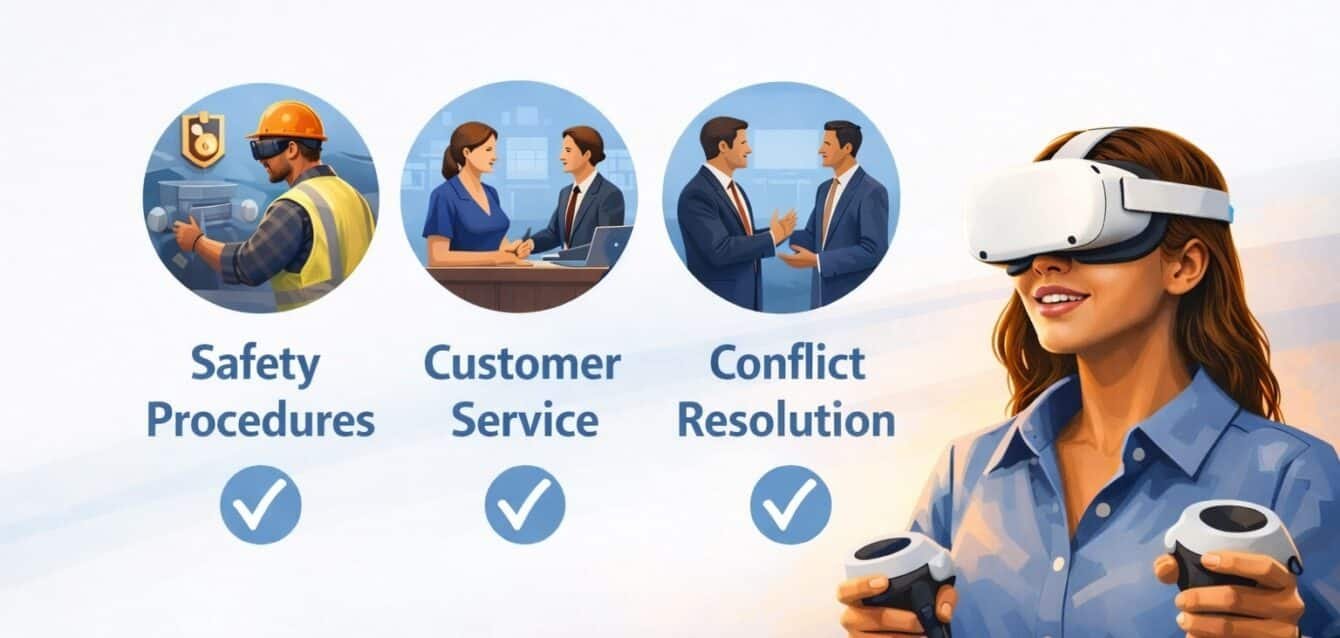
TL;DR: How VR Training Simulations Are Transforming Employee Onboarding. Learn about costs, features, ROI, and how US brands use this technology in 2026.
Picture your first day at a new job. You sit through hours of slide presentations, sign a stack of compliance forms you will never read again, shadow a colleague who is too busy to explain anything clearly, and leave the building wondering whether you made the right decision. According to research, more than 20 percent of employee turnover happens within the first 45 days of employment. The onboarding experience is not a minor administrative formality — it is one of the most consequential moments in an employee’s entire relationship with a company.
Virtual reality training simulations are fundamentally changing that story. In 2026, forward-thinking organisations across healthcare, retail, manufacturing, aviation, finance, and hospitality are replacing the slide deck with the headset — and seeing results that traditional onboarding programmes simply cannot match. This guide explains exactly what VR training simulations are, how they work, why they are so extraordinarily effective, and how to evaluate whether they belong in your organisation’s onboarding strategy.
1. What Are VR Training Simulations?
Virtual reality training simulations are immersive, computer-generated environments in which employees can practise real-world tasks, navigate complex scenarios, and make consequential decisions — all without any of the real-world consequences that make on-the-job learning so costly, dangerous, or emotionally stressful.
Unlike watching a training video or reading a procedure manual, VR places the learner inside the experience. Using a headset and motion controllers, a new warehouse operative can practise loading a forklift truck in a virtual distribution centre. A newly hired hospital nurse can respond to a simulated patient deterioration event. A customer service representative can navigate an angry customer interaction before they encounter one on a real call. The body and the brain respond to these simulated environments with remarkable biological genuineness — pulse rises, focus sharpens, and procedural memory forms just as it would in a real situation.
“VR does not teach employees what to do. It gives them the experience of having done it before they ever need to do it for real.”
This is the fundamental distinction that makes VR training so effective: it moves learning from the cognitive domain into the experiential domain. Research in neuroscience consistently shows that humans learn and retain information most effectively through doing and experiencing, not through passive reading or listening. VR is the first technology capable of delivering genuine experiential learning at the scale and consistency that modern organisations require.
2. The Onboarding Crisis That Nobody Is Talking About
Before we explore the solution, it is worth understanding the scale of the problem. Employee onboarding as it is commonly practised in 2026 is broken in ways that are expensive, largely invisible, and almost universally accepted as normal.
The Forgetting Curve Is Working Against You
Hermann Ebbinghaus’s forgetting curve — documented over a century ago but as relevant today as ever — demonstrates that without reinforcement, humans forget approximately 70 percent of new information within 24 hours. Traditional onboarding, which front-loads a week of information into a new employee’s first days, is almost perfectly designed to trigger this forgetting response. By the time the employee needs to recall a procedure or policy, the information has largely been overwritten by the demands of actually doing the job.
The Safety and Compliance Liability
For organisations operating in regulated industries — healthcare, energy, construction, aviation, food processing — the consequences of an undertrained new employee go well beyond poor performance. Workplace accidents disproportionately involve new workers in their first months on the job. Compliance failures during the onboarding window can trigger regulatory investigations, personal liability claims, and reputational damage that dwarfs any investment in better training. Traditional compliance training — click-through eLearning modules and video watches that require a signature — does not produce competence. It produces a paper trail.
The Consistency Problem at Scale
When your organisation operates across dozens of sites, shifts, or countries, every single onboarding experience is subtly or dramatically different depending on who delivers it and when. A great team leader produces great onboarding. A burnt-out manager produces terrible onboarding. A busy period means shortcuts. VR training simulations deliver an identical, quality-controlled learning experience to the ten-thousandth employee as they delivered to the first.
3. How VR Training Simulations Actually Work
Understanding the mechanics behind VR training helps demystify it and makes the business case far easier to evaluate. Here is a clear breakdown of how these systems are built and deployed:
| 01 | Needs Analysis & Scenario Mapping
Every effective VR training programme begins with a deep analysis of what the organisation actually needs new employees to know and be able to do on Day 30, 60, and 90. Scenario designers work with subject-matter experts to map the critical tasks, decision points, common errors, and emotional situations that new employees will face. This phase determines what gets simulated and why. |
| 02 | Environment and Character Design
Three-dimensional artists and developers build photorealistic replicas of the actual workspaces employees will inhabit — the factory floor, the hospital ward, the customer service desk, the data centre. AI-driven characters are designed to behave with genuine variability: an angry customer does not always use the same script; a patient’s condition deteriorates at different rates; a supervisor provides feedback in different tones. |
| 03 | Branching Scenario Development
Unlike linear video training, VR scenarios branch based on every decision the learner makes. Choose to take a shortcut in the safety procedure, and the simulation responds with a realistic near-miss event. Handle the customer interaction with empathy and patience, and the scenario resolves positively. The branching logic is what makes VR training genuinely adaptive rather than simply visual. |
| 04 | Data Layer Integration
Every interaction inside the VR environment is recorded: where the employee looked, how long they paused before making a decision, which steps they completed out of sequence, how their heart rate (via biometric sensor) responded to stressful situations. This data layer feeds into a learning management system (LMS) and provides managers with objective, behavioural insight into each learner’s readiness that no traditional assessment can match. |
| 05 | Hardware Deployment & Scaling
Modern standalone VR headsets — requiring no PC, no cables, no dedicated room — have made large-scale corporate deployment genuinely practical. Headsets can be pre-configured and shipped to any location globally. Device management platforms allow IT teams to push content updates, monitor usage, and manage hundreds of headsets from a central console, exactly as they would manage any other employee device. |
| 06 | Iteration and Content Refresh
Unlike a printed training manual or a filmed induction video, VR content can be updated rapidly as procedures change, regulations evolve, or new risks are identified. A policy change that used to require reprinting materials and retraining trainers can now be pushed as a content update to every headset in the organisation within hours. |
4. VR vs. Traditional Onboarding: A Clear-Eyed Comparison
The debate between traditional and VR onboarding is often framed as a question of novelty versus familiarity. It should be framed as a question of effectiveness versus tradition. Here is an honest comparison across the dimensions that matter most to organisations:
| Dimension | Traditional Onboarding | VR Training Simulation |
| Learning Speed | Slow — lecture & reading dependent | Up to 4x faster with immersive practice |
| Knowledge Retention | 10–20% retained after 1 week | 75%+ retained after 12 months |
| Error-Safe Practice | Mistakes carry real-world consequences | All mistakes happen in a safe sandbox |
| Emotional Engagement | Low — passive information intake | High — adrenaline, presence, empathy |
| Geographic Scalability | Costly to replicate across locations | Identical experience everywhere, always |
| Performance Measurement | Subjective manager assessments | Objective real-time behavioral data |
| Cost Over Time | Recurring trainer & venue costs | Depreciates — model built once, used many |
| Customisation Depth | Generic curriculum for all roles | Role-specific branching scenarios |
What this table cannot fully capture is the qualitative difference in how employees feel after VR onboarding versus traditional programmes. Research consistently shows that employees who complete immersive VR inductions report higher confidence in their ability to perform their role, stronger identification with the organisation’s values, and a more pronounced sense that the employer genuinely invested in their success — all of which are predictors of longer tenure and higher engagement.
5. Six Transformative Benefits for Modern Organisations
Benefit 1: Retention That Actually Sticks
The science of memory is unambiguous: we retain what we experience far more reliably than what we are told. Studies comparing VR-based learning with traditional classroom training consistently find that VR learners retain significantly more information after periods of weeks and months. In practical terms, this means fewer errors, faster time-to-competence, and lower remedial training costs throughout the employee’s first year.
Benefit 2: A Psychologically Safe Space for High-Stakes Practice
One of the most underappreciated benefits of VR training is psychological safety — the freedom to make mistakes without fear of judgement, injury, or serious consequence. In a traditional healthcare onboarding environment, for example, a new nurse who hesitates during a simulated emergency feels embarrassed in front of colleagues. In VR, she can freeze, make the wrong call, see the outcome unfold, reset, and try again as many times as she needs. This freedom to fail safely accelerates competence development in ways that supervised on-the-job training cannot replicate.
Benefit 3: Building Empathy and Cultural Intelligence
Some of the most innovative applications of VR onboarding are not procedural but empathetic. Major retailers have used VR to allow new employees to experience a shopping trip through the eyes of an elderly customer navigating the store with impaired mobility. Large financial institutions have onboarded employees into VR scenarios that simulate the experience of a customer in financial crisis. These empathy simulations produce measurable improvements in customer satisfaction scores and employee communication quality that no amount of classroom instruction achieves.
Benefit 4: Objective Readiness Data That Protects the Organisation
When a new employee causes an accident, the regulatory question is always the same: Was this person adequately trained? In a traditional onboarding programme, the answer is a stack of signed forms and a trainer’s verbal assurance. In a VR onboarding programme, the answer is a detailed, timestamped, behaviour-level record of exactly how many times that employee practised the procedure, which steps they consistently completed correctly, which decision points required multiple attempts, and what their physiological stress response looked like under simulated pressure. This is not just better training — it is better legal and regulatory protection.
Benefit 5: Dramatically Reduced Time-to-Productivity
Traditional onboarding often takes weeks or months before a new employee is genuinely productive in their role. The learning curve is long because mistakes happen on real tasks with real consequences, slowing both the employee and their team. VR training compresses this curve by allowing employees to build procedural fluency before their first day on the actual job. Studies in retail, manufacturing, and logistics consistently find that VR-trained employees reach independent competence 30 to 50 percent faster than their traditionally trained counterparts.
Benefit 6: A Powerful Statement About Organisational Values
In 2026, attracting and retaining talent is as competitive as any market a business competes in. The investment an organisation makes in its new employees’ onboarding experience sends an unmistakable signal about its values, its ambition, and its respect for the people it hires. Candidates comparing two job offers are increasingly noting which employer offered the more sophisticated, thoughtful, and technologically advanced onboarding process. VR induction is not just a training tool — it is a talent brand statement.
6. The Numbers Behind the Transformation
The business case for VR onboarding is no longer theoretical. Documented outcomes from deployments across industries paint a compelling picture:
| 4×
Faster learning speed vs. classroom-based training |
75%
Long-term knowledge retention after 12 months in VR |
40%
Reduction in onboarding-related errors in early tenure |
30%
Lower employee turnover within the first 90 days |
| $300B+
Global VR in enterprise training market projection by 2028 |
3.5M+
VR headsets deployed in corporate training environments in 2025 |
94%
Of VR-trained employees feel emotionally ready for their role |
50%
Faster time-to-competence in skilled trade and technical roles |
7. Industries Leading the VR Onboarding Revolution
VR training simulations have found fertile ground across a wide range of sectors. These are the industries where adoption is most advanced and outcomes most documented:
| 🏥 Healthcare & Nursing
New clinical staff practise patient interactions, emergency responses, and procedure execution in simulated ward environments before encountering real patients. |
🏭 Manufacturing & Logistics
Machinery operation, safety protocols, and quality inspection procedures are mastered in virtual factory floors that mirror the real facility exactly. |
| ✈️ Aviation & Aerospace
Crew resource management, emergency procedures, and safety briefing delivery are simulated with the fidelity and data capture that traditional drills cannot provide. |
🏪 Retail & Hospitality
Customer interactions, store layout navigation, stockroom operations, and brand culture immersion are delivered as consistent, scalable VR experiences. |
| 💳 Financial Services
Compliance scenarios, fraud identification, difficult client conversations, and regulatory procedure adherence are practised in consequence-free simulated environments. |
🏗️ Construction & Utilities
Site hazard recognition, equipment operation, emergency evacuation, and height-work safety are experienced with physical realism that classroom training cannot reproduce. |
| 🧪 Pharmaceutical & Biotech
Cleanroom protocol, laboratory safety, and sterile manufacturing procedures are practised in virtual environments before employees enter regulated production areas. |
📡 Technology & Data Centres
Server room procedures, cable management, cooling system operation, and incident response workflows are trained in photorealistic digital twins of actual facilities. |

8. Honest Challenges to Consider
A genuine guide acknowledges the full picture. VR onboarding is powerful, but it is not without legitimate challenges that organisations should evaluate carefully before committing to implementation:
| ⚠️ Upfront Development Investment
High-quality VR scenario development requires a meaningful initial investment in design, development, and testing. Simple interactive simulations may be achievable in the lower tens of thousands; photorealistic, multi-branching scenarios for complex roles can run significantly higher. The ROI case is strong — but the upfront number requires senior stakeholder alignment. Mitigation: Begin with your highest-risk, highest-volume onboarding scenarios — those where training failures are most costly. The ROI from even a single well-targeted module often funds the next phase of development. |
| ⚠️ Motion Sickness & Physical Accessibility
A small proportion of users — typically 5 to 10 percent — experience discomfort or motion sickness during VR experiences, particularly in scenarios involving locomotion. Modern headsets have significantly reduced this incidence through improved refresh rates and reduced latency, but it remains a factor. Mitigation: Design onboarding programmes to include both VR and non-VR components. Ensure VR modules are accessible alternatives, not mandatory gateways, for employees with relevant physical conditions. |
| ⚠️ Content Maintenance and Currency
VR training content that is allowed to drift out of date becomes not just useless but actively harmful — training employees in procedures that no longer reflect current practice. Content governance must be built into the programme from day one. Mitigation: Build content refresh cycles into the programme management plan and contract with your VR development partner for update support. Modular scenario design makes targeted updates far cheaper than full rebuilds. |
9. How to Evaluate and Implement VR Onboarding
For organisations considering their first VR training initiative, the path from interest to implementation is more navigable than it might appear. Here is a practical framework for doing it right:
- Identify your highest-value onboarding scenarios: Do not start with everything. Identify the two or three onboarding situations where failure is most costly — safety incidents, compliance breaches, high-value customer interactions, or complex technical procedures. These are your priority modules.
- Audit your existing content: VR enhances and replaces training content; it does not create it from nothing. Review your current onboarding curriculum and identify the scenarios that are most engaging in live delivery — these are likely your best VR candidates.
- Pilot with a defined cohort: Run a controlled pilot with 20 to 50 new employees alongside a control group following the traditional programme. Measure knowledge retention, time-to-competence, error rates in early tenure, and employee satisfaction scores. Let the data make the case.
- Evaluate partners on content quality, not just technology: The VR headset is a commodity. The quality of the scenario design, the fidelity of the environment, and the sophistication of the data layer are what differentiate a training programme that works from one that impresses on a demonstration day and underperforms in daily use.
- Plan your content governance from day one: Define who owns content accuracy, how update requests are submitted, how frequently modules will be reviewed, and who has authority to approve changes. Content governance failures are the most common reason VR programmes decay after an initially strong launch.
10. Frequently Asked Questions
These are the questions organisations ask most often when evaluating VR onboarding for the first time.
Is VR training suitable for non-technical employees?
Absolutely. Some of the most compelling VR onboarding deployments are in frontline retail and hospitality roles, where the training is not about operating equipment but about navigating human situations — handling a difficult customer, responding to a health and safety incident, communicating a brand message. If there is a human interaction or a procedural task in the role, there is a VR training scenario that can prepare an employee for it more effectively than any alternative format.
How long does it take to develop VR training content?
A focused, single-scenario VR module typically takes 8 to 16 weeks from briefing to deployment, depending on the complexity of the environment, the number of decision branches, and the fidelity required. More sophisticated multi-scenario programmes for complex roles can take 6 to 12 months for initial launch. Many organisations begin with off-the-shelf VR content for generic compliance and safety training while commissioning custom content for role-specific scenarios.
What hardware does VR training require?
Modern enterprise VR programmes predominantly run on standalone headsets that require no PC, no cables, and no dedicated room. A basic training station requires only a headset, a charging dock, and a Wi-Fi connection. Device management platforms allow central content management across unlimited headsets, making large-scale deployment straightforward for IT teams already managing a fleet of mobile devices.
Can VR training replace human mentors entirely?
No — and the best programmes are not designed to. VR excels at procedural fluency, safety-critical scenario practice, and consistent information delivery. Human mentors excel at contextual judgment, relationship building, and the kind of informal knowledge transfer that no simulation can fully replicate. The most effective onboarding programmes in 2026 use VR to accelerate the technical foundation, freeing human mentors to focus on the relational and contextual dimensions of development.
How do we measure the ROI of VR onboarding?
ROI calculation should track: reduction in onboarding-related errors and incidents in early tenure, reduction in time-to-competence measured against performance benchmarks, reduction in remedial training costs, improvement in 90-day retention rates, and improvement in new employee engagement scores. Organisations that measure these metrics consistently find that well-designed VR programmes pay back their investment within the first 12 to 24 months of deployment, with ongoing returns as the asset base scales.
11. The Future Belongs to Organisations That Train Differently
The first 90 days of an employee’s experience at your organisation shapes almost everything that follows: their confidence, their safety, their sense of belonging, their likelihood to stay, and their capacity to deliver value. Getting those 90 days right is not an HR box-ticking exercise — it is one of the highest-leverage investments a business can make.
Virtual reality training simulations are not a technology in search of a problem. They are a remarkably well-matched solution to one of the most persistent, expensive, and consequential failures in modern organisational management: the gap between what employees are told during onboarding and what they are actually able to do when it matters.
The organisations leading in this space are not the biggest or the most technology-obsessed. They are the ones that understood, before their competitors did, that the way you welcome someone into your organisation tells them everything about the organisation they have joined. They chose to welcome new employees with genuine preparation, genuine investment, and genuine respect for the learning science that actually works.
“The question is no longer whether VR onboarding works. The question is whether your competitors will deploy it before you do.”
At Ink N Algorithm, we work with organisations to design, develop, and deploy immersive training and content experiences that change the way people learn, perform, and connect with their work. Whether you are taking your first step into VR onboarding or scaling an existing programme, we bring the creative precision and strategic depth to make it genuinely transformative.
| Ready to Reimagine Your Onboarding?
Let’s talk about how immersive VR training can reduce turnover, accelerate competence, and transform your people strategy. |
Ready to get started? Contact Ink & Algorithm to discuss your project—we’ll help you create results that drive sales.
FAQ
How much does vr training simulations are transforming cost?
The cost varies based on project scope and complexity. Contact us for a custom quote tailored to your specific needs.
How long does vr training simulations are transforming take?
Typical projects take 2-8 weeks depending on scope. We provide detailed timelines during consultation.
Do you work with US brands?
Yes, we work with US brands across all 50 states. Our team understands the US market and delivers solutions that drive results.