
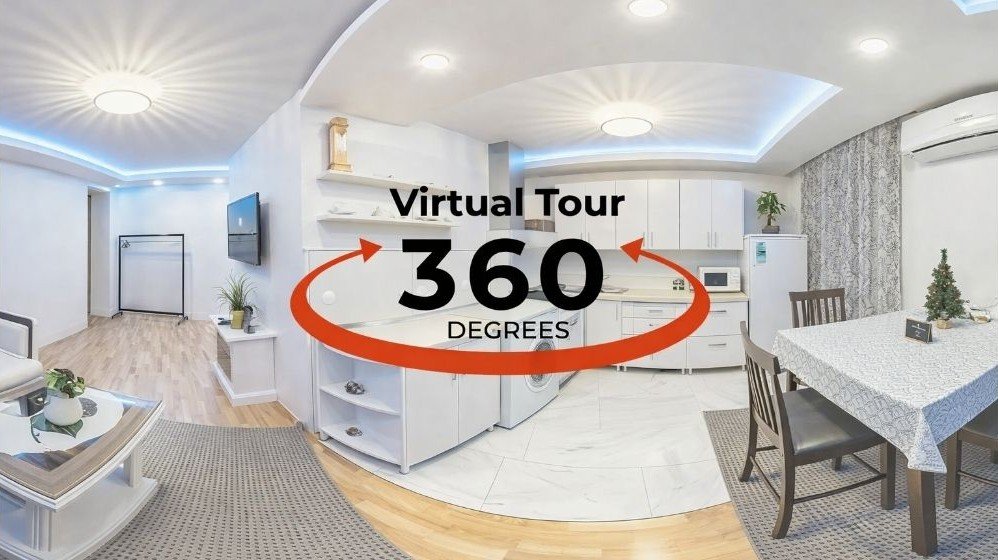
TL;DR: 360 Virtual Tours for Real Estate. Learn about costs, features, ROI, and how US brands use this technology in 2026.
INTRODUCTION
The way properties are discovered, evaluated, and shortlisted has fundamentally shifted. Buyers today are more informed, more mobile, and more digitally confident than any generation before them — and the tools they expect from the market have evolved accordingly. At the centre of this shift is technology that was once the exclusive preserve of high-budget developers and luxury agencies: 360-degree virtual tours. These immersive, self-directed digital walkthroughs have moved from novelty to necessity, and for any buyer navigating today’s competitive property market, understanding how to use them effectively is no longer optional — it’s a genuine strategic advantage.
This guide is written for buyers at every stage of the process. Whether you’re comparing neighbourhoods across three cities, shortlisting investment properties without the time for endless physical viewings, or simply trying to understand what a virtual tour can and cannot tell you before you commit to a Saturday viewing — everything you need is here, laid out clearly and without the marketing hype that typically surrounds this technology.
At Ink N Algorithm, we build immersive VR and 360 virtual experiences for real estate developers and agencies. We know this technology from the inside — which is exactly why we can give you an honest, complete picture of it from the outside, as a buyer.
The Architecture of a 360 Virtual Tour
Before you can extract maximum value from a virtual tour as a buyer, it helps to understand what you’re actually looking at. A 360-degree virtual tour is not a video, and it’s not a slideshow. It is a collection of spherical, high-resolution images — each one capturing a complete view of a room from a fixed central point — stitched together and linked so that you can navigate freely between spaces as if moving through the property yourself.
The defining characteristic that separates a virtual tour from every other property marketing format is interactivity. You are in control. You choose which room to enter, how long to spend there, which corner to examine, and whether to look at the ceiling or the floor. No agent is curating your experience. No edit cut is hiding the awkward gap between the kitchen and the utility room. What the camera captured, you can see — and that self-directed quality is the foundation of everything that makes this technology genuinely useful.
At the most basic level, a tour consists of several linked panoramic positions — typically one per room, sometimes two in larger spaces. Clicking on a hotspot or a floor plan icon moves you to the next position. More advanced tours replace this with continuous 3D navigation, where you move through the property as fluidly as you would in a video game, with full spatial geometry mapped and rendered around you.
| IMPORTANT NOTE
Not all virtual tours are created equally. The difference between a low-quality 360 photo tour and a high-specification 3D scanned model is enormous — both in terms of the information they provide and your ability to trust what you see. Later in this guide, we break down exactly what to look for in tour quality. |
How the Technology Works
Understanding the production process behind a virtual tour matters because it directly affects what you can trust. There are two dominant technologies in use across the real estate market today, and they produce significantly different outputs.
Spherical Photography — The Widely Used Standard
The most common method involves a specialist 360-degree camera — typically a dual-lens system that fires both lenses simultaneously to capture the full sphere of a room in a single shot. A photographer positions the camera on a tripod at the optimal point in each room, takes the shot, then moves to the next space. Editing software then stitches the images together and links them into a navigable sequence.
This approach is cost-effective and quick to produce, which is why it dominates the mid-market residential sector. At its best, the results are impressively lifelike. At its worst — poor lighting, cheap equipment, hasty positioning — it produces distorted, muddy images that actually tell you very little about how a room feels to be in. As a buyer, always note the quality of the photography itself, not just the content.
LiDAR 3D Scanning — The High-Specification Alternative
A growing number of premium listings and new developments are now captured using LiDAR (Light Detection and Ranging) technology. A LiDAR scanner fires millions of laser pulses per second across every surface of a room, building a mathematically precise three-dimensional point cloud of the entire space. This data is then rendered into an interactive 3D model.
The result is categorically different from a photo tour. The buyer gains a true dollhouse view of the entire property, the ability to switch between 3D navigation and floor plan modes, and — critically — the ability to measure. With a LiDAR-based tour, you can click on any two points in the space and see the exact distance between them. You are no longer relying on the listed dimensions or your judgment of scale from a photograph. You have the numbers in front of you.
KEY MARKET DATA
| 3×
More buyer enquiries on listings featuring virtual tours |
74%
Of buyers prefer properties that offer an interactive tour |
54%
Of buyers feel confident enough to make an offer post-tour |
49%
Fewer unnecessary physical viewings reported by tour-enabled agencies |
The Real Value for Property Buyers
The narrative around virtual tours tends to focus on what they do for sellers and agents — faster sales, wider reach, reduced footfall. But the gains for buyers are equally substantial, and arguably more transformative. Here is what a high-quality virtual tour genuinely delivers to the person on the other side of the transaction.
| 01 | Geographical Freedom
The most structurally significant benefit is the removal of geography as a constraint. Buyers relocating from another state, another country, or even another continent can meaningfully evaluate properties without incurring travel costs or scheduling conflicts. Remote buyers who previously had to rely entirely on an agent’s word and a handful of photos now have the ability to walk through a property themselves, on their own schedule. |
| 02 | Autonomous Evaluation — No Social Pressure
A physical viewing is a social performance as much as an inspection. The presence of an agent creates subtle pressure to react quickly, to seem decisive, to move through rooms at pace. A virtual tour eliminates all of that entirely. You can spend 20 minutes in the main bedroom examining the light from every angle, go back to the entrance hallway three times, and form your own unhurried opinion of the property without anyone watching. |
| 03 | Collaborative Shortlisting
Property decisions are almost never made alone. Partners, family members, and trusted advisors all influence the process — but coordinating everyone’s schedules for viewings of multiple properties is logistically demanding and time-consuming. A virtual tour link can be shared instantly with everyone whose opinion matters, enabling independent exploration and collective discussion before committing to a single in-person visit. |
| 04 | A Smarter Use of Physical Viewings
When you arrive at a property having already toured it virtually, the dynamics of the visit change completely. You are not forming first impressions. You are testing and verifying them. You know which rooms need the most scrutiny, which dimensions felt unclear, and which questions the tour raised but could not answer. Your physical viewing becomes a focused, productive exercise rather than a general impression exercise. |
| 05 | Round-the-Clock Access to Every Listing
Properties come to market at unpredictable times. A virtual tour means that the moment a listing goes live, you can fully evaluate it — regardless of the hour, the day of the week, or the agent’s availability. In fast-moving markets, this responsiveness can be the difference between getting a serious viewing booked and missing a property entirely. |
360 Tours vs. Photos, Video, and In-Person Visits
Buyers encounter four primary ways to evaluate a property remotely: static photography, video walkthroughs, 360 virtual tours, and the hybrid approach of combining formats. Each has a distinct set of capabilities and limitations that affects how much you can trust what you see.
| Capability | Photo Gallery | Video Tour | 360 Virtual Tour |
|---|---|---|---|
| Self-directed exploration | No | No | Yes |
| Honest spatial perspective | Limited | Partial | Yes |
| Revisit at any time | Yes | Yes | Yes |
| Share a single link | Yes | Yes | Yes |
| Measurable room dimensions | No | No | Yes (3D scan) |
| VR headset immersion | No | No | Yes |
| Ceiling & floor visibility | No | No | Yes |
| Harder to stage/manipulate | No | No | Yes |
Static photography is the most aggressively optimised format in property marketing. Wide-angle lenses, strategic lighting, professional staging, and post-production editing all serve a single purpose: making every room look as large, bright, and appealing as possible. None of this is dishonest per se, but it means that what you see in a listing photograph is a best-case interpretation of the space — not a neutral record of it.
Video walkthroughs are less easily manipulated, but they remain entirely under the control of whoever produced them. The camera goes where the director chooses. The pace is set by the editor. The most flattering route through the property is the one you see. A room that didn’t photograph well simply doesn’t appear.
A 360 virtual tour fundamentally disrupts this dynamic. Because you control the direction of view, you are not watching someone else’s interpretation of the property — you are forming your own. The seller’s marketing strategy cannot follow you into the corner behind the door, or make you look at the ceiling when you want to look at the floor.
A 360 virtual tour is the first property marketing format that puts the buyer in control of what they see. That one shift changes the entire information dynamic of the transaction.
A Structured Approach to Watching a Virtual Tour
Most buyers approach a virtual tour the same way they approach a photo gallery — they click through it quickly, form a general impression, and move on. Buyers who use the technology more deliberately get significantly more out of it. The following sequence gives you a disciplined framework for extracting real, decision-relevant information.
| 01 | Establish the Floor Plan First
Before entering any room, find the floor plan view or the dollhouse overhead perspective. Your goal at this stage is orientation — understanding how spaces connect, where the circulation routes run, how the private and social zones of the property relate to each other. A floor plan that looks logical on paper can reveal practical awkwardness when you walk it virtually: a kitchen that is physically isolated from the main living area, bedrooms that open directly off a social space, or a bathroom positioned so that it is accessible only through another bedroom. |
| 02 | Move Through the Transition Spaces Deliberately
Hallways, landings, utility corridors, and entrance areas are the spaces that photography consistently neglects and virtual tours consistently reveal. These functional zones are critical to how a property feels to actually live in — and they are where a great deal of the character, or lack of it, in an older property is most honestly visible. A narrow, low-ceilinged hallway connecting two well-photographed rooms changes the entire feel of a property. |
| 03 | Examine Every Room in All Six Directions
This is the discipline that most buyers skip. For each room you enter, make a deliberate point of looking up at the ceiling, down at the floor, behind the door, and into the corners. Ceiling staining, evidence of condensation around window frames, visible patches in flooring materials, and awkward pipe runs in corners are all visible in a good 360 tour — but only if you look for them specifically. |
| 04 | Evaluate Light Critically and Sceptically
Natural light is the most emotionally influential quality in any room, and it is also one of the most easily manipulated through photography. When examining a 360 tour, pay attention to the size and number of windows relative to the room area, the direction those windows face, and whether any adjacent structure — a neighbouring building, a fence, a garden wall — appears to obstruct light into the space. Remember that most virtual tours are shot during optimal lighting conditions. |
| 05 | Look for What Is Absent
A conspicuously absent room in an otherwise complete virtual tour is always worth noting. There is almost always a reason. Similarly, note whether outdoor spaces — gardens, terraces, balconies — are included or omitted. A property presented comprehensively in all its spaces creates a very different impression from one where the tour appears to have been carefully curated. |
| 06 | Revisit Before the Physical Viewing
Do not treat a virtual tour as a one-time engagement. Once you have scheduled a physical viewing of a property, return to the virtual tour the day before and create a specific list of things to verify or investigate in person. Walk in with the equivalent of a prepared brief, not a blank slate. |
What Experienced Buyers Look for in Every Room
The gap between a first-time buyer using a virtual tour and an experienced property investor using the same tour is almost entirely a gap in what they know to look for. The following checklist covers the indicators that matter most, room by room.
ENTRANCE & CIRCULATION
- Width of entrance hall and doorways — critical for furniture access and accessibility compliance in older stock
- Ceiling height throughout the circulation route
- Condition of walls and skirting — indicators of general maintenance standard
- Whether natural light reaches the entrance area, or whether it relies on artificial lighting
MAIN LIVING SPACES
- Aspect and window size relative to room area — south or west-facing principal rooms retain light into the evening
- Proportions of the room versus the furniture staging — wide-angle distortion is most obvious here
- Signs of cracking around door frames, bay windows, or cornices — may indicate structural movement
- Continuity of flooring throughout connected spaces
KITCHEN
- Available worktop surface and storage volume relative to the size of the household
- Condition and apparent age of appliances included in the sale
- Presence of an extractor fan or evidence of ventilation provision
- Whether the kitchen is open to other living spaces or separated — and whether that suits your lifestyle
BEDROOMS
- Whether the room can accommodate your actual furniture — not the staging furniture
- Number and position of windows — a single small window in a principal bedroom is a significant quality-of-life factor
- Built-in storage provision or available floor area for wardrobes
- Whether bedrooms share a party wall with a neighbouring property
BATHROOMS
- Evidence of condensation, mould, or discolouration around the shower enclosure or window frame
- Condition and age of sanitary ware — replacement cost is often underestimated
- Whether there is ventilation, and if so, whether it is natural or mechanical
- Presence of storage provision — a bathroom with no storage is a liveable limitation
The Different Types of Virtual Tour You’ll Encounter
Not everything described as a virtual tour in property listings is built on the same technology or to the same standard. Understanding the differences helps you calibrate your expectations and your trust in what you see.
Panoramic Photo Tours — The Market Standard
Individual high-resolution spherical photographs, linked together with clickable hotspots or floor plan navigation. This is the most common format across all price points. Quality varies enormously — from consumer-grade 360 cameras producing mediocre imagery, through to professional setups producing genuinely impressive results. The key limitation is that these remain photographs: they have no spatial depth data, cannot provide accurate measurements, and are subject to the same lighting and lens choices as any other photography.
LiDAR-Based 3D Tours — The Precision Standard
Built from millimetre-accurate spatial data rather than photographs, these tours provide a true three-dimensional model of the property. Navigation feels different — more continuous and spatially coherent — and the additions of a dollhouse view, a floor plan mode, and on-screen measurement tools change the category of information available to the buyer entirely. Increasingly common in premium residential sales, commercial property, and new-build marketing.
CGI Virtual Tours — The Off-Plan Standard
For new-build developments and off-plan purchases, it is not possible to photograph a property that does not yet exist. CGI virtual tours — built from architectural drawings and design specifications — fill this gap with photorealistic computer-generated environments. At Ink N Algorithm, this is a core part of what we build for real estate developers: fully immersive, spatially accurate CGI tours of properties in pre-construction, complete with selectable finishes, furniture configurations, and lighting conditions.
A well-executed CGI tour from a reputable technology partner is an extraordinary sales tool and a genuine aid to buyer confidence. An under-specified one can create unrealistic expectations. Always verify what is a fixed specification and what is an illustrative suggestion.
VR Headset Tours — The Immersion Standard
An increasing number of developers and high-end agencies are producing tours specifically optimised for virtual reality headsets. The experience of scale, presence, and spatial relationship that a VR headset delivers is in a different category from any screen-based tour. Buyers who have experienced a property through a high-quality VR tour consistently report higher buying confidence and a stronger sense of spatial familiarity before the physical visit.
| INK N ALGORITHM
We design and build bespoke VR and 3D virtual tour experiences for real estate developers and agencies. From LiDAR-captured existing stock to fully rendered off-plan CGI environments — including customisable specifications, daylight simulation, and VR headset delivery. Contact us at inknalgorithm.com to discuss your project. |
What Virtual Tours Cannot Show You
A guide that only tells you what virtual tours do well is a marketing brochure, not useful information. Here is an honest account of what this technology cannot convey, and why those limitations matter to a buyer.
The Sensory Dimensions of a Property
No virtual tour captures smell — and smell is one of the most decisive factors in whether a property feels right or wrong on first visit. Persistent damp, historic tobacco smoke embedded in plasterwork, and inadequate ventilation all reveal themselves immediately in person and are completely invisible digitally. Sound is equally absent. A property that photographs beautifully may sit directly beside a main road, below a flight path, or adjacent to a commercial kitchen — none of which a 360 tour will disclose.
The Street, the Neighbourhood, and the Context
Most virtual tours begin and end inside the front door. The quality of the street, the character of the surrounding neighbourhood, the proximity of amenities, the noise profile at different times of day — none of this is captured, and none of it can be assumed from an interior tour. Use satellite mapping tools and street-level imagery to supplement your virtual evaluation, and always visit the area in person before committing to a serious offer.
The Mechanical and Structural Condition
A virtual tour cannot inspect a boiler, assess the age of a roof, evaluate the adequacy of the insulation, or identify whether the electrical installation is compliant with current standards. These are the discoveries that a professional building survey is designed to make — and no amount of tour quality is a substitute for that professional assessment on a property you intend to purchase.
Wide-Angle Distortion and Its Consequences
This is the most practically significant limitation of photo-based 360 tours. Wide-angle lenses — which are almost always used to maximize the apparent size of the image — introduce barrel distortion that makes rooms appear physically larger than they are. The effect is most pronounced in smaller spaces. A box room can be made to look like a comfortable single bedroom. A narrow galley kitchen can be made to look like a workable cooking environment. Always cross-reference the listed room dimensions against your own spatial judgment from the tour.
The Right Questions to Ask After a Virtual Tour
A virtual tour that raises no questions is either an unusually transparent property or an unusually incurious buyer. The following questions are those that consistently surface after a thorough virtual evaluation — and that consistently produce decision-relevant answers.
- Why is [specific room or space] not included in the virtual tour?
- When was the virtual tour produced, and does it reflect the property’s current condition?
- Can you confirm the floor-to-ceiling height in the principal bedroom and main living room?
- Has the property had any history of damp, water ingress, or structural movement?
- What aspect does the main reception room face, and at what time of day was the tour captured?
- Are all the appliances shown in the kitchen included in the asking price?
- What is the age and service history of the boiler and the heating system?
- What is the noise profile of the street — is there traffic, commercial activity, or other significant sound sources?
- Is the garden, parking area, or external space included in the tour? If not, can you provide separate images?
- Has planning permission been granted for any neighbouring development that would affect light or outlook?
Where This Technology Is Heading Next
The virtual tour market is not static. The underlying technologies are advancing rapidly, and the buyer experience of evaluating property digitally in three years’ time will be meaningfully different from what it is today. Understanding these developments helps you make sense of what you encounter as more sophisticated tools enter the mainstream market.
AI-Driven Personalisation
The integration of artificial intelligence into virtual tour platforms is already underway. Early implementations allow buyers to specify their priorities — natural light, storage, open-plan layouts, proximity to green space — and have the tour interface highlight relevant features automatically. More advanced versions are being developed that can compare properties against each other in real time as you tour them, flagging where one property meets your requirements and another falls short.
Live-Guided Remote Tours
Several platforms now allow an agent to accompany a buyer through a virtual tour in real time — sharing the same view, controlling the navigation, and responding to questions as they arise. This hybrid format combines the information density of a virtual tour with the responsive, conversational quality of a physical viewing. For buyers who are geographically remote or who have accessibility requirements, this is a transformative development.
Augmented Reality for Renovation Evaluation
The combination of accurate 3D spatial data and augmented reality tools is beginning to enable buyers to evaluate a property’s renovation potential in ways that were previously impossible without professional consultation. Buyers can overlay proposed kitchen layouts, visualise the effect of removing a partition wall, or see a dated bathroom after a specified refurbishment — all within the tour interface itself. This has particular implications for buyers evaluating properties that require work, who previously had to commit to a visit and a series of specialist opinions before forming a realistic picture of the opportunity.
Immersive VR as Standard for New Developments
Off-plan purchasing has always required a significant leap of faith from buyers who cannot visit a physical space. As VR headset hardware becomes more affordable and accessible, the expectation that new-build developers will provide a fully immersive VR experience — not just a CGI fly-through — is growing into a market standard. At Ink N Algorithm, we are already delivering this for real estate clients who understand that the quality of the buyer experience during the sales process directly affects the confidence with which offers are made and the speed at which developments sell.
Frequently Asked Questions
Do I need any special equipment to view a 360 virtual tour?
No specialist equipment is required. Every standard virtual tour is designed to function fully on a desktop browser, a laptop, a tablet, or a smartphone. On a mobile device, many tours allow you to look around by physically moving the device — using the phone’s built-in gyroscope. A VR headset is an optional enhancement that produces a significantly more immersive experience, but its absence does not restrict access to any information available in the tour.
How accurate are the room dimensions shown in a virtual tour?
This depends entirely on the type of tour. A standard panoramic photo tour has no spatial depth data and cannot provide accurate dimensions — and wide-angle lens distortion typically makes rooms appear larger than they are. A LiDAR-based 3D tour can provide highly accurate measurements, often to within centimetres. As a rule, always cross-reference whatever dimensions you perceive in the tour against the official floor plan provided with the listing.
If a property has an excellent virtual tour, can I skip the in-person viewing?
For casual shortlisting purposes — eliminating properties that clearly don’t meet your requirements — a virtual tour alone can be sufficient. For any property you are seriously considering making an offer on, an in-person visit is non-negotiable. A virtual tour cannot convey smell, sound, the feel of the neighbourhood, or the condition of mechanical and structural systems. It is a highly effective pre-filter, not a substitute for physical due diligence.
Can sellers use a virtual tour to hide problems with a property?
It is harder to conceal issues in a 360 virtual tour than in a static photo gallery — precisely because the buyer controls the view and can look anywhere. However, strategic camera placement can still avoid certain areas, and a seller is under no obligation to include every room in the tour. If a room or space is conspicuously absent, always ask specifically why it was excluded and request to see it during your physical visit.
Are virtual tours available for properties at all price points?
Yes — and the market has shifted significantly in this direction. While high-specification LiDAR tours remain more common in premium and luxury property, the cost of producing standard panoramic 360 tours has dropped to a level where mid-market and even entry-level properties are increasingly listed with them. If a property you are interested in does not have one, it is entirely reasonable to request that the agent provides one before you commit to an in-person visit.
What is the difference between a virtual tour and an interactive floor plan?
An interactive floor plan is a two-dimensional representation of the property layout that allows you to click between rooms — but each room view is typically a single photograph, not a spherical 360 image. A virtual tour gives you a full 360-degree view of each space, allowing you to look in any direction from the camera position. The two are sometimes combined in a single interface, with the floor plan serving as a navigation tool within a full virtual tour.
How should I use a virtual tour if I’m buying off-plan?
For off-plan purchases, a CGI virtual tour is your primary tool for evaluating the proposed finished product. Approach it critically: distinguish between elements that are part of the fixed specification and those that are illustrative staging choices. Use the tour to assess spatial proportions, natural light potential, and circulation logic — but verify every material finish, appliance specification, and storage provision against the formal sales documentation before proceeding.
CONCLUSION
The property market rewards preparation. Buyers who arrive at viewings having done less work see less, ask fewer questions, and make decisions on thinner information than those who have invested time in understanding what they are evaluating and why. Virtual tours are the most powerful preparation tool available to property buyers today — but only when used with the right knowledge of what they show, what they don’t, and how to translate what you see into useful, actionable intelligence.
Used with discipline, a 360 virtual tour compresses weeks of preliminary shortlisting into hours, eliminates viewings that would always have been disappointing, enables genuinely collaborative decision-making across households and geographies, and puts you in a fundamentally stronger position when you do walk through a property door.
The technology is advancing rapidly. The expectations of buyers are advancing with it. And the agencies and developers who invest in delivering the highest quality virtual experiences — through the kind of immersive VR and 3D tour production that Ink N Algorithm specialises in — are already demonstrating that superior buyer experience produces superior sales outcomes for every party in the transaction.
Use this guide as a reference throughout your property search. Return to the checklist sections before every virtual tour you take. Ask the questions. Look in the corners. And trust the technology — but verify everything it tells you in person.
| INK N ALGORITHM
Transform Your Real Estate Brand With Immersive VR Technology We build photorealistic 360 virtual tours, off-plan CGI experiences, and full VR property environments that convert browsers into committed buyers. Trusted by real estate developers and agencies across North America. |
Ready to get started? Contact Ink & Algorithm to discuss your project—we’ll help you create results that drive sales.
FAQ
How much does 360 virtual tours for real cost?
The cost varies based on project scope and complexity. Contact us for a custom quote tailored to your specific needs.
How long does 360 virtual tours for real take?
Typical projects take 2-8 weeks depending on scope. We provide detailed timelines during consultation.
Do you work with US brands?
Yes, we work with US brands across all 50 states. Our team understands the US market and delivers solutions that drive results.